

Teeth from two preagricultural hunter-gatherers on the Indonesian island of Sulawesi preserve an unusual pairing: deep, rounded wear left by repeatedly holding a hard object in the mouth, and chemical traces of arecoline, the main neuroactive alkaloid in areca seeds.
Adam Brumm and colleagues report in the peer-reviewed Science Advances paper Betel nut sucking is the earliest recorded evidence for the habitual use of a neuroactive plant drug that the older person lived between 25,000 and 16,000 years ago. A second person, found 33 kilometers away, lived between about 7,600 and 6,300 years ago.
This is research reporting, not medical advice. This is one study, not settled consensus. The sample contains only two individuals, and the evidence cannot establish how common the habit was, why either person began, or what the experience felt like.
The older remains were only part of a jaw
The Late Pleistocene person, labelled Maros-LBB-1a, was excavated from layer 4a at Leang Bulu Bettue, a cave and rock-shelter complex in South Sulawesi. Only a right upper-jaw fragment and three molars survive. Dental wear placed the person in middle-to-old adulthood, at least 35 years of age, but the fragment was too incomplete for a secure sex estimate.
The 25,000-to-16,000-year range comes from the archaeological layer, not a direct date on the jaw. Researchers had constrained that layer using several methods, including uranium-series dates on stalagmites formed within the sediments. The remains were described in an earlier study; the new paper re-examines their distinctive wear and chemical residues.
The second individual, CPL-R2a, was a middle-to-old adult male from Leang Cappalombo 1 in South Sulawesi’s limestone uplands. His more complete skeleton included the skull, jaw, teeth and hands. Charcoal immediately beneath the skull and a shell from the same archaeological layer place that context between roughly 7,600 and 6,300 calibrated years before present.
Both people predated farming on Sulawesi. CPL-R2a was associated with the Toalean technocomplex, a localized hunter-gatherer tradition, while Maros-LBB-1a lived thousands of years earlier around the last glacial period.
Grooves made the habit visible
Ordinary chewing flattens tooth surfaces in recognizable ways. These teeth instead carried circumferential grooves, including severe wear around the older person’s molars and around molars, premolars and canines in the younger person’s mouth.
The shape suggested that a hard spherical object about 10 to 20 millimeters across had repeatedly been held between the teeth. Different grooves indicated that it was moved among several positions, sucked and probably gently gnawed. Making depressions that deep in enamel and dentine would have required a long-running habit, not one exposure.
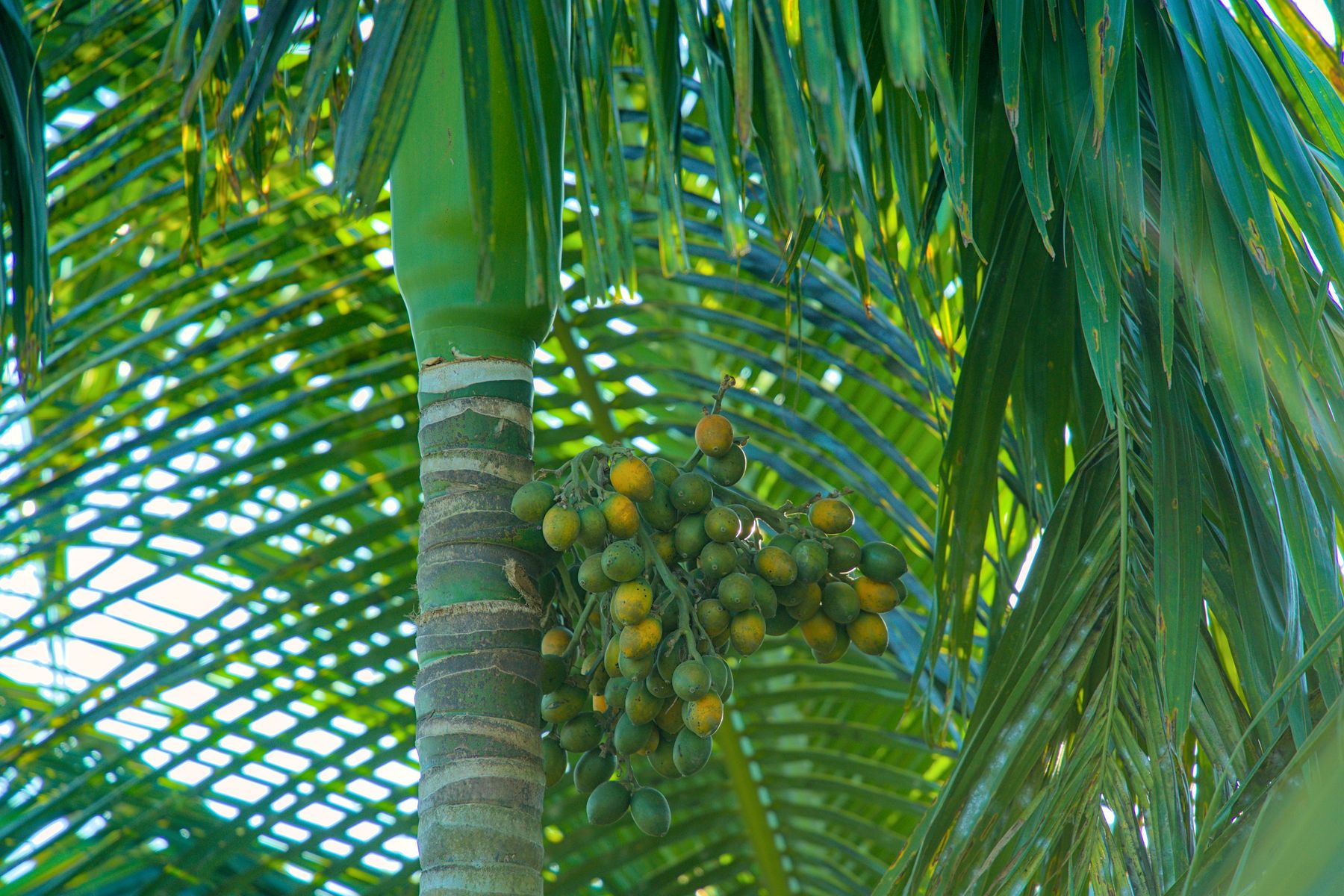
The researchers considered whole, dehusked areca seeds the best fit. Wild Areca triandra is native to South Sulawesi and produces seeds within the inferred size range. Unlike the flatter wear caused by routine mastication or grooves sometimes attributed to using teeth as tools, the pattern wrapped around multiple tooth surfaces.
Neither set had the red-brown stain associated with chewing betel quid. The team instead proposes prolonged sucking of whole seeds.
The wear supports repeated behavior by two people. It does not establish that every member of either community, or even many of them, shared the habit.
Chemistry strengthened the identification
Shape alone could not name the object. The team therefore soaked intact teeth and fragments in acetonitrile, methanol or both for at least a week, then analyzed the extracted residues with liquid chromatography and high-resolution mass spectrometry.
The procedure was deliberately minimal. No tooth was cut, ground, drilled or acid-etched. Solvent blanks accompanied the runs, and the authors report that modern areca seed and betel leaf had never previously been analyzed in that laboratory or on the newly purchased analytical column.
One intact molar sample from Maros-LBB-1a tested positive for arecoline. Three small fragments from the same person did not produce that diagnostic result, although they contained other plant-related compounds. In CPL-R2a, one intact worn tooth was positive for arecoline while another sample was not.
Those mixed detections are important to report. Residue does not distribute evenly through a mouth or survive uniformly for thousands of years. The positive results identify exposure in each person; they do not turn every compound found on the teeth into evidence of the same plant or meal.
Guvacine, guvacoline and arecaidine were not detected. The paper notes that slaked lime drives formation of some of these compounds in a prepared quid, so their absence, together with the lack of staining, is consistent with whole-seed sucking without lime. Consistent does not mean chemically unique, which is why the unusual wear pattern carries so much of the interpretation.
ScienceBlog previously covered arecoline and a possible arecaidine derivative in 4,000-year-old dental calculus from Thailand. At the time, that was described as the earliest direct biomolecular evidence for betel-nut use in Southeast Asia. The Sulawesi teeth move the securely evidenced history much further back and propose an earlier, simpler method of taking the plant.
The lab test asked whether sucking was enough
Modern betel quid usually combines processed areca seed, slaked lime and the leaf of a different plant, Piper betle. Some preparations also contain tobacco. Lime changes the alkaloids into forms that are more biologically available, raising a reasonable question: could an intact seed held in saliva release active material without that preparation?
The team incubated three kinds of intact and broken areca seeds in a physiological salt solution. These included dried and fresh Areca catechu and wild A. triandra. The liquid was kept overnight for 21.25 hours at 36 degrees Celsius, adjusted for acidity and then applied to frog egg cells engineered to express human M1 and M3 muscarinic acetylcholine receptors.
Liquid exposed to intact dried and fresh seeds produced transient electrical currents in those cells, a response consistent with arecoline activating the receptors. A. triandra produced smaller responses. The experiment supports the premise that prolonged contact with an intact seed can release a physiologically active compound even without grinding and lime.
It was a receptor assay, not a trial of betel-nut sucking in people. It did not recreate prehistoric saliva, measure a dose entering the bloodstream or establish intoxication. It also cannot reveal whether pain relief, alertness, flavor, social custom or another motive sustained either person’s behavior.
“Oldest” describes evidence, not the first use
Even the younger end of the older jaw’s date range predates the roughly 13,000-year-old evidence for brewing at Raqefet Cave in Israel. On the current archaeological record, that makes the Sulawesi teeth the oldest known evidence of habitual use of a neuroactive plant drug.
That superlative needs boundaries. Archaeological firsts mark the oldest material evidence found, dated and interpreted so far. They do not recover the first time a person experimented with a plant. Leaves, fruit and soft tissue decay, while many ways of consuming them leave no durable trace.
The two individuals are also separated by at least 8,000 years and lived at different sites. Their similar wear suggests the practice appeared more than once in preagricultural South Sulawesi, but it cannot demonstrate continuous transmission across all the intervening generations.
This is where earlier ScienceBlog reporting on dietary traces in ancient dental calculus offers useful context. Teeth can preserve molecular evidence long after artifacts and plant remains disappear, but a detected molecule still has to be interpreted alongside wear, burial context, contamination controls and plausible alternative routes of exposure.
Ancient use does not make areca nut safe
The result should not be read as advice to use areca nut. The International Agency for Research on Cancer classifies areca nut as carcinogenic to humans, while arecoline on its own is classified as possibly carcinogenic. Tobacco is not required for the areca-related hazard.
The ancient mouths already show a separate form of harm. In CPL-R2a, wear exposed roots and opened pulp cavities in several places, conditions likely to have caused chronic pain and infection. Both individuals had poor periodontal health.
The authors suggest that arecoline’s analgesic effects may have made sucking useful for tooth pain, even as the hard seeds worsened the damage. That possible cycle could help explain persistence, but it is an interpretation. The study did not diagnose addiction, observe pain relief or recover a person’s reason for using the seed.
Anyone concerned about present-day areca-nut use or changes in the mouth needs advice from a qualified clinician. An archaeological study cannot guide individual care.
The next evidential step is a larger set of securely dated remains. Repeated chemical detections, direct dates where preservation permits and the same distinctive grooves at more sites would show whether betel-nut sucking was a durable regional tradition rather than two rare personal histories.