

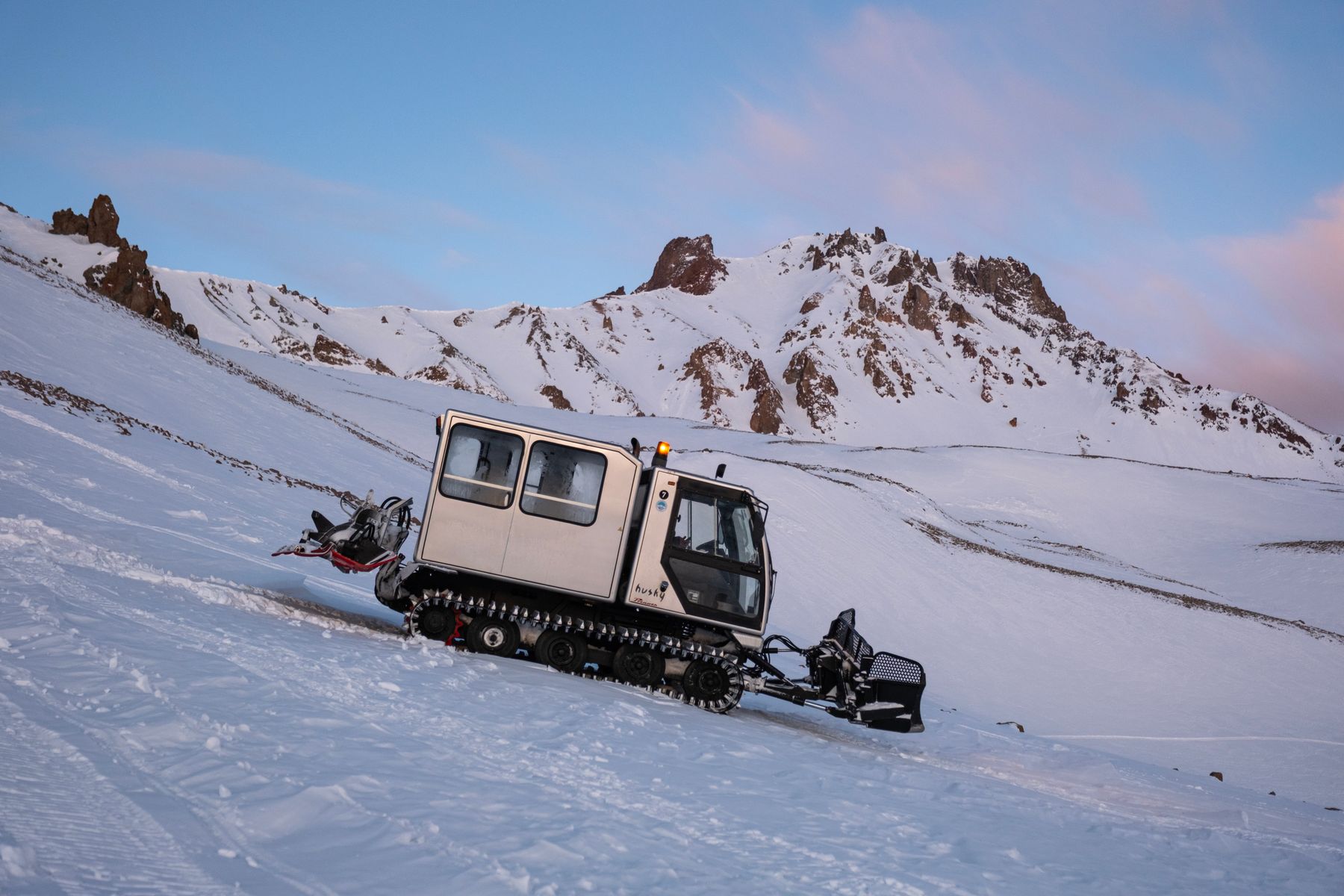
The quickest way from McMurdo Station to the South Pole is by air. The heavier way is a 1,030-mile road made almost entirely of compacted snow. Each Antarctic summer, the South Pole Traverse sends tracked tractors along it, towing fuel and cargo toward a station that must be supplied before winter closes in.
The figures are easy to mistake for a stunt. They are operating averages published by the United States Antarctic Program. A round trip takes about 52 days. The route climbs more than 9,300 feet, and each southbound fuel run offsets roughly 33 LC-130 Hercules flights. Across a typical season, the traverse delivers about 300,000 gallons of fuel.
Those figures describe an average system, not a promise for every journey. Weather, the condition of the route, the load and mechanical delays vary by season. But together they show why a deliberately slow supply chain became valuable in one of the least forgiving places on Earth.
The route is maintained, not paved
The South Pole Area Management Plan describes a route that took years to locate and make usable. Crevassed areas had to be surveyed and mitigated. The first vehicle on the first traverse of a season carries ground-penetrating radar so the crew can look for dangerous voids beneath the snow.
Leaving McMurdo near sea level, the train crosses the Ross Ice Shelf and climbs onto the polar plateau. By the time it reaches Amundsen-Scott South Pole Station, it has gained more than 9,300 feet in elevation. There are no fuel stations, repair shops or ordinary road shoulders along the way.
The trains do not simply drive 1,030 straight miles. Crews live with the machinery, inspect the route, stop for weather and mechanical work, and tow loads over a surface that changes. The published 52-day average covers the return journey as well as the climb south. A typical season involves three round trips and eight to 10 people per trip.
The fuel sled is mostly plastic
The cleverest part of the train is beneath the load. Two 3,000-gallon flexible bladders are strapped to a sheet of high-molecular-weight polyethylene measuring about eight feet wide, 68 feet long and half an inch thick. Four sheets can be linked behind a spreader bar, putting 24,000 gallons into one modular group.
That design avoids hauling a heavy steel tank and chassis across the continent. A US Army cold-regions engineering summary says the bladder sleds cost about one-sixth as much as comparable steel sleds, weigh one-tenth as much and allow a tractor to deliver roughly three times as much fuel.
The sheet is not just cheap packaging. Its large area spreads the load, reducing how deeply it sinks into snow. Frictional heating beneath the long runner can also lower towing resistance after the sled begins moving. Engineers tested towing forces, bladder materials and even bladder color because small reductions in drag become consequential across thousands of miles.
Each bladder holds 3,000 US gallons, about 11,350 liters. A train may tow many of them, along with accommodation modules, workshops and other cargo. The US program says the traverse can carry as much as 540,000 pounds of cargo in addition to fuel, although actual loads vary.
Thirty-three flights is a fuel comparison
The National Science Foundation’s Science on the Ice guide says each north-south traverse offsets approximately 33 LC-130 flights based on fuel delivery alone. That qualification matters. It is a comparison of bulk fuel moved, not a claim that tractors can replace everything aircraft do.
An LC-130 can make the McMurdo to Pole journey in hours. It can move people, urgent equipment and time-sensitive supplies, and it can support field camps away from the traverse route. The tractor train takes weeks and follows one prepared corridor. Its advantage is moving large, patient loads while reserving scarce aircraft time for jobs that need speed or flexibility.
The comparison also does not make the traverse emissions-free. Tractors burn fuel, crews must be supported and the route must be maintained. It means the overland system uses its energy more effectively for this particular freight. A 2012 engineering paper in the Journal of Terramechanics reported that a traverse could move large fuel loads while consuming about half the fuel and emitting less than one percent of the pollutants associated with equivalent aircraft resupply.
Walking pace depends on how it is counted
A 2,060-mile round trip spread across 52 days averages about 40 miles per day. Across every hour, including sleep and stops, that is roughly 1.65 miles an hour, slower than an ordinary walking pace. The tractors travel faster while actually driving, but maintenance, route work, rest and weather pull down the elapsed average.
The slow pace is therefore part of the system, not evidence that it has failed. Fuel is selected for overland transport precisely because it can leave early and arrive gradually. A delayed scientific instrument can interrupt a project; a bladder of fuel can be scheduled months in advance and moved as part of a large train.
The return journey is not identical to the outbound climb. The vehicles have delivered most of their payload, but they still bring equipment and waste north, and the same distance remains. Average round-trip figures smooth over those operational differences. They should not be read as a constant vehicle speed.
Why so much fuel must reach the Pole
Amundsen-Scott is isolated for the Antarctic winter, when darkness, cold and weather close the normal summer supply season. Fuel supports electrical generation, heating, snow melting for water, vehicles and the infrastructure around scientific instruments. The station’s year-round existence depends on the summer logistics window.
The traverse delivers about 300,000 gallons in an average season, according to the NSF guide. That is not the station’s entire supply chain, and the exact mix changes. Aircraft remain essential. What the tractor trains do is remove a large block of heavy, predictable freight from the air schedule.
The system is also a reminder that efficiency is not always the same as speed. Aviation makes the continent traversable on human timescales, but using an aircraft for every gallon would consume aircraft capacity and additional fuel. The overland route trades time for payload.
A supply chain built around Antarctic time
I think that trade is the most useful way to read the 33-flight comparison. The dramatic number is the aircraft count. The more revealing fact is that the program can exchange a few hours in the air for weeks on the ice because bulk fuel does not care how quickly it travels.
From a distance, the South Pole Traverse looks almost archaic: tractors pulling flexible bags over snow. Up close, it is a carefully engineered answer to a modern logistics problem. The route, radar surveys, low-friction sheets and timing all serve the same purpose. They move the largest routine load by the method best suited to it.
At the South Pole, fast transport remains indispensable. So does the convoy that arrives at little more than walking pace.
