

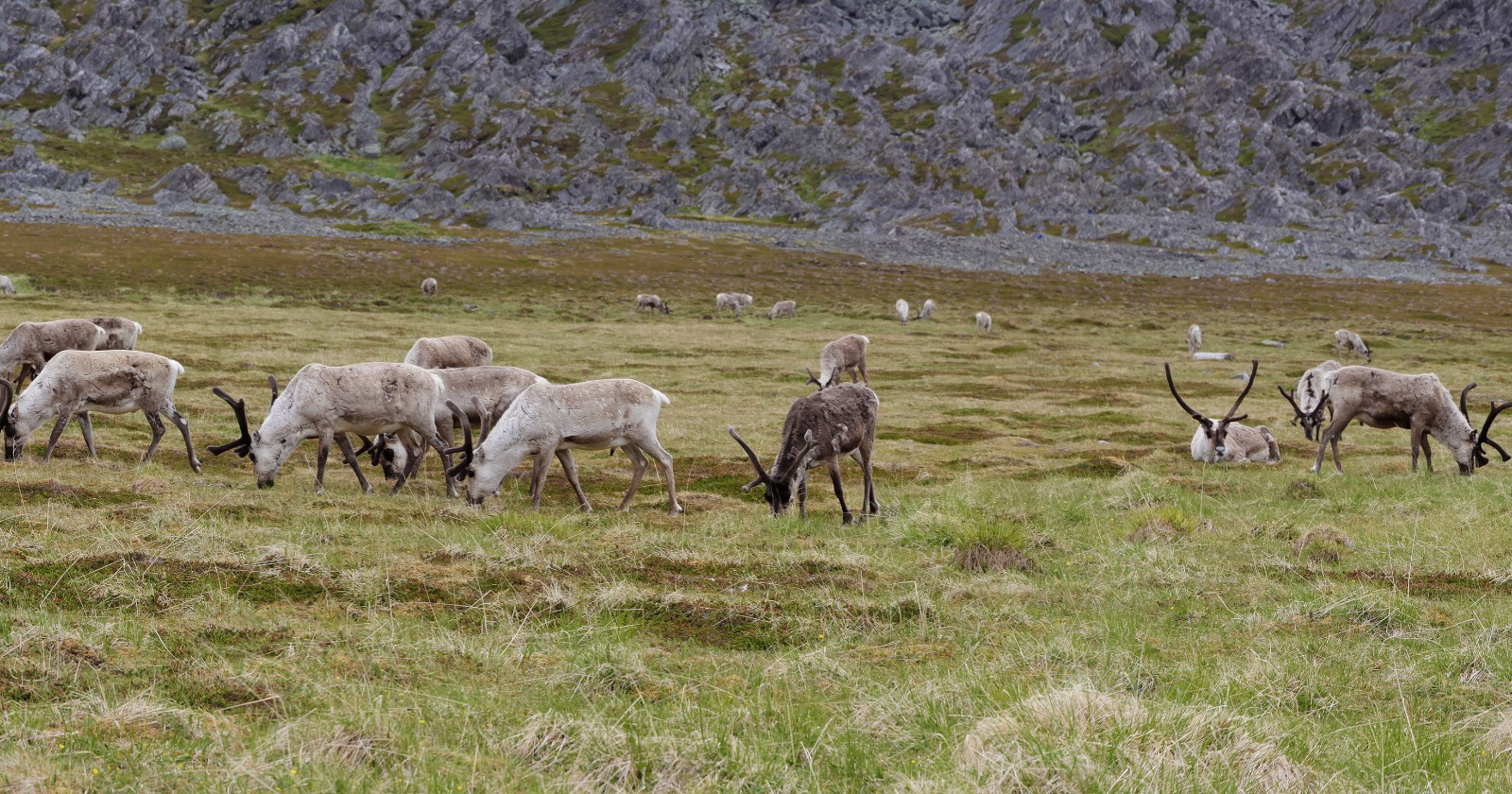
A herd of reindeer released from Sami reindeer husbandry in central Norway about fifty years ago has been taking up DNA from the wild herds around it, and the borrowed DNA sits most heavily in the parts of the genome that carry signs of recent selection. That is the finding of a whole-genome study of fifty animals from six Norwegian populations, published in Proceedings of the Royal Society B in July 2026.
The test behind it is a standard one in population genetics. Take four populations whose family tree you already know, and count the sites where the pattern of shared mutations disagrees with that tree. If no genes have moved between populations, the two kinds of disagreement should turn up about equally often, because both are just the noise of shared ancestry. A lopsided count points to gene flow.
The count came out lopsided, and the authors read the lopsidedness as hybridization that likely helped domestication run partly backwards. Their own wording is careful throughout: gene flow between wild and feral reindeer is what the data suggest, and the direction of that flow is, in their phrase, probably complex.
Where the Forollhogna herd came from
Forollhogna covers 1,843 square kilometres and holds roughly 1,800 reindeer. The original wild animals there had been wiped out by 1920. What replaced them arrived from reindeer herding: in 1951 there were 23 semi-domestic animals apparently resident in the area, alongside a visiting herd of about 300 marked reindeer. The first hunt for wild reindeer took place in 1956, and the area became a regulated management zone in 1965.
The founding stock came from Riast-Hylling, a southern Sami reindeer herding district known as Gåbrien sijte, about ten reindeer generations ago. Riast-Hylling runs roughly 4,500 animals under a selection regime that slaughters every calf below average body mass and typically most yearling males, which is about as direct a form of artificial selection on body size as herding gets.
Herding in the region is old and was not imported. Genetic work published in 2008 concluded that the Sami of Fennoscandia domesticated their own reindeer independently of the indigenous cultures of western Russia, so the animals at Riast-Hylling descend from a separate domestication event rather than a single Eurasian one.
Norway holds about 250,000 semi-domestic reindeer against 25,000 to 30,000 feral and wild ones. The study sampled twelve animals from Forollhogna, twelve from Riast-Hylling, and seven each from three wild herds at Rondane, Snøhetta and Knutshø, with a further five from Hardangervidda used in the population tree.
How big the excess actually is
The four-population test returned 1.2 million sites that agreed with the accepted family tree. Of the sites that disagreed, 850,715 carried the pattern consistent with gene flow between the feral and wild populations, against 842,063 carrying the pattern consistent with gene flow between the semi-domestic and wild ones. That works out to a difference of 8,652 sites, or about half of one percent of the disagreeing sites, a figure derived here rather than stated in the paper.
The resulting statistic is 0.005, with a Z score of 4.73. That clears the conventional bar for statistical significance comfortably, and the authors describe the underlying quantity in their own figure caption as a small excess yielding a slight excess of shared derived alleles, consistent with potential gene flow. Both things are true at once: the signal is unlikely to be an accident, and it is a thin one.
What the test measures is how often particular DNA variants are shared. It does not measure survival, fertility, body condition or behaviour in any animal, and no reindeer in this study was assessed for fitness of any kind. The authors say plainly that the fitness consequences and functional roles of the loci they flag require further investigation. A reader who takes the paper as evidence that hybrid reindeer do better in the wild is reading something the data cannot supply.
Two searches for selection that found no genes in common
The team looked for selection twice, by different routes. The first scanned the genome in 100 kilobase windows for high differentiation between groups and kept the top five percent, a cutoff the authors themselves call arbitrary. That produced 1,197 windows, of which 15 also showed the long uninterrupted haplotypes that recent selection tends to leave. Those 15 windows contained 41 genes.
The second route started from the literature, assembling 2,055 candidate genes from published work on domestication in rabbits, camels, pigs, rats, reindeer and neural crest development. Fifteen of those showed the same haplotype signature.
The two sets do not overlap at all. Not one gene appears on both lists, which the authors attribute to how conservatively they drew their outliers. The gap is worth holding on to, because it means the paper’s evidence for selection is two independent pictures that do not corroborate each other gene for gene.
What ties the two halves of the paper together is a second measurement. Running the introgression estimate window by window, rather than across the whole genome at once, the team found consistently higher values inside the selected regions than across the genomic background, for both routes. That is the result the headline claim rests on: not that hybridization happened, but that where it shows up is not random with respect to where selection shows up.
The visual check narrows things further. Of the 41 genes from the first route, 13 carried enough variants to plot usefully, and 6 of those showed clear shared haplotypes between wild and feral animals. The 15 genes from the literature route showed no clear overlap between selection and hybridization when plotted the same way. The number of genes where the two signals are visible together is therefore six, not 41 and not 56.
Which direction the genes were travelling
A second set of statistics, designed to separate direction from mere presence of gene flow, came back negative across all four comparisons. Read out, those results put Knutshø, a wild herd, on the receiving end: taking genes from the semi-domestic herd at Riast-Hylling and from the feral herd at Forollhogna, measured against Rondane. There is also a signal of exchange between Rondane and Forollhogna.
The authors’ conclusion is that gene flow likely runs in several directions at once, with Knutshø acting as a hotspot, which fits its position in the middle of the other populations. The headline reading, wild genes moving into the feral herd, is the direction they judge most likely for the selection result. It sits inside a picture that also shows herding genes and feral genes moving into wild animals.
Gene functions offered as possibilities
Among the genes flagged are an olfactory receptor, from a family that earlier sequencing found unusually expanded in the reindeer genome, two free fatty acid receptors involved in digestion, an immune gene, and several tied to neuronal function.
Every functional reading attached to these is hedged in the paper. Selection on smell genes may reflect a renewed reliance on olfaction for foraging and avoiding predators. The digestive receptors may indicate shifts in gut physiology. The immune gene is consistent with a changed pathogen environment. These are annotations transferred from cattle and sheep and matched against what such genes do elsewhere, not measurements made on reindeer, and the authors flag that most of them need further work before anyone can say what they do in this species.
What feralization has looked like in other animals
Feralization has been studied in enough species to give the reindeer result a frame, and one general finding sets the ceiling on what it can do: animals going back to the wild do not simply undo domestication, because the genetic diversity lost on the way in is not automatically recovered on the way out. That is the gap hybridization with wild animals could in principle fill. Feral chickens show selective sweeps landing in the same regions of the genome across separate populations. Feral rabbits show selection working against the alleles domestication favoured. In chum and masu salmon bred in captivity and released, researchers reported that wild-derived variants improved survival, which is the closest published parallel to what the reindeer paper proposes.
The traffic has run the other way too, and not always benignly. Domesticated mallards released into wild populations carried novel foraging and migratory behaviour into them through hybridization. In alpine ibex, a locus tied to immunity and associated with domestication turned up in wild animals.
Against that background the reindeer authors make a specific claim of novelty: that finding genomic regions under selection overlapping with signatures of hybridization is, to the best of their knowledge, the first such demonstration in mammals. The hedge is theirs and worth keeping, because it is a claim about the published record rather than about reindeer.
The reintroduction argument this lands in
Wild reindeer are Red-Listed globally, and in Norway feral animals do not count as wild for that purpose, which makes the genetic line between the categories a matter of official consequence rather than taxonomy. Gene flow from semi-domestic herds is already treated as a threat to the genetic integrity of Norway’s wild reindeer, and the country has built an environmental quality standard around protecting them.
The argument is live because of disease. Chronic wasting disease turned up in a wild Norwegian reindeer population in 2016 and the population was destroyed entirely. After a fallow period the plan is to put reindeer back, and a number of veterinarians have argued for using semi-domestic animals carrying genetics more robust against the disease. The same problem is visible at Hardangervidda, the largest wild area at 8,000 square kilometres, where numbers are down to around 5,000 after heavy culling to contain the disease.
Against that, the Forollhogna result cuts the other way. If wild alleles have been flowing into a feral herd and landing in regions under selection, then the traffic between these categories is not only a threat to be managed but also, in at least one direction, a source of variation that a formerly herded population appears to be drawing on. The paper stops short of saying which of those readings should govern policy. Its authors conclude only that wild and semi-domesticated reindeer have been shaped by different selection pressures, and that anyone making management decisions about them should take that difference into account.