

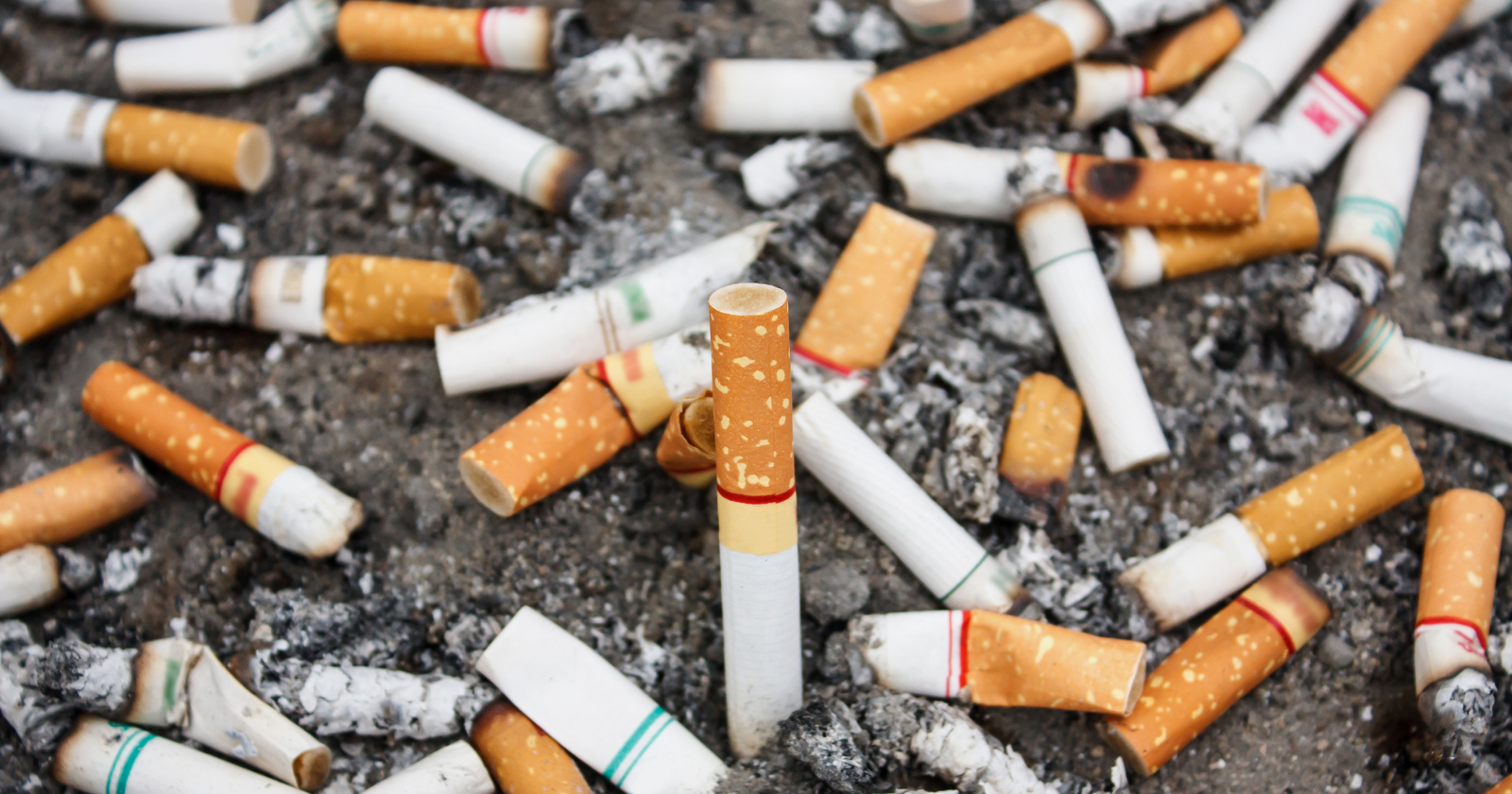
One day the wall behind you may be made partly of other people’s smoke breaks.
Cigarette filters are the most littered object on the planet. The Secretariat of the WHO Framework Convention on Tobacco Control estimates that 4.5 trillion butts are improperly discarded every year. Cellulose acetate, the material they are made from, is a plastic, and it carries whatever the smoker pulled through it into the nearest gutter or stormwater drain.
So a group of civil engineers in Melbourne asked a strange question. What if the fastest way to get rid of them was to bake them into buildings?
What the laboratory actually did
Halenur Kurmus and Abbas Mohajerani, working at RMIT University, blended collected filters into brick clay at 0.5, 1, 1.5 and 2 percent by mass, then tested them against control bricks containing none. The mixer shredded the waste as it went. Each batch was compacted, oven dried and fired at 1,050 degrees Celsius for three hours. Every number reported is an average of three samples.
Their results, published in the journal Materials in 2020, are the source of the 1 percent figure now in circulation.
The strength trade-off
How much strength does a brick actually need?
Control samples reached 48.6 megapascals of compressive strength, which is the load it takes before it crushes. The 1 percent mix came in at 30.8, a drop of roughly 37 percent. That sounds like a disaster until you check the standards. Kurmus and Mohajerani note the minimum recommendation is 3 to 5 MPa for non-load-bearing units and 5 to 10 MPa for load-bearing ones.
So the 1 percent brick comfortably cleared the cited minimum for load-bearing use. It was still well short of an ordinary brick.
Other properties moved as well. Water absorption climbed from 9 to 12.1 percent. Efflorescence, the chalky white bloom that surfaces on masonry as salts migrate out, was rated slight at 1 percent and moderate at 2.
Why the kiln burns less
The energy saving works because the filter does part of the furnace’s job. Cellulose acetate has a high calorific value, meaning it gives off a lot of heat as it burns, and the researchers measured it at 16.53 megajoules per kilogram. As the clay fires, that organic material combusts inside the mixture and supplies heat the kiln would otherwise have to generate. For the 1 percent mix, the calculated saving came to 10.2 percent.
The bricks also came out lighter, dropping from 2,114 kilograms per cubic metre to 1,983. All those tiny voids left behind by the burnt filters cut estimated thermal conductivity by 17 percent, which means a finished wall leaks less warmth in winter and less cool air in summer.
The saving is a calculation rather than a meter reading from a working production line. It assumes 2 megajoules of firing energy per kilogram, a value taken from a survey of Southeast Asian brickworks conducted in the mid-1990s.
The metals that come along for the ride
Used filters hold on to arsenic, chromium, nickel and cadmium. Dropped on a footpath, they release that cargo slowly into soil and water.
In a companion paper on heavy metal leaching, the same pair ran fired and unfired brick samples through the Australian Bottle Leaching Procedure at pH 2.9, 5.0 and 9.2, spanning acid rain through to alkaline conditions. Firing at high temperature altered the ceramic structure enough to lock most of the tested metals in place. The lock is partial, though, and it was measured in a laboratory rather than across decades of weather.
Where the 2.5 percent figure comes from
The eye-catching claim that a fraction of global brick output could swallow the world’s cigarette waste predates that laboratory work. Mohajerani, Aeslina Abdul Kadir and Luke Larobina set it out in 2016 in Waste Management, proposing that 1 percent filters in 2.5 percent of world brick production would absorb the lot.
That figure came off a spreadsheet. It multiplies a bench-scale mix ratio by global manufacturing volume and reports what falls out. That is a legitimate way to size a problem and a poor substitute for a factory trial.
The part that still does not scale
Brickworks are not the obstacle. Collection is.
Turning 4.5 trillion scattered objects into a usable feedstock requires bins, routes, contracts and someone willing to pay for the sorting. The RMIT team later published an implementation plan aimed squarely at that gap, covering whole butts, pre-shredded material and premixed options, with handling protocols for the workers involved. Mohajerani has argued the technical fix needs tougher littering penalties and dedicated receptacles behind it, because a recycling stream with nothing flowing into it is just a diagram.
More than fifteen years of testing has produced a brick that works. What it has not produced is a collection system able to feed that waste into the kilns at the volume the idea requires.