

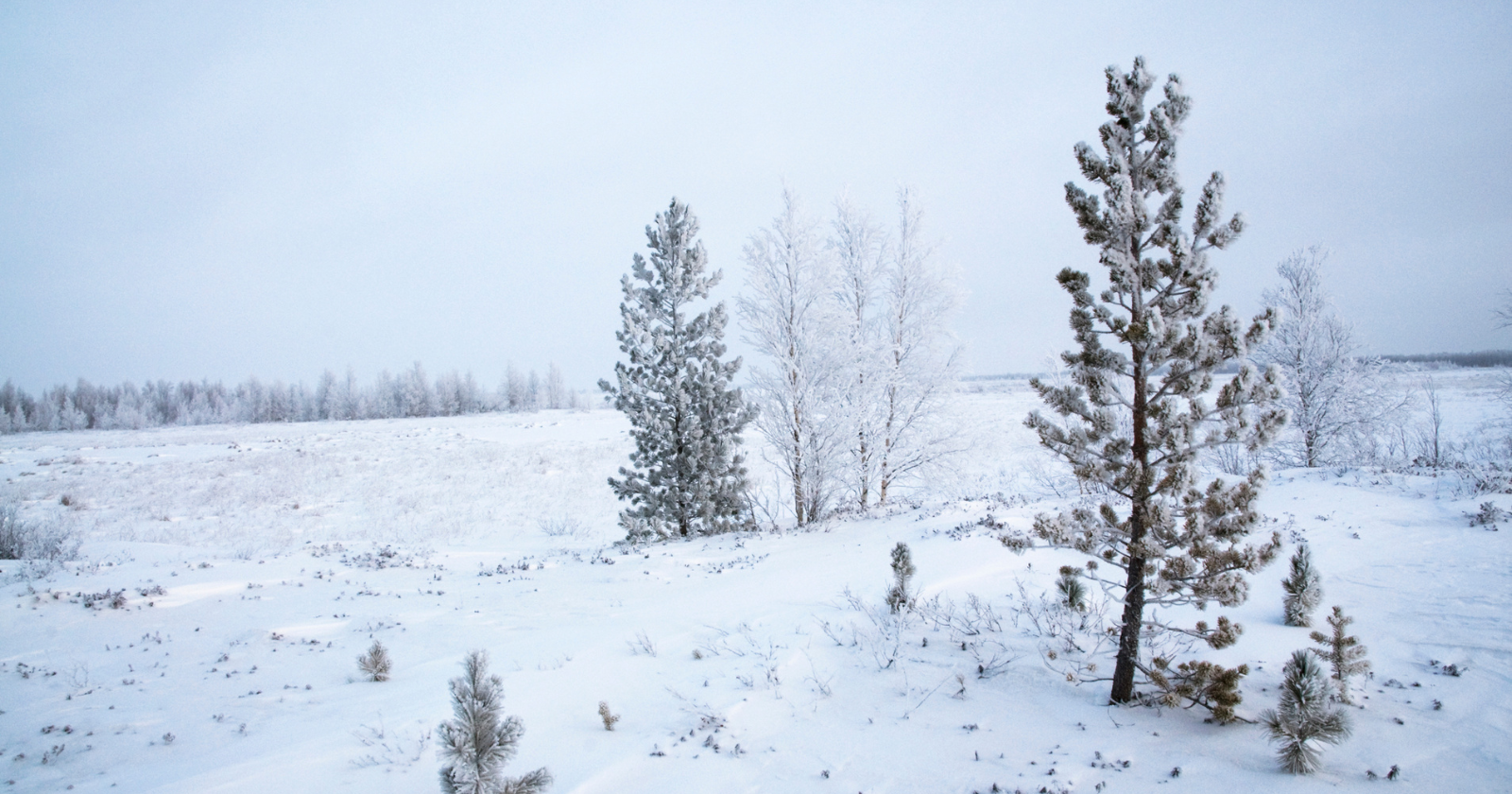
Sometime in the last ice age, an Arctic ground squirrel dug a burrow beside what is now the lower Kolyma River in northeastern Siberia and stashed away a hoard of fruit. Some remained uneaten. Silt and ice sealed the chamber, and the cache stayed frozen while the whole of recorded human history came and went.
When a Russian team recovered the fruits and grew living plants from their tissue, they reported the oldest plant material successfully regenerated into flowering plants.
The age is not the whole story. The striking part is that plants regenerated from ancient tissue and modern plants of the same species could grow side by side, their source material separated by roughly 32,000 years. Small differences in their flowers helped distinguish them.
The burrow that stayed frozen for 32,000 years
The site is called Duvanny Yar, on the lower Kolyma. Researchers including David Gilichinsky and Svetlana Yashina investigated fossil squirrel burrows in permafrost. As Sci.News reported, roughly 70 storage chambers were found along the lower river, between 20 and 40 metres below the present surface.
One burrow held the fruits that mattered. According to the team’s 2012 study in Proceedings of the National Academy of Sciences (PNAS), it lay 38 metres, about 125 feet, down in sediment that had remained frozen since burial. The present-day mean annual ground temperature was −7°C. Radiocarbon dating of seeds inside the fruits put their age at 31,800 ± 300 years.
The cold and stability are the whole point. Yashina told Radio Free Europe/Radio Liberty (RFE/RL): “It shows that permafrost acts as a natural cryochamber.”
Over the millennia, the fruits also accumulated natural radiation. The researchers calculated a total dose of about 70 grays, which they described as the highest reported accumulated dose associated with such survival. That was a reported observation, not proof of a universal limit beyond which ancient tissue cannot survive.
Growing a whole plant from cells, not seeds
The obvious approach, growing plants from the ancient seeds, did not produce mature plants. So the team went a different route. They took placental tissue, the structure to which seeds attach, from three undamaged, immature fruits and grew whole plants from the surviving cells. The method was tissue culture and clonal micropropagation, rather than straightforward seed germination. They raised 36 ancient plants, twelve from each fruit.
The species is Silene stenophylla, the narrow-leafed campion, a tundra wildflower that still grows in the region. That matters because there is a living modern population to compare the ancient plants against.
The revived plants grew, flowered and made seed. In an AFP report published by ABC Science, Yashina said: “For the first time, we managed to recreate a plant with the help of fruits that are 32,000 years old.”
For scale, the previous benchmark was a date palm grown from a roughly 2,000-year-old seed found at Masada. The Siberian material was more than fifteen times older, although the two experiments used different routes to regeneration.
The modern plant beside it, and the flowers that gave the gap away
The researchers compared 36 regenerated ancient plants with 29 modern plants grown from seeds collected in the same region. Both groups underwent laboratory culture.
Then they flowered. The ancient plants opened petals that were narrower and less divided, while the modern plants had wider, more deeply divided petals. This was a difference between the plants tested, not a comparison with every campion alive today.
Petal shape was not the only distinction. The ancient plants initially produced two or three strictly female flowers before producing flowers with both male and female reproductive structures. All flowers on the modern comparison plants had both.
After artificial cross-pollination, seeds from the revived plants sprouted at 100 percent in the laboratory. Their seed-grown offspring also developed through the full life cycle and retained their parents’ morphological features.
What the differences do and don’t tell us
It is tempting to read those flowers as a snapshot of what the species looked like 32,000 years ago. But the study did not establish exactly why the ancient and modern plants differed.
The researchers discussed possible genetic differences and the influence of environmental conditions on plant development. Their discussion in PNAS did not present tissue culture as a demonstrated explanation for the narrower petals. Nor was this simply one trait measured once: the next generation retained the observed features.