

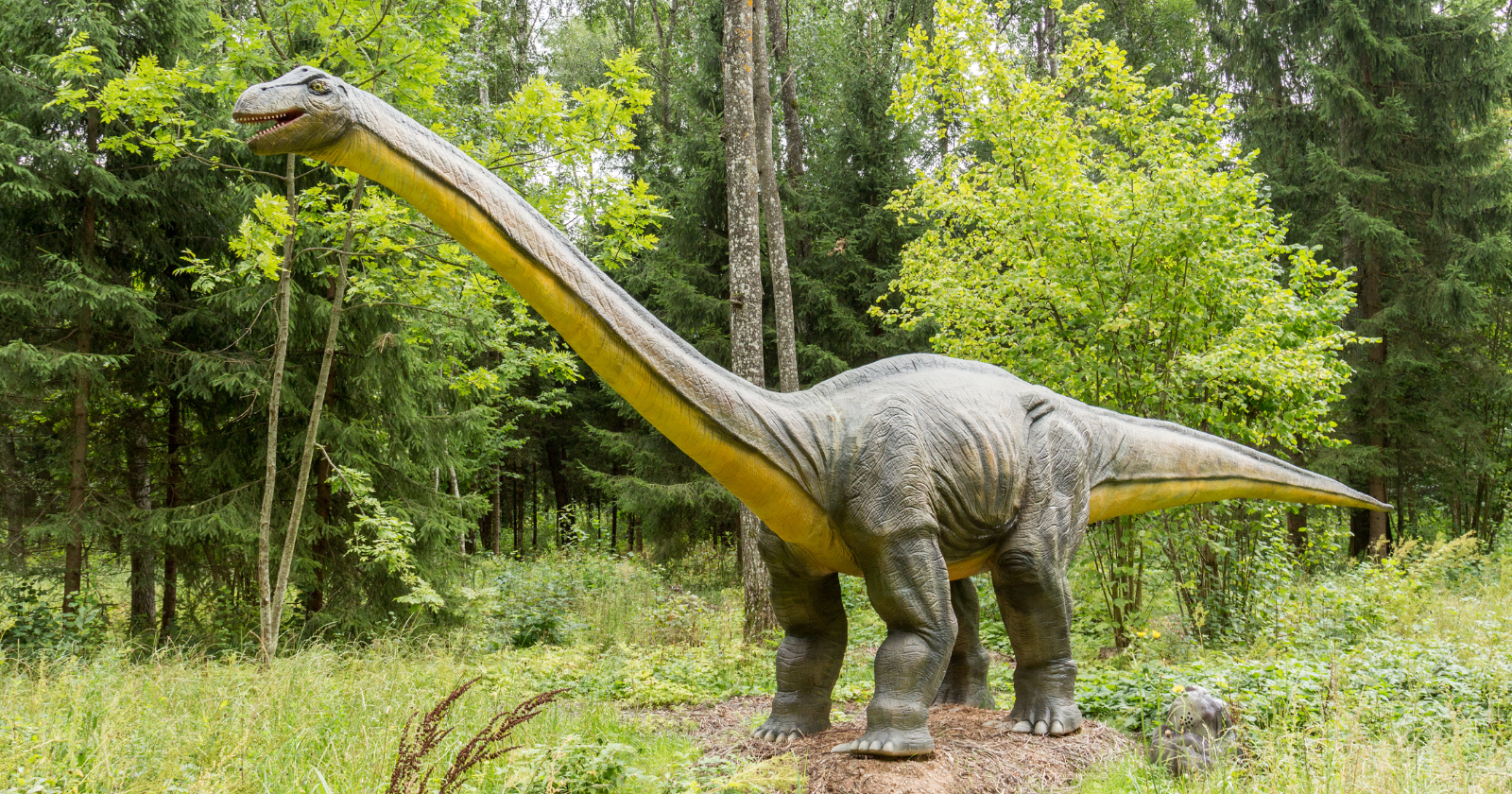
On their own, a set of tail bones is not the kind of find that makes headlines. What made these ones unusual was their identification. The bones pointed to a dinosaur genus that, for nearly a century and a half, had never been confirmed outside the western United States.
The puzzle is simple to state and harder to solve. Why does a dinosaur famous for its American fossils appear to be buried in Spain?
What Diplodocus is, and why the location matters
Diplodocus is one of the most recognizable long-necked dinosaurs: a whip-tailed giant from the Late Jurassic, the sort of skeleton that anchors a museum hall. It was named in 1878 from bones in the American West. Until this discovery, all confirmed specimens came from the Morrison Formation of the western United States, according to the journal publisher’s Taylor & Francis announcement.
That is what made the Spanish bones significant. Europe already had its own known diplodocids, the broader family that includes Diplodocus. The new finding identifies the genus itself on the far side of what is now the Atlantic.
How the team pinned the identification down
The specimen has a label, CT-30, and a home: the La Tejería site at El Castellar, in Teruel. As Everything Dinosaur reports, the animal lived roughly 150 million years ago.
The bones came out over several seasons rather than in one lucky afternoon. As noted by The Brighter Side of News, five tail vertebrae were recovered in 2008, and digs in 2014 and 2015 added nine more. The recovered vertebrae are thought to represent positions 22 through 35 in the tail.
The animal’s total length was estimated at about 25 meters, or 82 feet, as Sci.News reported, comparable with its North American relatives.
Identifying a dinosaur from part of its tail requires close anatomical comparison. The team, led by Sergio Sánchez Fenollosa of Fundación Dinópolis, identified a combination of features characteristic of Diplodocus. These included elongated vertebral bodies without lateral ridges, deep grooves underneath the vertebrae, and distinctive forked chevron bones.
Alongside the bone-by-bone comparison, the researchers used evolutionary family-tree analyses, including maximum parsimony and Bayesian methods. These placed CT-30 within Diplodocus, close to the North American species Diplodocus hallorum.
“With each new result, the picture became clearer: we were looking at a Diplodocus,” Sánchez Fenollosa said in comments reproduced by Ancient Pages. The team’s study appeared in the peer-reviewed Journal of Vertebrate Paleontology in September 2026.
The land-bridge question it reopens
The identification speaks to something larger than one tail. It bears on how animals moved between landmasses while the North Atlantic was developing.
As the Taylor & Francis announcement explains, falling sea levels could have exposed temporary land bridges across parts of the developing ocean. The proposed connections would not have needed to remain permanently open. They could have provided occasional opportunities for animals to spread before rising seas separated the land again.
This find does not arrive into an empty debate. Earlier research by Philip Mannion, Octávio Mateus and colleagues, described a Portuguese specimen with strong similarities to Apatosaurus from the Morrison Formation. The Spanish specimen adds evidence to an existing picture of related dinosaur communities on both continents.
What one specimen can and can’t settle
The distinction matters: the researchers identified a dinosaur from its anatomy, then interpreted what its location means for ancient geography. The fossil supports a wider distribution for Diplodocus, but it does not preserve a migration route.
Nor does finding the genus on two continents, by itself, establish the direction or precise timing of dispersal. Did its ancestors spread from North America toward Europe, or the reverse? Were there several opportunities for exchange? Those questions require the fossil evidence to be considered alongside evolutionary relationships and reconstructions of the land and sea.
A map with one new pin on it is not the same as a route. What the Spanish Diplodocus does is add a specific, anatomically supported identification to the evidence for Late Jurassic connections. Fourteen tail bones extend the known range of a familiar dinosaur and sharpen the question of how it got there.