

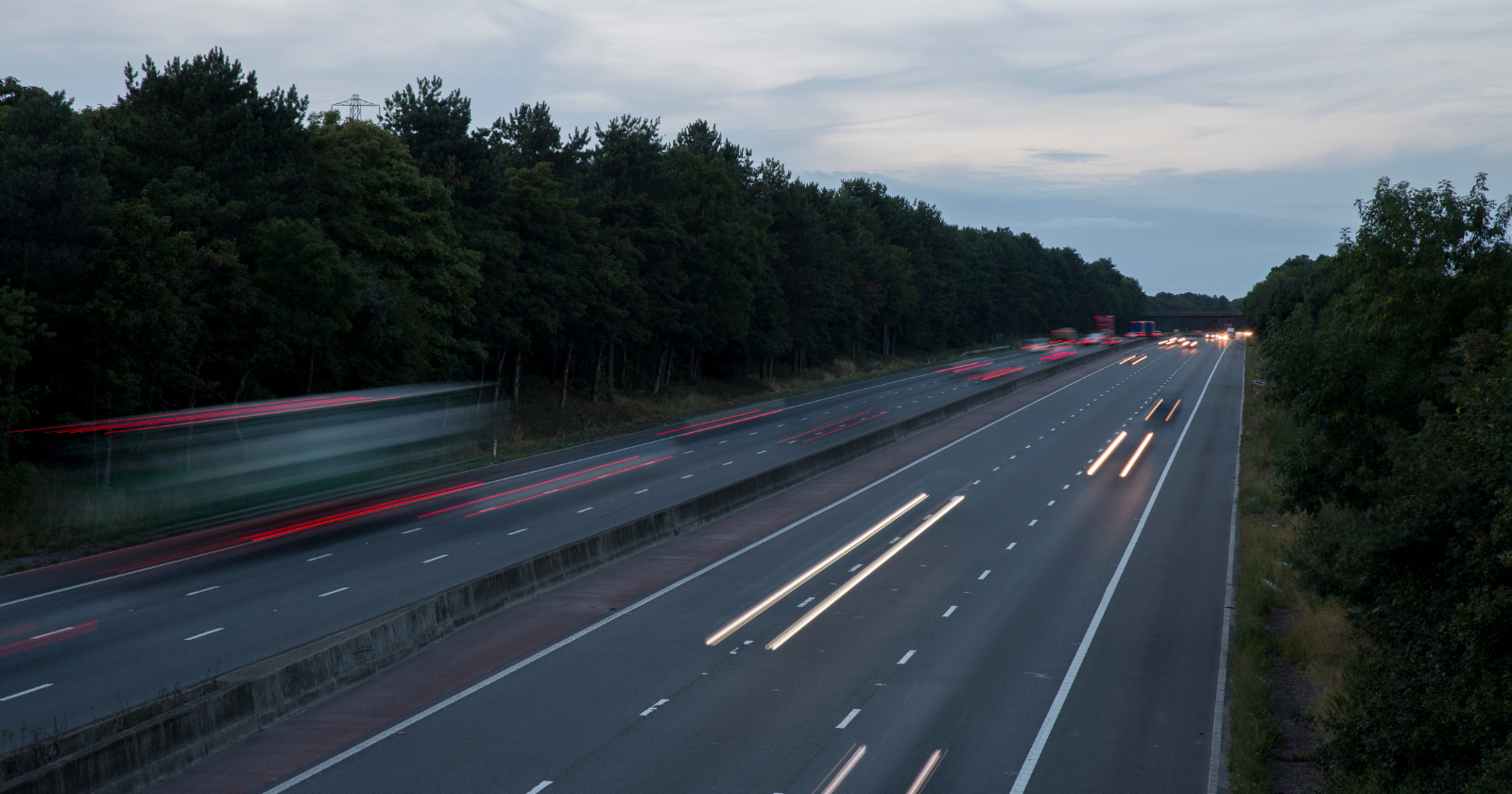
Here is the short story. Britain took discarded tyres, ground their rubber into crumb, mixed it into road surfacing, and resurfaced part of a motorway with the result. Every kilometre could use rubber from up to 750 waste tyres. A waste problem and a road-building problem helping to address each other.
It is a satisfying story, and its central claim is true. The trouble starts with how neatly it gets retold.
The tyre-road idea is real. What needs care is how a conditional estimate becomes a fixed number, and how an early trial gets confused with everything that happened afterwards.
Where the 750 figure comes from
When the trial was announced in August 2019, a Highways England press release on GOV.UK stated: “It is estimated by Tarmac that up to 750 waste tyres could be used in every kilometre of road surfaced with the new material, depending on the thickness of the road.”
That sentence carries conditions the headline version can drop. It is an estimate, not a reported count of tyres used on the M1. It comes from Tarmac, the company developing and selling the material. And it depends on surfacing thickness. “Up to 750” does not mean every kilometre contains rubber from precisely 750 tyres.
Tarmac has also published a lower figure. Its 2021 sustainability report says up to 500 waste tyres could supply rubber for each kilometre surfaced, again depending on thickness. But that does not establish that the company corrected or withdrew the original estimate. Its ULTIPAVE R product page still cites up to 750.
The figures therefore need their product and construction context. They should not be presented as a documented downward revision without an explanation from the company establishing that connection.
What was really laid on the M1
The physical thing is less dramatic than “a road made of tyres” suggests. In 2019, Highways England funded a trial of Tarmac’s rubber-modified asphalt on the southbound M1 between junctions 23 and 22 near Leicester. It was a section of motorway surfacing, not an entire motorway built from waste tyres.
The material incorporates granulated tyre rubber into asphalt. Tarmac’s Rubber Modified Asphalt product information describes using roughly one tyre’s rubber per tonne of asphalt. Rubber is an ingredient in the mixture, not a replacement for the whole road surface.
The framing that matters is that this was a durability trial. The stated purpose was to test the surface on a heavily trafficked network. Martin Bolt, who oversaw innovation projects for Highways England in the Midlands, described the trial as a possible first step towards reducing accumulated waste tyres. His statement was about potential, rather than a declaration that the problem had been solved.
Why the idea still matters after the caveats
Keeping the number in proportion is not the same as dismissing the material. The 2019 Highways England release put UK waste-tyre generation at around 40 million tyres annually. That is the historical figure quoted when the trial began, not a current national total.
Against that backdrop, another domestic use for recovered rubber could be valuable. But counting tyres incorporated into asphalt answers only one question. Whether a particular road delivers an overall benefit also depends on its performance, maintenance needs and the impacts of producing and using the material.
The project did progress beyond its initial trial. In April 2021, the Institute of Materials, Minerals & Mining (IOM3) reported that Tarmac’s ULTIPAVE R had received British Board of Agrément HAPAS Clause 942 approval as a thin surfacing system. The report described testing over several years, including the M1 trial.
That is a more concrete milestone than an estimate of tyre consumption. It supports the material’s suitability for its assessed road-surfacing application; it does not, by itself, quantify every environmental benefit.
Where things stand in 2026
As of September 2026, Tarmac still lists ULTIPAVE R among its road-surfacing products. The idea has also moved beyond the original motorway trial, with documented applications on local roads.
In Bolton, Tarmac’s Seymour Road case study records a resurfacing project completed in October 2020. Crews laid 200 tonnes of rubber-modified asphalt across 2,484 square metres of residential road. The company says the material incorporated rubber from around 200 waste tyres.
In April 2022, Lancashire County Council reported using 160 tonnes of ULTIPAVE R on Abingdon Road in Padiham, recycling rubber from approximately 150 tyres. The council also recycled the underlying road layers. Its reported carbon-footprint reduction of more than 30 percent applied to that combined approach, rather than to the tyre rubber alone.
These are relatively small projects, but they nevertheless show that the material found practical uses beyond the M1.