

Here is a strange fact about the heaviest invertebrate we know of: for a hundred years after its scientific description, nobody had confirmed observing one alive at depth in its natural habitat.
The colossal squid had a name and a reputation as a giant of the deep, built largely from specimens and remains. We knew the animal mostly through what had eaten it, or what it had eaten. That gap closed on a single day in March 2025.
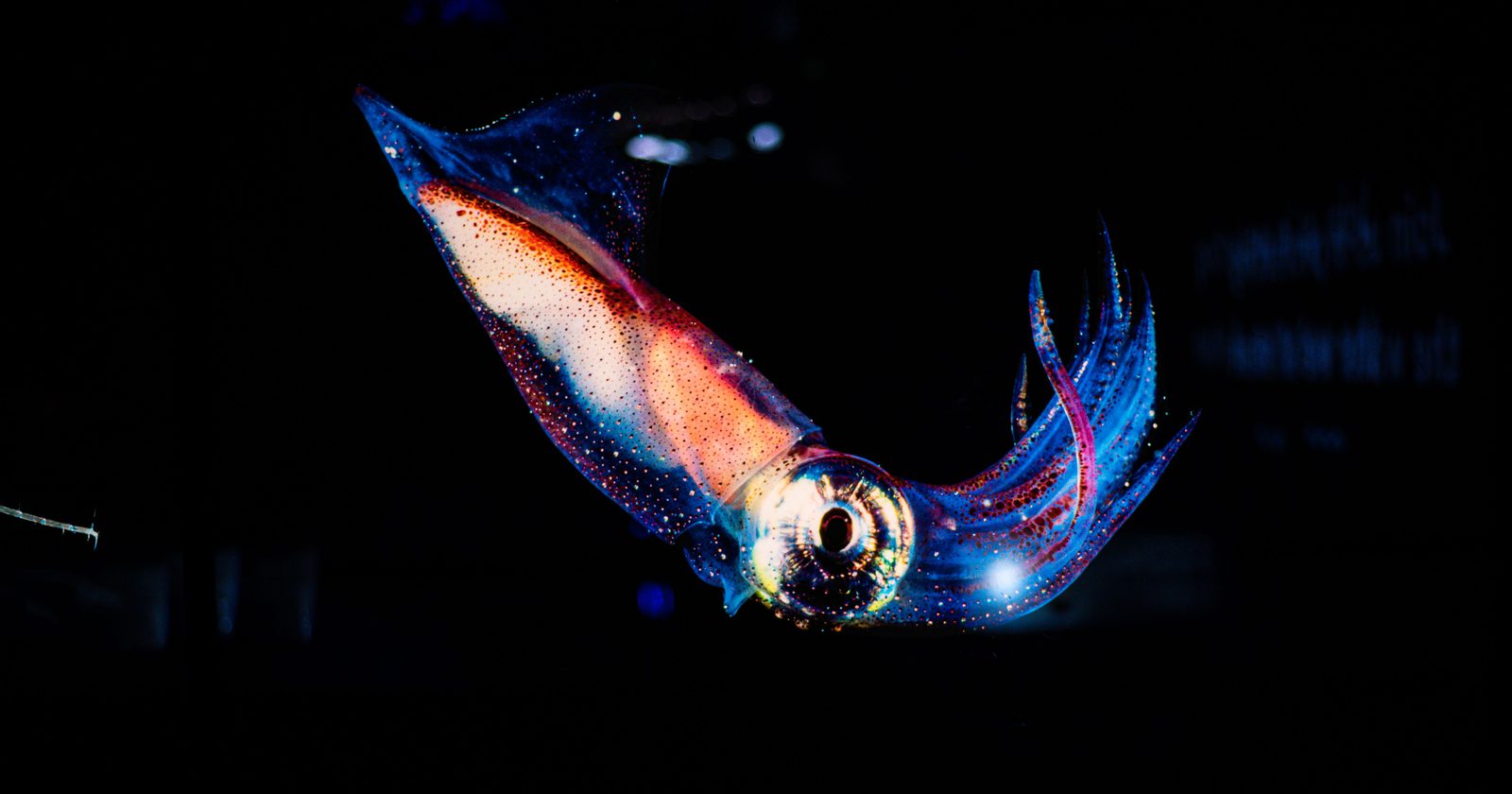
According to the Schmidt Ocean Institute, the footage came from 600 meters down, near the South Sandwich Islands in the South Atlantic. What the camera found was small and see-through, nothing like the monster the name promises. A juvenile, about 30 centimeters long, drifting.
A century of knowing it mostly through remains
The species got its name in 1925. As the Museum of New Zealand Te Papa Tongarewa explains, Guy Coburn Robson described Mesonychoteuthis hamiltoni from two arm crowns recovered from a sperm whale’s stomach. The founding record was not a complete body, but the leftovers of a whale’s meal.
The museum’s account lists only nine specimens above juvenile size reported since 1925. Complete specimens recovered by fishing vessels eventually allowed closer examination, but much of the record still came from beaks, hooks, and half-digested remains.
Kat Bolstad, a squid biologist at Auckland University of Technology and one of the experts brought in to confirm the footage, put the century plainly. As Sci.News reported, “For 100 years,” she said, “we have mainly encountered them as prey remains in whale and seabird stomachs and as predators of harvested toothfish.”
What SuBastian actually filmed
On March 9, 2025, an international team aboard the research vessel Falkor (too) recorded a juvenile colossal squid, using a remotely operated vehicle called SuBastian. The animal was nearly see-through and roughly a foot long, a far cry from the species’ estimated adult length of up to seven meters.
Confirming it was the real thing took some care. As Smithsonian Magazine reported, an online viewer flagged the animal during the livestream, prompting researchers to consult squid experts.
Aaron Evans, a glass-squid expert who helped verify the footage, pointed to its distinctive anatomy. “One of the most distinguishing characteristics of colossal squid,” he noted, “is the presence of hooks on the middle of their eight arms.” Those hooks helped turn a promising sighting into a confirmed one.
Bolstad’s own reaction caught the oddness of the moment. “It’s exciting to see the first in situ footage of a juvenile colossal,” she said, “and humbling to think that they have no idea that humans exist.”
Why the gap took a hundred years to close
The simplest reason no one had confirmed filming one alive at depth is that its home is hard to reach. Colossal squid inhabit deep, cold Southern Ocean waters. Adults are thought to live deeper than the 600 meters where this juvenile appeared, beyond the reach of sunlight.
There’s also the animal itself. Bolstad has explained that it can be difficult to film colossal squids because of their likely aversion to brightness and loud noises, both features of deep-sea research equipment.
Michelle Taylor, the expedition’s chief scientist and a professor at the University of Essex, framed the sighting as the rarity it is. In an ABC News report carried by ABC7, “This is a once-in-a-lifetime situation,” she said, “these types of discoveries don’t come along very often.”
From specimens to a living animal
It would be easy to overstate what one clip changes. The footage doesn’t suddenly explain how these animals hunt, mate, grow, or reach weights of around 500 kilograms. Evans was careful on this point. The sighting “gives us a starting place,” he said, “because the life history of the colossal squid itself is kind of poorly known.”
What strikes us is the shift in the kind of knowledge on offer. For a century, researchers studied this species largely through preserved specimens and remains. That was evidence, not guesswork. The 2025 footage adds something different: a living juvenile moving in its own habitat.
Taylor put the wider point in a way that sticks. “People want to go into space,” she said, “and we have all this beautiful, uncharted territory on our own planet.”