
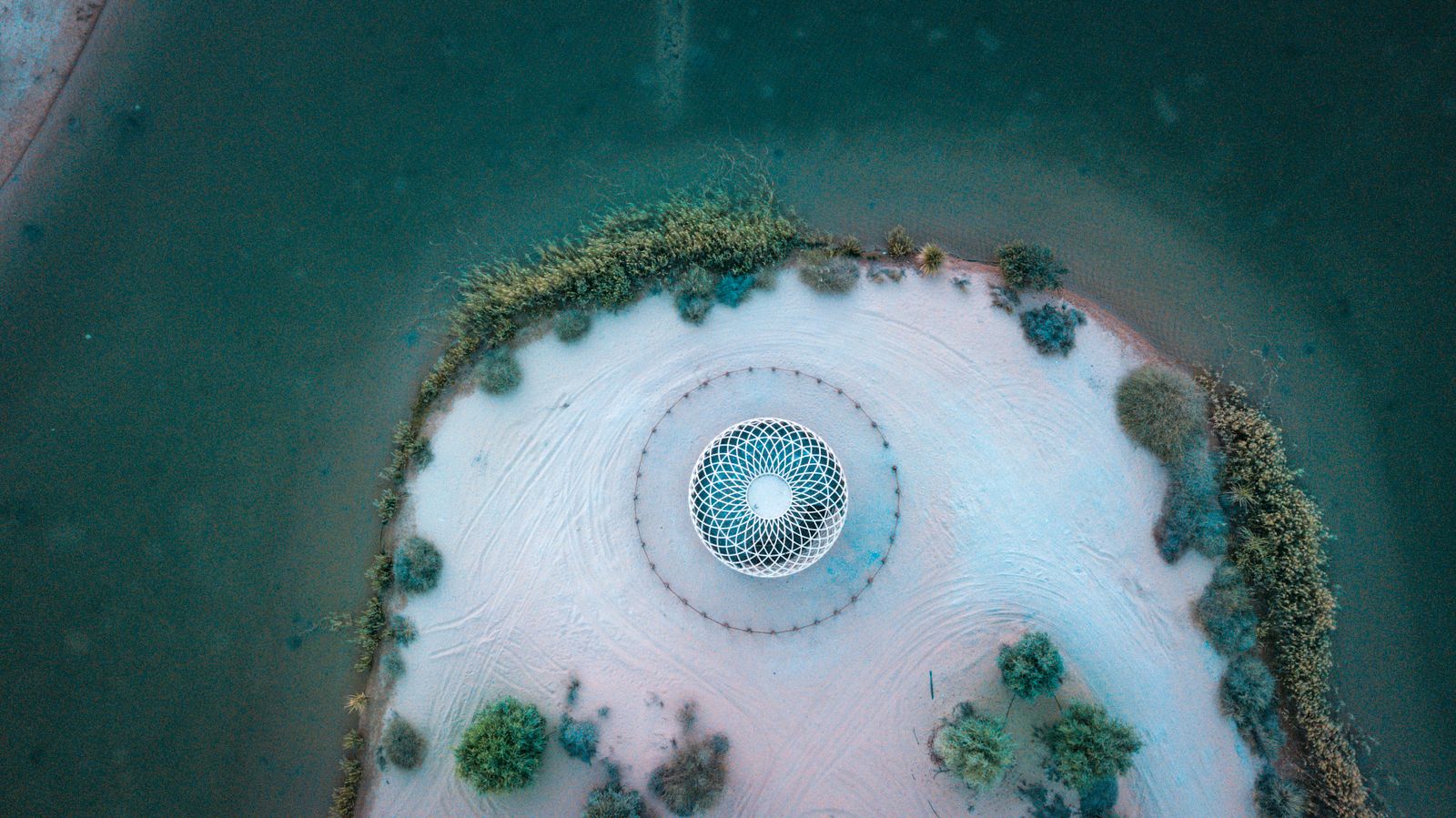
Marker Wadden is an artificial archipelago built to make an artificial freshwater lake more ecologically diverse. The first phase covers about 1,300 hectares of islands and underwater landscape, with seven islands created since construction began in 2016.
Natuurmonumenten and Rijkswaterstaat commissioned the project, with Boskalis carrying out the dredging work. According to Nature’s 2023 feature on Marker Wadden, the first island was finished in 2016 and the project used 37.2 million tonnes of material dredged almost entirely from the lake floor. Natuurmonumenten’s own project figures also record a smaller amount of soil and dredged material brought in from elsewhere, so the construction was overwhelmingly local rather than exclusively local.
The lake is artificial. The islands are engineered. The habitat developing across them is the experiment.
A dead lake, then an idea
Markermeer emerged from two major Dutch water works. The Afsluitdijk closed in 1932, creating the freshwater IJsselmeer, and the Houtribdijk was completed in 1976, separating the southern Markermeer. It is shallow, generally only a few metres deep, with hard shorelines and limited river input.
Fine sediment accumulated on the bed and is easily stirred by wind-driven waves, keeping the water turbid. As Deltares explains in its FutureLakes programme, diking also removed many of the gradual transitions between land and water that help shallow-lake ecosystems remain resilient.
Natuurmonumenten developed the island plan after years of work on Markermeer’s ecological problems. Funding from the Dutch Postcode Lottery, national and regional government and other partners eventually brought the first phase to roughly €90 million.
The premise was practical. If the lake could not simply be returned to its earlier state, new shallow-water and marsh habitat could instead be created inside it.
How you build an island out of mud
Marker Wadden’s outer perimeter is roughly rectangular, with one long side and one short side forming an L-shaped shield against prevailing wind and waves. Most of that barrier is sand, while the most exposed stretch is reinforced with stone. Inside it, low islands were formed with sand ring dykes and filled with a slurry of clay, silt, peat and water.
The engineering philosophy was to set the structure in place and let natural processes do as much work as possible. Dutch Water Sector described the scheme as a Building with Nature project, designed to make use of natural sedimentation and flow patterns.
Mud proved less predictable than sand. Nature’s reporting described greater-than-expected contraction as water drained and evaporated, forcing the builders to add more material. It also reported that the archipelago is settling into the soft lake bed, with one independent specialist estimating about two metres of total subsidence over time and project engineers saying the rate of sinking was slowing.
Markermeer does not have the tidal sediment supply that can help some coastal or estuarine islands rebuild naturally. Deliberate gaps in the ring dykes can let storm-driven water carry sediment onto the islands, and plant growth can add organic matter, but long-term maintenance may still require more dredging.
What has actually moved in
The ecological response has been rapid. Nature’s reporting documented marsh ragwort colonising bare mud, reed beds spreading across the young landscape, and fish, insects and breeding birds using the newly created shallows and marshes.
Rare birds have nested there too, including gull-billed terns after decades without regular Dutch breeding. That does not amount to a population recovery, but it does show that the islands created breeding habitat where open water and hard shorelines had offered little before.
Research has tracked the project since the first construction phase. FutureLakes now treats the IJsselmeer region as one of six European demonstration sites, alongside Lake Karla in Greece, the Kartuzy Lakes in Poland, Lake Vesijärvi in Finland, Lake Vansjø in Norway and Loch Leven in Scotland.
Restoration, rewilding, or something else
Marker Wadden does not recreate a historic freshwater archipelago. It restores ecological functions by building a new landscape, which makes familiar labels such as restoration and rewilding imperfect fits.
That distinction matters if the project becomes a model elsewhere. Governments and engineers need to know which parts of the result came from the islands’ design, which came from Markermeer’s particular sediment and wind conditions, and which might transfer to a different lake.
The evidence is still site-specific. A project built from this lake’s sediment, under this lake’s wave regime and management rules, cannot by itself establish how the same method would perform under different nutrient loads, chemistry or hydrology.
Building land is an old habit here
The Netherlands has centuries of experience with dikes, dredging and reclaimed land, and large areas of the country lie below sea level. Marker Wadden belongs to that engineering tradition, but its end goal is unusual: habitat rather than farmland, housing or flood defence.
Using dredged sediment as a resource is not unique to Marker Wadden. Nature’s feature points to Poplar Island in Chesapeake Bay as a comparison, where dredged material has been used to rebuild island habitat. Marker Wadden differs in being an inland freshwater project built around the ecological problems of a shallow artificial lake.
The broader idea is simple: sediment that might otherwise be treated as spoil can sometimes become construction material for habitat. Marker Wadden pushes that idea to the scale of an island group and then asks natural succession to take over much of the work.
What the next decade has to prove
The immediate engineering question is whether the archipelago can keep enough elevation as mud consolidates and the lake bed compresses. If plant growth and storm-driven sediment cannot offset that loss, periodic dredging may become part of routine maintenance.
The ecological question is what the young landscape becomes as succession advances. Bare mud and pioneer plants will not dominate forever, and bird use will change as reed beds, soils and shallow-water habitats mature.
That is the long experiment inside Markermeer. Construction created the starting conditions; wind, waves, vegetation, sediment and future maintenance decisions will determine whether Marker Wadden remains a durable habitat or an engineered landscape that has to be rebuilt again and again.