

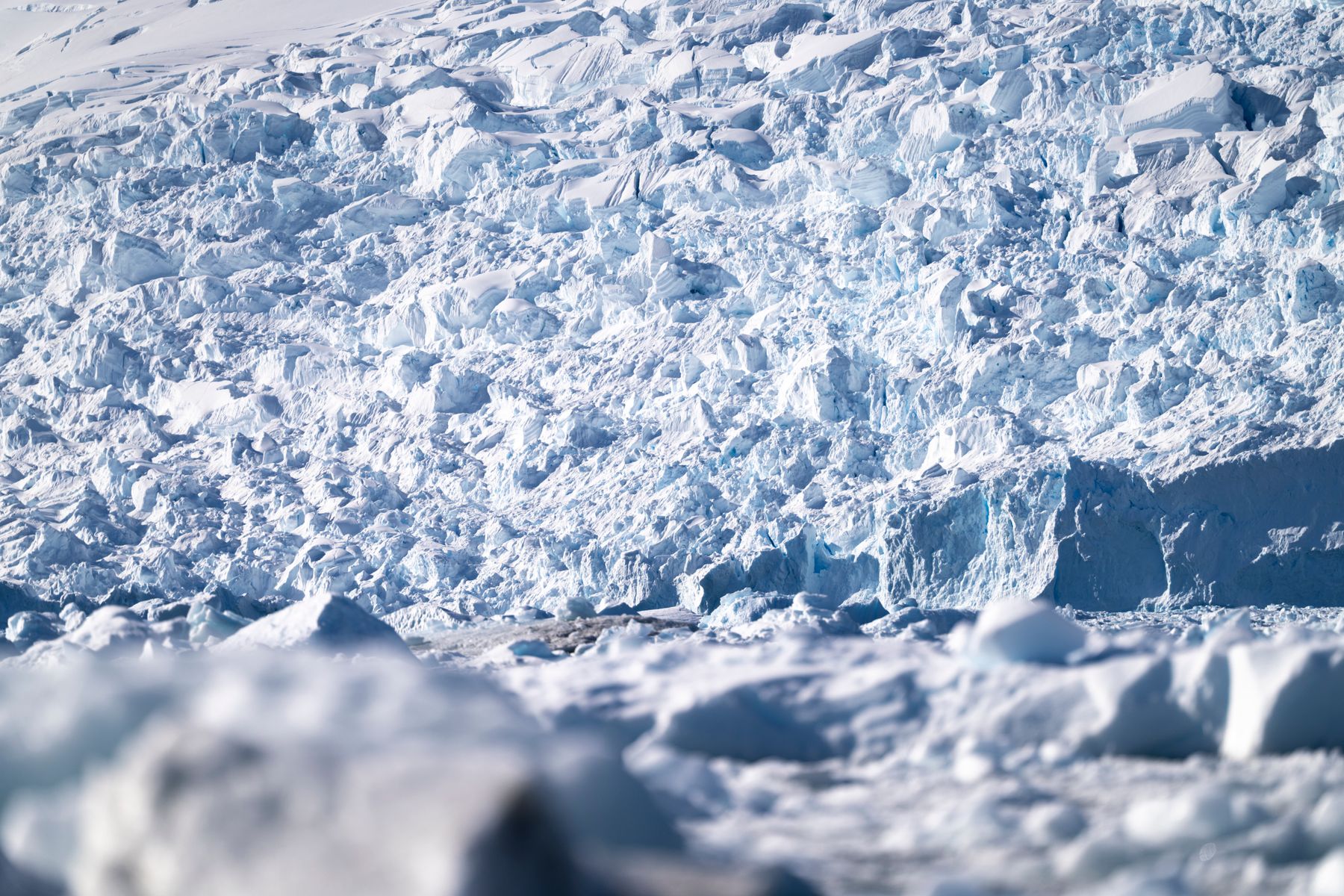
Blood Falls looks like a wound opened in the end of an Antarctic glacier. The red-orange material is neither blood nor a bloom of red algae. It is the surface record of iron-rich, hypersaline water emerging intermittently from Taylor Glacier.
A multi-technique analysis published in 2022 identified abundant, amorphous iron-rich nanospheres in material collected from the outflow fan. The particle identification comes from one study, not settled consensus. Its clearest correction was that the color could not be reduced to familiar crystalline iron oxides such as goethite or hematite.
There is also an important sequence hidden by the title’s shorthand. The buried brine carries mostly dissolved ferrous iron, Fe2+. The researchers concluded that exposure to air oxidizes that iron and produces the nanospheres at the surface. The particles are not simply ancient red beads transported unchanged from beneath the glacier.
I think the best way to understand Blood Falls is as a chemical transition made visible. A clear, reduced fluid leaves a dark subglacial system, meets an oxygen-rich surface and changes into a fine red-orange deposit.
Blood Falls is an intermittent discharge, not a permanent waterfall
The feature sits at the northern terminus of Taylor Glacier in the McMurdo Dry Valleys, beside the permanently ice-covered Lake Bonney. Despite the name, it is not a continuously flowing waterfall. Pressurized brine emerges episodically through the glacier, freezes and leaves a colored apron across the ice and moraine.
That fan changes between events. New outflows add salts, sediment and water. Summer melt, sublimation, ablation and dissolution remove or concentrate parts of the older deposit. A time-lapse camera can catch a release, but a visitor may instead find a frozen red-orange cone recording earlier pulses.
The feature was documented and named during the 1910–1913 Terra Nova Expedition led by Robert Falcon Scott. Geologist Thomas Griffith Taylor associated the discoloration with red algae, a reasonable early guess for colored snow and ice. Later chemical work shifted attention to iron.
By the mid-20th century, studies were describing yellow-brown or reddish-yellow material and proposing hydrated iron oxides, including goethite. The broad idea was right: iron is central to the color. The precise identity and structure of the coloring material were less secure than later summaries implied.
Liquid brine survives inside a very cold glacier
Taylor Glacier has a mean annual air temperature near −17°C. Surface melting is limited, yet liquid moves through and beneath the ice because it is not fresh water. A high concentration of dissolved salts lowers its freezing point.
Freezing also releases latent heat into the surrounding ice. Combined with the viscosity difference between brine and clean ice, normal glacier movement and changes in pressure, this can produce a cycle of channeling, trapping, freezing, warming and renewed migration.
Radio-echo sounding reported in the Journal of Glaciology mapped a subhorizontal zone of brine extending upstream from Blood Falls in the direction of ice flow. That work showed that the outflow belongs to an internal hydrologic system, not a shallow puddle thawed by sunlight.
The glacier’s weight helps pressurize the fluid. Brine can move through basal crevasses and then upward toward the discharge point. The plumbing need not remain continuously open, which helps explain why the surface release comes in episodes.
The source carries an ancient marine signature
The word “ancient” is well supported, but it needs care. Chemical ratios and isotopes indicate that the brine ultimately derives from seawater concentrated by freezing and altered by long interaction with rock. That does not mean every molecule has one neatly measured residence time.
A 2019 geochemical study used a clean-entry probe to sample brine 17 meters down in an englacial conduit connected with Blood Falls. The chemistry supported a marine origin followed by extensive rock-water alteration. Iron concentrations measured in the discharge and brine have ranged from roughly 476 to 3,000 micromolar, mostly in the reduced Fe2+ state before surface exposure.
The wider geological picture is a Taylor Valley that once experienced marine incursions. As climate cooled and ice advanced, freezing removed comparatively pure water and concentrated salts in the remaining fluid. Dense brines persisted beneath glaciers and permafrost where ordinary fresh water would freeze.
A Nature Geoscience study published in 2026 added biological evidence for ancient marine influence at the Taylor Glacier terminus. Marine-associated eukaryotic lineages dominated parts of the local red mud and sediment community, and modern wind transport alone did not readily explain the pattern.
That study did not date the brine to one exact year or show that all organisms came directly from the hidden reservoir. It strengthened a history already suggested by ions, isotopes and bacterial relationships.
Ten surface samples met a battery of instruments
The nanosphere study analyzed ten grab samples from the Blood Falls ice cone. Material was collected once in November 2006 and twice in November 2018. The samples included colored salt crusts, amber material, moraine sediment and ice-embedded precipitates.
No active discharge was visible during collection, although time-lapse images recorded an event in September 2018. That distinction matters. These were surface materials altered by freezing, air, sunlight, dehydration and time, not pristine brine drawn directly from the aquifer.
The team deliberately used many overlapping techniques. X-ray diffraction searched for crystal structures. Infrared, Raman and visible-to-near-infrared spectroscopy examined molecular bonds and optical behavior. Mössbauer spectroscopy focused on iron-bearing phases. Chemical methods measured elemental abundance.
Scanning electron microscopy, electron-probe microanalysis and transmission electron microscopy then examined individual grains and nanoparticles. No one instrument supplied the answer. Some techniques identified the dominant minerals; others ruled out iron phases that had long been assumed.
The bulk crystalline material was dominated by the carbonate minerals aragonite and calcite, accompanied by quartz, feldspar, halide and clay minerals. Iron was abundant in the fine fraction, but it was not a significant part of either carbonate.
Electron microscopes revealed what diffraction missed
X-ray diffraction identifies a mineral by the orderly repetition of atoms in a crystal lattice. It is powerful when enough crystalline material is present. It struggles with trace components, particles only a few nanometers across and substances without long-range crystal order.
That limitation was central at Blood Falls. Diffraction and spectroscopy could exclude several proposed iron oxides but did not supply one clean replacement. Transmission electron microscopy revealed abundant spheres with variable composition in the finest material.
Their shape resembled ferrihydrite, a poorly crystalline iron material. Yet selected-area electron diffraction and high-resolution imaging showed that the spheres themselves were structurally amorphous. They lacked the repeating lattice required to classify them as a conventional mineral.
The particles were rich in iron but chemically mixed. Analyses also found chlorine and other cations, including magnesium and sodium, while some nanoparticles showed relationships between iron and aluminum. The researchers called the population amorphous iron-rich nanospheres rather than assigning one simple formula.
This is why “it is rust” is both useful and incomplete. Oxidized iron makes the familiar color analogy work, but the actual particles are not flakes of ordinary crystalline rust. Their nanoscale structure and accompanying ions influence how they absorb visible light.
Oxidation paints the ice after the brine emerges
In the dark, oxygen-poor brine, much of the iron is reduced Fe2+ and remains dissolved. Observers have reported that the effluent can emerge clear. The outflow then reddens as it encounters air, oxidizes and loses water.
The 2022 team concluded that dissolved Fe2+ does not readily crystallize into the iron oxides earlier explanations expected. Instead, it forms kinetically metastable, hydroxylated ferric iron material arranged in amorphous nanospheres.
“Quickly oxidizes” describes the contrast with long confinement beneath the glacier, not a stopwatch result from this study. The samples were not collected through a timed sequence from clear discharge to red deposit. The paper says the fan progressively reddens as phases precipitate, oxidize and become concentrated by ice loss.
Iron may not act alone. Other ions in the nanospheres can change the optical result, and mixed brines in laboratory analogues form different colors depending on their chemistry. The study identified iron-rich particles as the main source without reducing every shade to iron alone.
Microbes live there without painting the falls
Rejecting algae as the pigment is not the same as declaring Blood Falls lifeless. Its subglacial brine supports metabolically active microorganisms in a cold, salty environment without sunlight. Their chemistry helps cycle sulfur and iron and weather the rock.
The 2026 genetic work makes the distinction more interesting. More than 60 percent of diatom sequences in some red mud and sediment samples belonged to marine-associated groups. The authors found evidence consistent with long persistence after ancient marine influence.
Those diatoms inhabit or leave signatures in the environment around the terminus. They are not evidence that a red algal bloom supplies the visible stain. The nanosphere paper and the ecological paper answer different questions: what colors the deposit, and what biological history the site preserves.
Keeping those questions separate prevents a common mistake. A place can contain abundant life without life producing its most visible feature.
Why the particles matter beyond Antarctica
Blood Falls is studied as an analogue for cold, dry and salty environments on Mars and for brines beneath ice elsewhere in the Solar System. The analogy concerns processes and detection challenges, not a claim that Antarctica duplicates another world.
Several bulk techniques used in the 2022 study resemble instruments flown on Mars missions. They were good at identifying carbonates, silicates and some iron signatures. The amorphous nanoparticles became clear only when high-resolution microscopy connected structure with composition.
A rover cannot routinely carry a laboratory transmission electron microscope. Surface spectra may therefore reveal that iron is present while leaving its exact nanoscale host ambiguous. A colored fan could be evidence of a subsurface brine even if remote measurements fail to assign every particle to a named mineral.
The authors also noted limitations. They did not measure the iron valence inside individual nanospheres with electron energy-loss spectroscopy. Samples had spent years frozen in storage, and amorphous material can slowly reorganize. The particles persisted, but the study could not reconstruct every transformation from reservoir to laboratory.
I think that methodological lesson is more useful than declaring a century-old mystery permanently closed. Blood Falls does not bleed, and algae do not paint it. Dissolved iron leaves an old, dark brine, meets the surface and becomes a population of particles small and disordered enough to evade the first tools used to look for them.