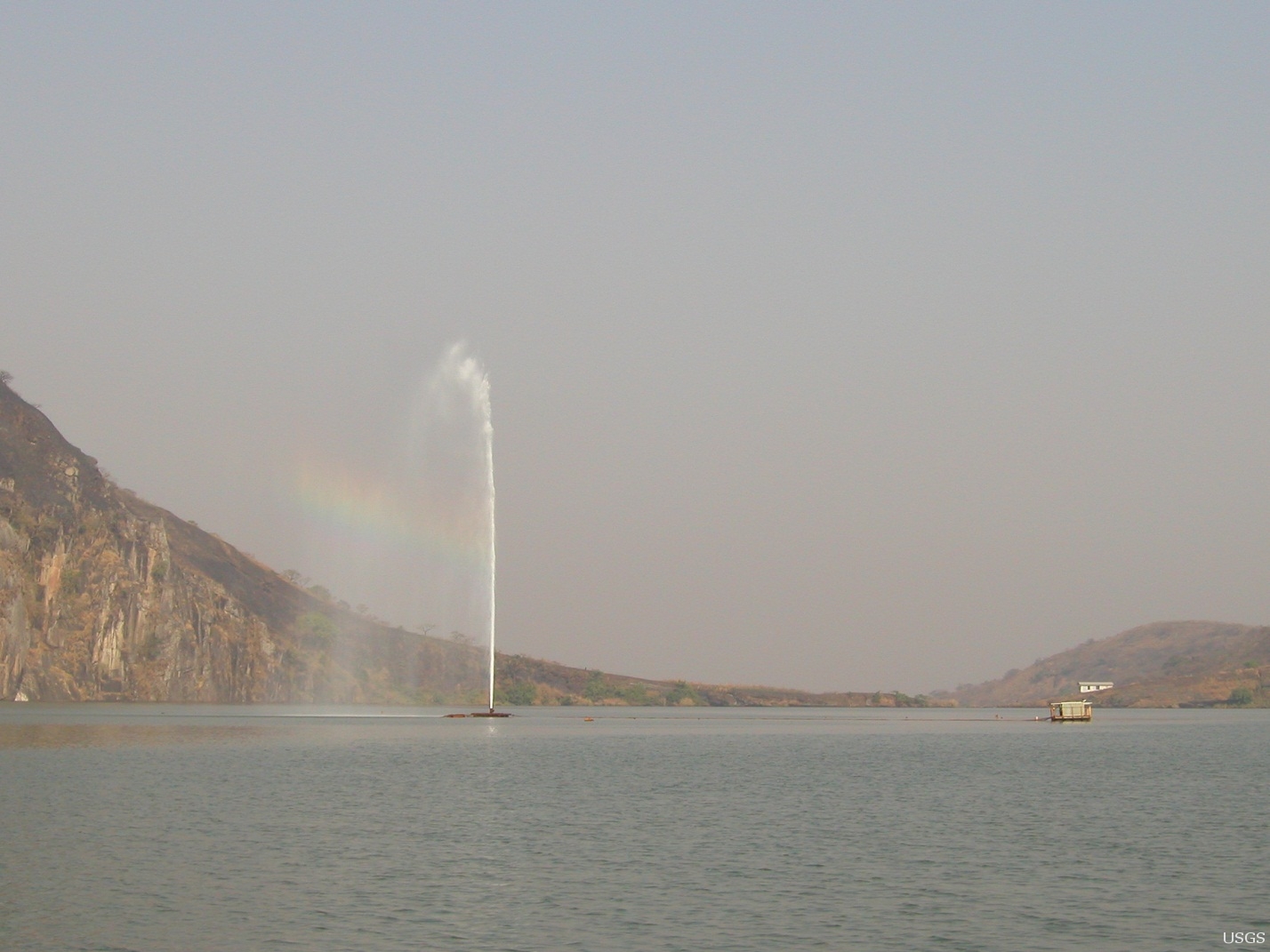
A black polyethylene tube hangs straight down into a crater lake in northwest Cameroon, open at both ends, attached to nothing that burns fuel or draws current. Its intake sits 203 meters down, close to the bottom. Water climbs it on its own. When the system was primed in January 2001, the column of spray at the surface stood about 48 meters — roughly 160 feet — above the raft that holds the pipe. It has been running ever since, though the jet is far shorter now than it was, for precisely the reason the project exists. The fountain is not decoration and not a monument. It is a pressure-relief valve for a body of water that killed at least 1,700 people in a single night.
Lake Nyos sits in a volcanic maar, a steep-walled crater gouged by a steam explosion and since filled in. On the night of 21 August 1986, something in that lake turned over, and a cloud of carbon dioxide poured out of the basin and down the valleys to the north. People in the villages below did not hear an eruption, because there was no eruption in the usual sense — no lava, no ash column, no shaking that survivors could later agree on. There was a sound some described as a rumble, a smell some remembered as rotten eggs or gunpowder, and then a dense invisible gas moving downhill faster than anyone could get up and out of it.
What the survivors woke up to
The American scientific team that went in afterward — ten researchers, among them USGS geochemist William Evans and limnologist George Kling — filed its findings with the U.S. Geological Survey as Open-File Report 87-97, and that document remains the primary account of what happened. Its casualty figure is deliberately a floor rather than an estimate: at least 1,700 people dead, along with roughly 3,000 head of cattle. The gas did not stay near the water. It ran north out of the basin and stayed concentrated enough to kill 23 kilometers down the valleys, through Nyos, Subum and Cha. Birds, insects and livestock died across the same footprint. The cause of death was asphyxiation. Carbon dioxide is about one and a half times as dense as air, so it hugged the ground and filled the low places where people sleep.
Two details from the team’s findings do more work than any casualty number. The first is that survivors regained consciousness 6 to 36 hours later — meaning the gas sat in the valleys long enough that people who went down in the evening came back in the following afternoon, or the day after that, into villages where nearly everyone else had not. The second is the oil lamps. Investigators found lamps extinguished with oil still in the reservoir, which is how a flame behaves when the oxygen around it is displaced rather than consumed. There was no fire. There was nothing left to burn.
The 1987 report was careful about mechanism in a way that later popular accounts often were not. The carbon dioxide came from deep magmatic sources, seeping upward through the crater floor and dissolving into the cold, dense bottom water of the lake over years. Pressure at depth keeps it in solution the way a sealed bottle keeps carbonation in beer. Nyos is deep — about 210 meters — and its water column had not been mixing, so the gas accumulated at the bottom with nowhere to go. What happened in August 1986 was a limnic eruption: the deep water rose, the pressure on it dropped, the dissolved CO2 came out of solution, and the rising bubbles dragged more deep water up behind them in a runaway that emptied the lake’s gas load into the air in a matter of hours. On the trigger — a landslide off the crater wall, a cold rain, an internal wave, a small seismic nudge — the USGS team declined to commit. The report lists the trigger as undetermined.
Engineering against a refill
The uncomfortable part is that nothing about the 1986 event stopped the gas supply. Magmatic CO2 kept seeping into the bottom of Lake Nyos afterward, and the lake began recharging toward the same condition that had already killed once. A second Cameroonian crater lake, Monoun, had released gas in August 1984 and killed 37 people. The engineering question was not whether to intervene but how to bleed a lake without setting off the thing you are trying to prevent.
The solution is almost embarrassingly simple, and it is the same physics that made the disaster. Drop a pipe from the surface to the gas-charged deep water. Prime it once — pump briefly, or lower it while full — and deep water starts up the tube. As it rises, pressure falls, dissolved CO2 comes out of solution inside the pipe, the bubbling column becomes less dense than the surrounding water, and the flow sustains itself. Champagne, run through a straw. No pumps, no fuel, no grid connection at a remote crater in the Oku volcanic field. The first permanent degassing column went in in January 2001: polyethylene, 140 millimeters across, with its intake set at 203 meters and a self-powered fountain above it that looked like a geyser and was in fact a controlled leak.
Three pipes, and the wall
One pipe was never going to be enough. It vented gas faster than the lake recharged, but only barely, and the deep reservoir that had built up over decades needed years to draw down. Two more pipes went in in 2011, installed through late 2011 and early 2012 with EU funding, their intakes pushed down to between 207 and 209 meters — a few meters off the lake bed. The extra capacity did what it was meant to do: the lake’s dissolved gas was drawn down to a safe level by 2015.
Success has a strange shape here, because the fountain is powered by the very thing the fountain removes. Take enough gas out and the pressure at the intake falls, the bubbling column loses its lift, and the jets get shorter and shorter — which is exactly what has happened at Nyos since 2001, and what stopped the self-lift outright at Monoun, where a small solar-driven pump was installed in December 2013 to keep moving deep water. The researchers who monitor both lakes have made the same recommendation for Nyos: once self-degassing ends, a solar-powered deep-water removal system is needed, because the magmatic recharge underneath does not stop.
The other remaining worry at Nyos is not gas but geology: the natural dam of loose volcanic debris holding the lake in its crater has been eroding toward failure, and a breach would send a flood down the same northern valleys the cloud took — into the Kimbi and Katsina drainages and on toward the Nigerian border — while dropping the pressure on whatever gas remains. That barrier has since been consolidated by jet grouting, a curtain of high-pressure injections that mixes the loose tephra into a soil-cement wall. What stands at Nyos now is a crater lake kept deliberately, permanently fizzing, on the theory that a lake allowed to exhale a little every day should never again exhale all at once.