

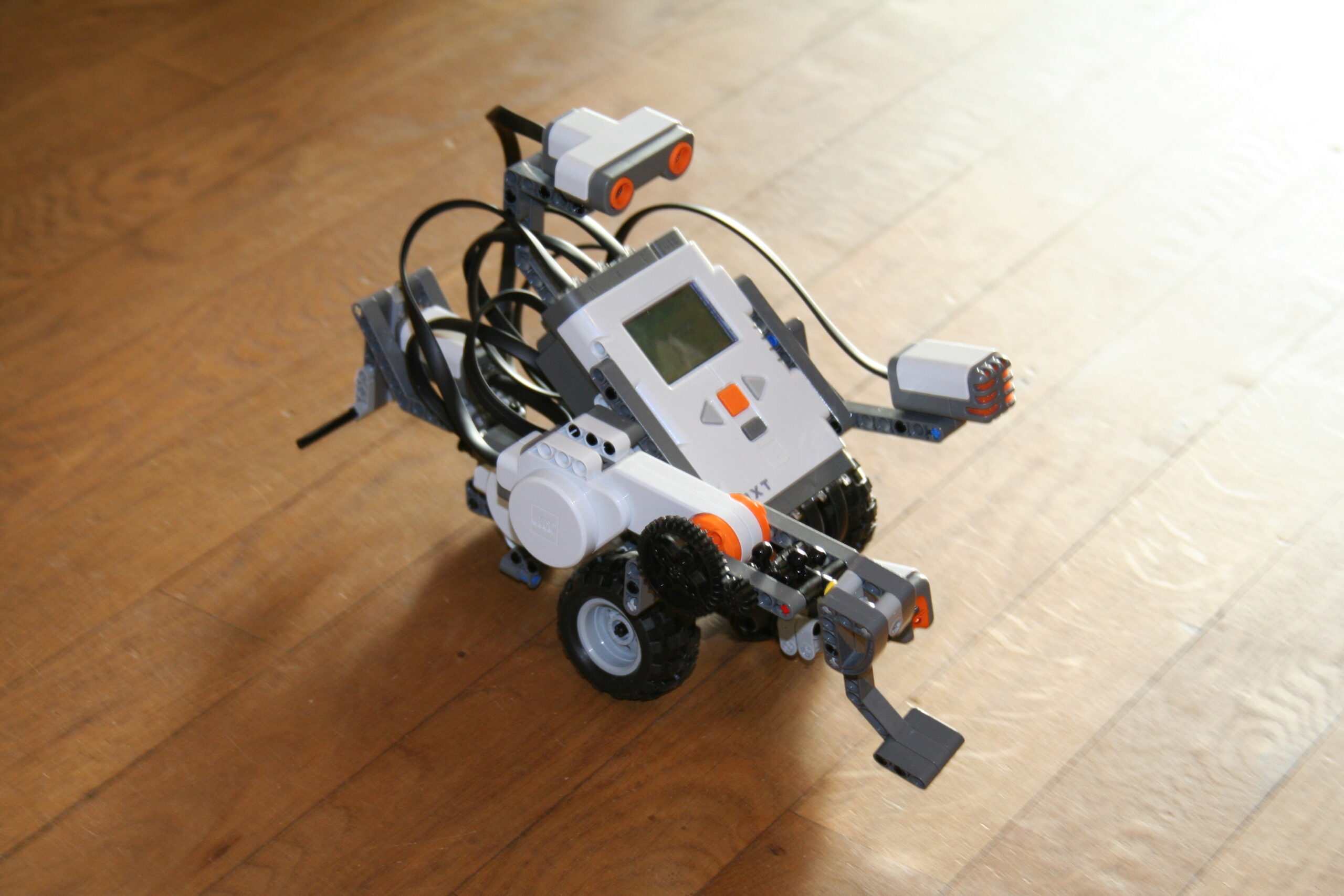
A plastic robotics kit with a retail price around $350 — motors, a programmable brick, a scatter of beams and pins — sat on a kitchen table in Santa Clara, California, and came back together as a machine that punched raised dots into paper tape. The builder was 12. The science fair question he had started with was smaller than the object he ended up with: how do blind people read?
The answer he got, after some searching, was that they read Braille, and that the hardware for producing it at home was expensive. Shubham Banerjee’s project became Braigo v1.0, a Braille printer assembled from a Lego Mindstorms EV3 set plus hardware-store oddments, and the number that made it newsworthy was the gap between what he spent and what the alternative cost. Commercial Braille embossers, as widely reported in coverage at the time, started at roughly $2,000 — a journalism consensus figure rather than an audited survey of the market, but one repeated consistently enough to frame the comparison. A seventh-grader’s Lego rig was not going to match a production embosser on speed or durability. It did not have to. It printed dots, and it cost about a sixth of the entry price.
By November 2014, the BBC reported that Intel had invested in the company built around that prototype, Braigo Labs. The BBC’s story describes him as 13 at that point, which is not a contradiction. The build happened earlier the same year, when he was 12, and there was a birthday in between: Reuters reported that he was still 12 when the funding round closed in October, and had turned 13 by the time it was made public.
The floor that nobody had bothered to lower
Braille embossers are a small market serving a small population, and small markets tend to hold their prices. Machines are mechanically fussy: they have to strike paper hard enough to raise a dot that survives being read by fingertips, repeatedly, without tearing the sheet. That is a solved engineering problem, but it is solved in low volumes, by specialist manufacturers, for institutional buyers — schools, libraries, government agencies — who write the check and move on. There was no consumer pressure pushing the entry price down, because the consumer segment was thin enough to be almost theoretical.
What a Lego kit demonstrates is not that the specialists were wrong but that the floor was arbitrary. The EV3 brick is a general-purpose controller. Its motors are precise enough to index paper and drive a stylus. Everything else is geometry. Once a 12-year-old has proven that the underlying mechanism can be assembled from a toy and a trip to the home improvement store, the $2,000 figure stops looking like a technical constraint and starts looking like a market condition.
That distinction is what interests investors. It is also, in fairness, the part that is hardest to carry from a science fair table to a shipping product. A Lego prototype does not have a power supply certification, a paper path that tolerates humidity, a service plan, or a manufacturing partner.
Thirty-five thousand from the family, an undisclosed sum from Intel
The prototype went to the White House Maker Faire in June 2014, which is the kind of exposure that converts a school project into a story with momentum. Banerjee’s family then put $35,000 of their own money into founding Braigo Labs that summer; the Associated Press reported the initial sum as coming from his father, an engineer who worked at Intel. It is a specific, unglamorous number that tends to get skipped in retellings, and probably shouldn’t be. Before any corporate venture arm was involved, the seed capital was a family’s savings.
Intel’s investment followed. The company did not disclose the amount, and it has not since. Reuters reported that both Banerjee and an Intel Capital spokesman declined to give a figure, and that a person familiar with the matter put it at a few hundred thousand dollars — an unnamed source’s estimate rather than a confirmed number from either party. What Intel did confirm was the involvement, which made Banerjee among the youngest recipients of funding from the chipmaker’s venture operation.
Most of the engineering, though, came before the check rather than after it. Braigo 2.0 was built with the family’s $35,000, not Intel’s. It dropped the Lego chassis in favour of an off-the-shelf desktop printer and a newly released Intel chip — the Intel Edison, a compute module roughly the size of an SD card that the company was pushing at the time for wearables and embedded projects. Banerjee demonstrated the Edison-based version at the Intel Developer Forum in September 2014, two months before the investment was announced; the AP reported that Intel’s money then went toward hiring professional engineers and advisers. The stated target for the commercial version was around $350, roughly what the original Mindstorms kit had cost. The prototype’s budget became the product’s price ceiling. That is a tidy piece of framing, and it was almost certainly deliberate.
What the advocacy side said, and what it wanted
The Royal National Institute of Blind People welcomed the investment, with the organization’s Clive Gardiner quoted in the BBC’s coverage. That endorsement is worth reading carefully rather than as a rubber stamp. Blindness organizations have watched a long parade of well-meaning assistive technology arrive with enthusiasm and leave without a support contract. The useful question about any low-cost Braille device is not whether it works on a demo table but whether someone will still be manufacturing consumables, shipping replacement parts, and answering the phone in five years.
The more durable point is about who noticed the problem. Braille literacy rates among blind people in the United States and the United Kingdom have been a persistent concern for decades, and cost of access to Braille production is one input among several. A twelve-year-old with a robotics kit did not solve that. What he did was expose, in an unusually legible way, that a price barrier a whole industry had treated as fixed could be interrogated by anyone willing to ask why — and that the tools for asking now sit on toy shelves.
The kit was $350. The machine it became argued that the number on the other side of the comparison had never been examined closely enough.