

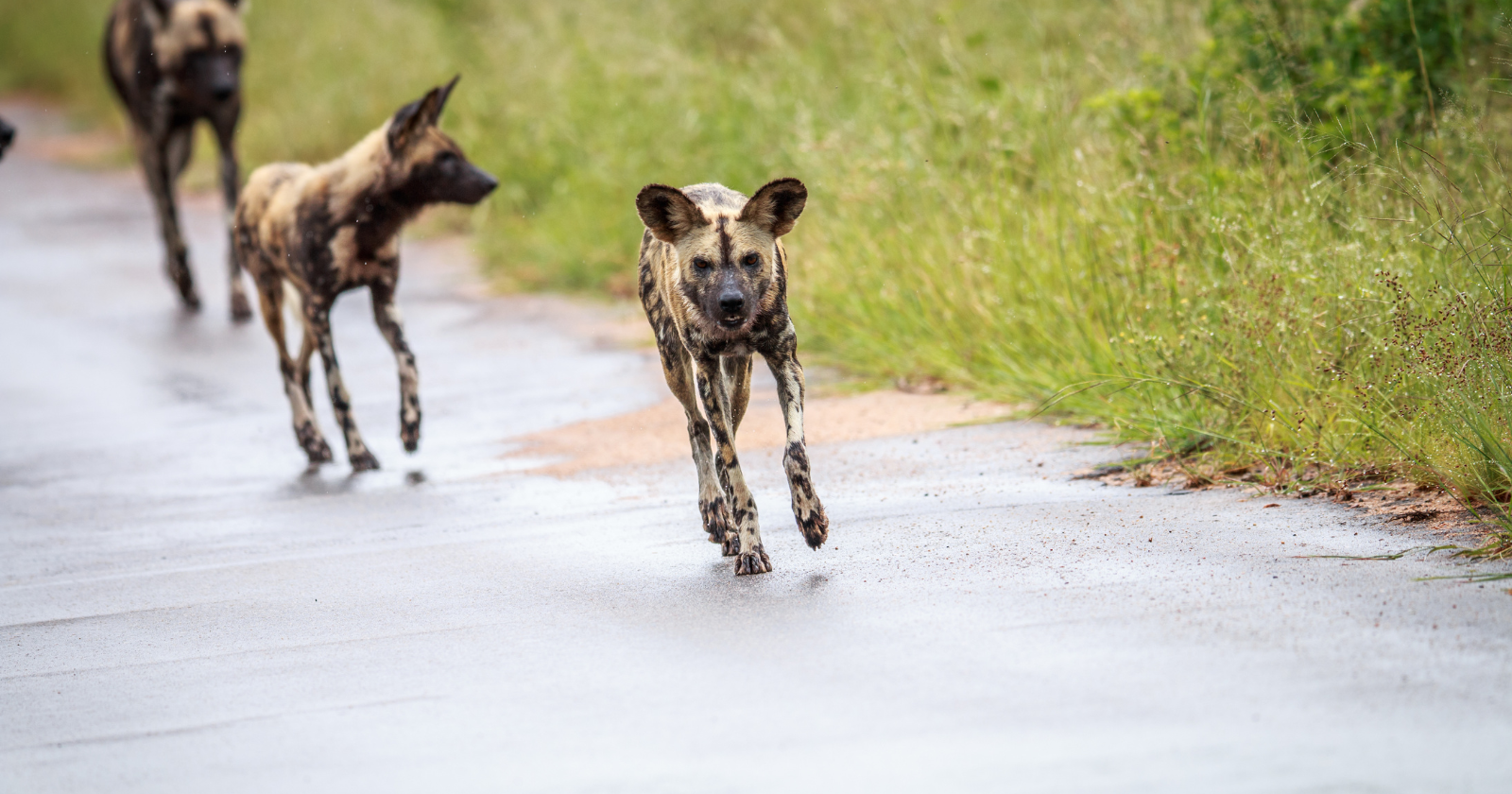
Three male African wild dogs left the Mayukuyuku pack in Zambia’s Kafue National Park in July 2025 and did not stop moving for roughly eight months. By the time GPS collars showed them settling into a new range in the Luangwa Valley by April 2026, the brothers had covered 4,126 kilometres — the longest dispersal distance yet recorded for any African mammal, according to the researchers who tracked them.
The animals’ path was far from direct. Collar data show them ascending and descending the Great Rift Valley escarpment, crossing major rivers and roads, and skirting the Copperbelt cities of Kabwe, Kitwe and Ndola before doubling back roughly 200 kilometres and continuing east toward the game management area between South Luangwa and Lower Zambezi National Parks. The straight-line distance between where the brothers started and where they stopped is a small fraction of the ground they actually covered.
Four tracked journeys, one shared pattern
The Mayukuyuku brothers were not tracked in isolation. Researchers with the Zambian Carnivore Programme followed four separate dispersal events during the same period, and the combined distance covered by those four groups reached 9,863 kilometres. Other collared dogs moving out of the same Kafue pack, and packs elsewhere in Zambia, logged journeys of well over 1,000 kilometres apiece through unprotected land before any of them reached another population.
Findings from the tracking effort were published in the journal Ecology, by Scott Creel of Montana State University and Matt Becker of the Zambian Carnivore Programme.
Why subordinate wild dogs leave the pack at all
African wild dogs live in tight cooperative packs, but breeding within a pack is normally restricted to a single dominant pair. Subordinate animals, typically between two and three years old, either wait years for a breeding opportunity at home or leave to find one elsewhere — a strategy that also reduces the odds of mating with close relatives. The Mayukuyuku brothers were subordinate males of exactly that age class, and their departure fits a dispersal pattern documented across the species for decades.
What made this case notable was its scale and its outcome. Most dispersing wild dogs die en route; the brothers evaded the roads, rivers and human settlements in their path and reached a distant population intact.
More than fifteen years of collar data behind the finding
The Zambian Carnivore Programme has fitted satellite GPS collars on wild dogs in Zambia for more than fifteen years, building a dataset that now spans hundreds of individuals across dozens of packs in Kafue, South Luangwa, Liuwa Plain and other landscapes. That long baseline is what let researchers place the Mayukuyuku brothers’ 4,126-kilometre trip in context — as part of a pattern, not an isolated anomaly — and compare it against a small number of comparably extreme journeys recorded in earlier years, including a female that crossed roughly 2,300 kilometres into Mozambique before dying in a wire snare.
That earlier case is a useful caution alongside the new one. Long-distance movement by wild dogs has been documented before. For population biology, survival afterward is what matters most.
Movement is not the same as confirmed connectivity
Two claims are easy to conflate here. One is that wild dogs are capable of moving vast distances between populations. The other is that this movement is producing measurable genetic or demographic exchange between them. The researchers treat these as distinct. GPS collars record where an animal goes; they do not, by themselves, confirm that it survived long enough to breed or that its genes entered the new population’s gene pool. Demonstrating actual connectivity requires evidence that a disperser was not just present in a new range but integrated into a pack there and reproduced — a harder bar to clear than documenting a track log.
More than half of the dispersing wild dogs tracked by the programme over the years have not survived their journeys, mainly killed by wire snares set for bushmeat, and also by rival packs, lions, crocodiles and vehicle strikes. Against that backdrop, a single successful, confirmed settlement — like the Mayukuyuku brothers’ arrival in the Luangwa Valley — is a meaningful data point, but it is one data point — not proof that dispersal is routinely stitching Zambia’s wild dog populations together at the genetic level.
What the wider dataset does and does not support
Creel has offered a more optimistic reading of the accumulated record, telling reporters after decades of study that most of the major wild dog populations across eastern and southern Africa probably remain connected by occasional long-range dispersal of this kind. That inference rests on the pattern built up across many tracked animals over roughly fifteen years, not on the outcome of any single trip. The four dispersal events totalling 9,863 kilometres are recent, high-profile additions to that longer record, and only one of the four — the Mayukuyuku brothers — is reported to have reached and settled into a new range; outcomes for the other three have not been detailed in the same way in public reporting so far.
The species remains classified as endangered, with roughly 6,600 adults left across about 39 fragmented populations, mostly confined to protected areas separated by farmland, roads and settlements. A pattern of occasional extreme dispersal across that fragmented landscape is compatible with ongoing gene flow strong enough to prevent long-term genetic isolation of the smaller, more cut-off populations. It doesn’t, on its own, demonstrate that gene flow is happening.
Why the corridors between parks matter
Nearly all of the ground covered by the Mayukuyuku brothers and the other tracked dogs lay outside any national park or game reserve. Becker, the Zambian Carnivore Programme’s chief executive, framed the finding as evidence that people and wildlife do not need to be kept entirely apart for a species like this to persist, saying, per Reuters, that “connectivity still works” and that more needs to be done to protect it. In practice that means reducing wire-snare density along known dispersal routes and maintaining passable habitat in game management areas and community lands that sit between the fenced or patrolled cores of major parks.
The Mayukuyuku brothers’ journey shows that a dispersing wild dog can still cross an increasingly developed stretch of Zambia and reach another population intact. Whether that capability translates into the sustained genetic and demographic connectivity that isolated wild dog populations need is a separate question, and one the researchers say continued tracking will have to answer — a single successful trip isn’t enough.