

For most of the 20th century, the land along the Illinois River near the Dixon Waterfowl Refuge in Putnam County grew corn and soybeans. The Hennepin Drainage and Levee District had drained the site’s wetlands in 1908, installing pumps and levees that turned marsh into farmland. The Wetlands Initiative, a Chicago-based conservation nonprofit, bought roughly 2,760 acres of that former farmland in 2000 (the refuge’s footprint grew to more than 3,000 acres with a later addition) and shut the drainage pumps off the following year, letting Hennepin and Hopper Lakes refill on their own.
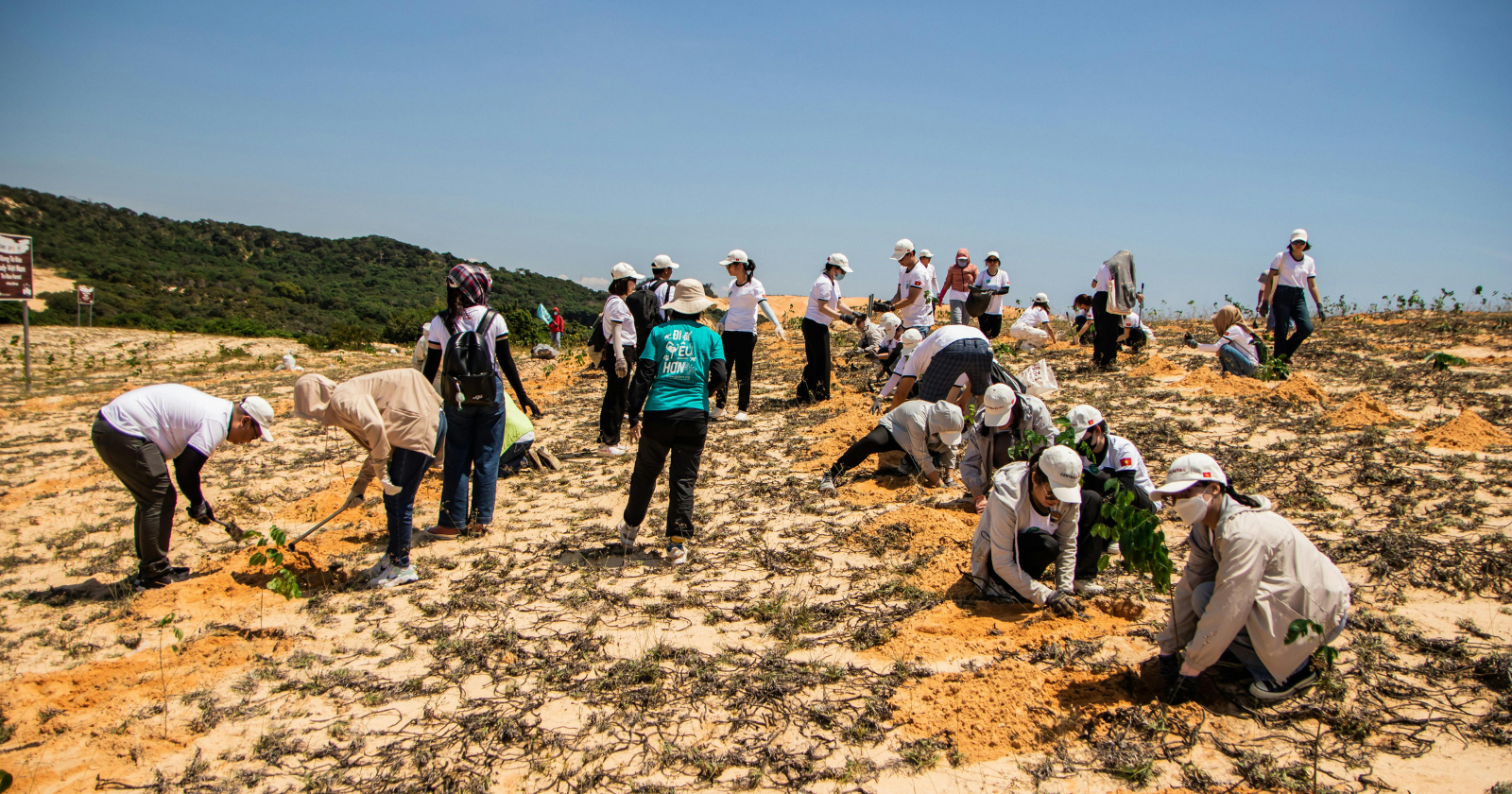
Restoring the site’s water was the easier half of the job. Rebuilding the plant communities that once surrounded those lakes took longer, and it depended heavily on people showing up with trowels and seed bags. The refuge still runs recurring plug-planting volunteer days and native seed harvest events, where volunteers collect seed from healthy patches of prairie and put plants into the ground by hand across the refuge’s upland margins.
Building a seed mix from nine prairie remnants
A case study published in January 2025 in the journal Ecological Solutions and Evidence describes how Wetlands Initiative ecologists tried to make that hand-planting more deliberate. Ecologists William Sluis, Katie Kucera and Gary Sullivan skipped the generic native mix. They surveyed nine tallgrass prairie remnants near the refuge to identify which mesic prairie species actually grow together in undisturbed ground, then used that list as a template. They planted 82 of the most common remnant species across five 10-by-10-meter plots, an approach the Wetlands Initiative describes as a “remnant reference ecosystem model.”
That is a far denser mix than most prairie plantings attempt. Typical restoration seed mixes run closer to 30 species, weighted toward a handful of aggressive grasses and forbs that establish reliably but leave out slower, more particular plants such as hoary puccoon and prairie dropseed. Getting all 82 species into the ground took time: most needed one or two separate planting attempts before they took hold, and by the fifth year every species on the list had been successfully introduced somewhere in the plots.
What the six-year resurvey actually found
After roughly six years of monitoring, individual plots held between 64 and 72 of the 82 planted species, averaging 68.8. That works out to an average persistence rate of about 84 percent per plot, with some plots losing closer to a fifth of their planted species and others losing well under a fifth.
The benchmark the researchers used for comparison was the species richness of those same nine remnant prairies, which also averaged around 82 species. On that measure, the restored plots came close to matching wild, never-plowed prairie in plant diversity within six growing seasons — a result the authors frame as evidence that a carefully designed, remnant-modeled seed mix can rebuild species-rich prairie faster than the loose, lower-diversity mixes common in typical roadside or conservation-program plantings.
A complication: some species spread further than others
Persistence numbers alone can flatten an important detail. The study also found that certain clonal species — plants that spread by rhizomes rather than relying only on seed — proliferated quickly and pushed past the boundaries of their assigned plots. That pattern matters for how a restored prairie actually looks and functions: a plot can retain most of its planted species on paper while a few aggressive clonal plants quietly take over more of the physical space, at the expense of slower-growing neighbors that are still present but increasingly crowded.
The study’s design also has real limits worth stating plainly. Five plots at a single refuge, monitored by one research team, is a useful demonstration but not a large sample, and the site sits in a river floodplain rather than the drier upland terrain where much of Illinois’ historic prairie once stood. The authors treat the work as a case study — a proof of concept for the reference-ecosystem approach. They stop short of claiming the method will produce identical results wherever it is tried.
Plant counts are not the same as a working prairie
Species lists are the easiest thing to measure in a young restoration, and the easiest to overstate. A plot where most of the planted species are present is not automatically a functioning tallgrass ecosystem. Soil structure, the insect and bird communities that depend on specific plants, and the belowground fungal networks that mature prairie relies on all recover on their own, often slower, timelines.
Research from Fermilab’s much larger, longer-running prairie restoration outside Chicago illustrates the gap. Soil scientists working with Fermilab Natural Areas have found that restored prairie soils can rebuild physical structure within a decade, but the organic carbon that defines deep, healthy prairie soil accumulates over a far longer span, “possibly hundreds of years,” according to Argonne National Laboratory ecologist Julie Jastrow’s work at the site. The Dixon plots, monitored for roughly six years, are nowhere near that timeline. The published study is scoped to the plant community that scientists could seed and count; it makes no claim about soil, insects, or wildlife.
Why the scale of Illinois prairie loss makes this work matter
The reason ecologists care about squeezing more species into a five-year planting window traces back to how little original prairie is left to draw on. Illinois once held an estimated 22 million acres of tallgrass prairie before European settlement; today, less than 0.01 percent remains unplowed. Almost every acre of restored prairie in the state, including the Dixon Waterfowl Refuge, is by definition reconstructed on former farmland; none of it is protecting anything original.
That scarcity is also why these projects keep leaning on volunteer labor instead of staff alone. At Fermilab, ecologist Wally Levernier has called volunteers “the backbone” of decades of prairie work there, handling seed collection and invasive-species removal across more than 950 acres. The Wetlands Initiative’s own seed-harvest and plug-planting days at Dixon serve the same function on a smaller scale: getting enough plant material, and hands, into the ground each season to keep pace with a seed list of dozens of species rather than a handful.
What the result does and does not show
Taken together, the Dixon Waterfowl Refuge study offers a modest, well-documented data point, not a dramatic breakthrough: a carefully modeled 82-species seed mix, planted with volunteer help on former corn and soybean ground, produced restored plots that averaged 68.8 species after six years and approached the plant diversity of nearby remnant prairie. It says nothing yet about whether that plant diversity will hold as clonal species keep spreading, or about how quickly the soil, insects, and birds that depend on a mature prairie will follow the plants back in.
For a state that has lost almost all of its original prairie, even a partial, plant-only recovery on a few acres of former cropland is worth tracking closely — and worth describing with the numbers the researchers actually reported.