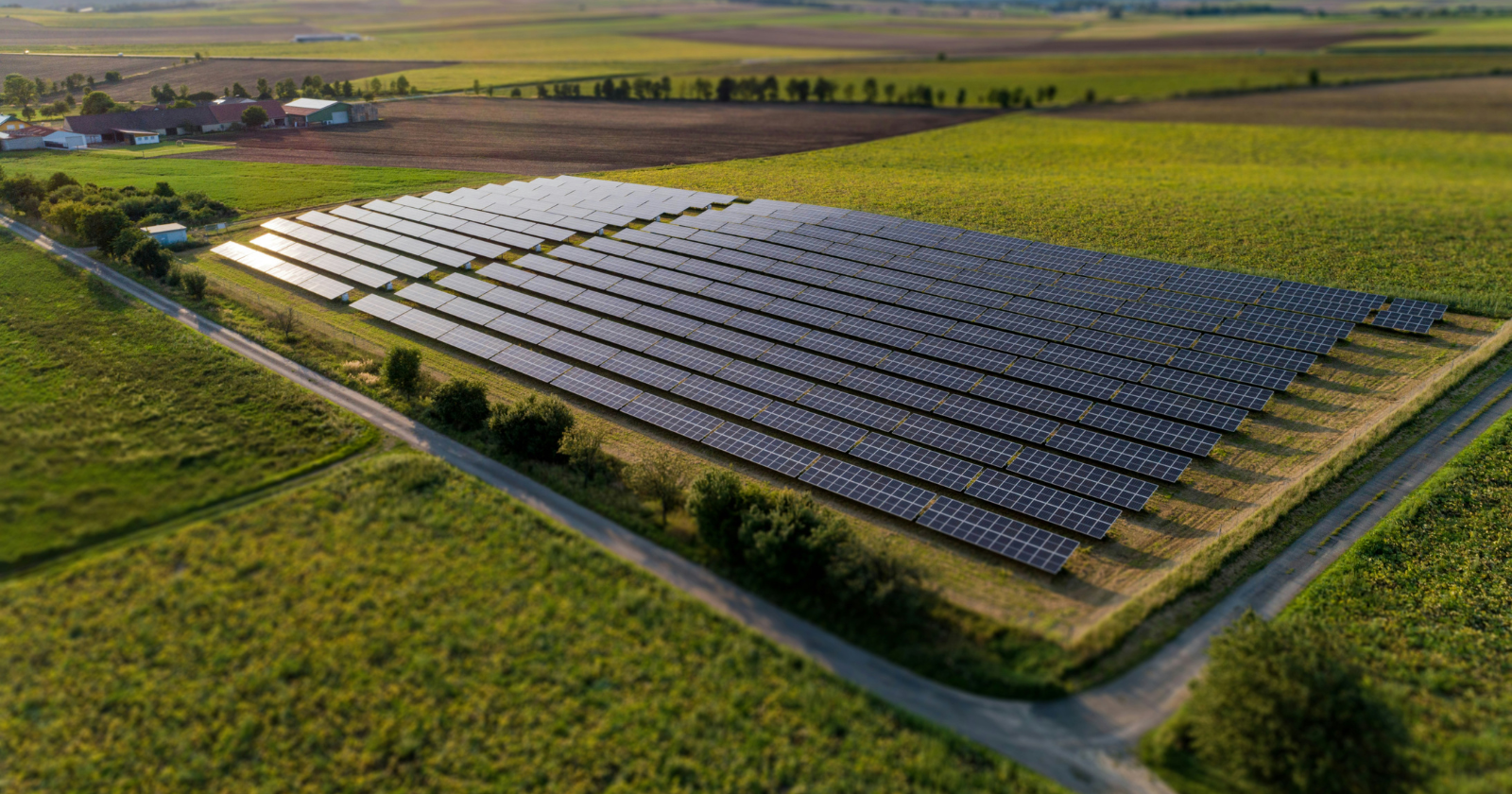
Thirty-five birds on one side, twelve on the other, and both counts came from walking the exact same distance under the exact same rules.
That split is the headline result of a peer-reviewed study in the journal Bird Study, and it runs against the instinct most of us carry about solar farms without ever really checking it. My own assumption was that a field of panels sits somewhere between neutral and bad for wildlife, a flat expanse of glass and steel standing in for a flat expanse of wheat or sugar beet.
What a team of ecologists actually found in England’s East Anglian Fens was a solar farm holding close to three times the birds of the cropland nearby, but only when someone had bothered to manage it that way.
The study was led by Dr. Joshua Copping, a conservation scientist at the RSPB, working with Dr. Catherine Waite of the University of Cambridge and several coauthors. Between April and June 2023, the team walked 200-meter transect sections across six solar farms scattered between Cambridge, Peterborough, and Lakenheath, recording every bird seen or heard within 100 meters on either side, which works out to a four-hectare strip per section. They walked the identical kind of route through nearby arable cropland, typically within a mile of each solar site, and did every route twice, once early in the breeding season and once late. Model-fitted results put the wildlife-managed solar sites at 35.1 birds per transect section on average, against 11.9 on the cropland. Round those two numbers and you land on the same 35 and 12 named at the top of this piece.
Across the whole project the team logged 830 individual birds from 44 species over roughly 38 kilometers of walked transects, a large enough sample that the gap between solar and cropland is hard to write off as noise. Worth saying plainly: this was an observational comparison across six existing sites, not a controlled experiment. The paper itself notes that earlier, smaller studies on solar farms and birds have produced mixed results elsewhere, some finding fewer birds inside solar sites and some finding more, depending on what kind of land the panels replaced.
What “managed for wildlife” meant on the ground
The advantage wasn’t automatic for every solar farm in the study, and that’s the part worth sitting with. The researchers split their solar sites into two groups by management style. What they called mixed habitat solar meant the grass around the panels was cut or grazed only occasionally, letting the sward grow tall and wildflowers take hold, with hedgerows or boundary trees left standing at the edges instead of stripped out. Species richness followed the same pattern as the raw bird counts: these sites averaged 13.5 species per transect section, against 5.5 on cropland and 5.3 on the other kind of solar farm in the study. Wood pigeon turned out to be the single most common bird recorded across the whole project, but the more interesting signal sat with birds that are already running low.
The birds already running out of road
Why single out corn bunting and yellowhammer specifically? Both sit on the UK’s Red List of birds of conservation concern, yellowhammer down 61 percent since 1967 and corn bunting down 83 percent over roughly the same stretch. The paper didn’t run a separate statistical test on every individual species, but it did model the whole group of Red- and Amber-listed birds together, and that group came out significantly higher on the wildlife-managed solar farms: 19.4 birds per transect section, against 7.8 on cropland and 9.6 on the other solar sites, a gap the researchers report as statistically solid rather than a fluke of small sample sizes. Corn bunting and yellowhammer both belong to that group, and both are named in the RSPB’s own account of the results as birds that turned up in the greatest numbers on the sites managed with a genuine mix of habitats.
The same panels, mowed short, told a different story
This is where the compare-and-contrast gets sharper than a simple solar-versus-cropland split. The study’s other solar category, simple habitat solar, sat on the same kind of infrastructure as the first. Same panels, same basic footprint, same region. The difference was maintenance: grass cut or grazed short all summer, no hedgerows, no boundary trees, nothing allowed to grow past ankle height. Those sites averaged 17 birds per transect section, roughly half of what the wildlife-managed solar farms produced and barely above the 11.9 recorded on ordinary cropland.
“Our study shows that if you manage solar energy production in a certain way, not only are you providing clean energy but benefitting biodiversity,” said Waite, in a statement released by the university. That’s the whole argument in one line, from someone who actually ran the numbers. A solar farm isn’t automatically good or bad for the birds around it. What happens to the grass in between the rows decides most of the outcome.
Video recommendation: A related dynamic plays out beneath the grass itself. Roots and fungi form a living network scientists describe as distributed intelligence, sensing and responding without any central control. The Vessel channel has covered this in a video titled The Brain Beneath Our Feet.
How you do anything is how you do everything
I’m not an ecologist, and nothing about breeding bird survey methodology is my actual territory. But I keep coming back to a line I use often, in work and at home: how you do anything is how you do everything. This study is, in its own understated way, that idea applied to infrastructure instead of people. The panels weren’t the variable that mattered most. Two solar farms sitting on nearly identical hardware produced very different outcomes for corn bunting and yellowhammer, and the difference traced back to whether a maintenance crew let the grass grow and left the hedgerow standing, or mowed it flat on a schedule.
Copping put the stakes plainly in comments released alongside the study: “Species such as Corn Bunting, Linnet and Yellowhammer have seen their populations dwindle and finding ways to help them is critical for their long-term survival.” Those are the same two species named at the top of this piece, and Copping isn’t reaching for a random example. Corn bunting and yellowhammer are two of the clearest test cases anywhere in British farmland for whether a change in land management can actually move the needle.
None of this argues that solar farms are automatically good for birds wherever they’re built, and the researchers are careful to say so themselves, noting that siting still matters and that solar development should stay away from land that’s already valuable for wildlife, regardless of how any developer plans to manage the grass. The all-or-nothing question, whether solar farms are good or bad for birds, turns out to be the wrong one to ask. The real question sits in the strip of ground between the rows, and whether anyone treated it like it mattered. Thirty-five birds and twelve birds walked the same 200 meters into this study under identical rules, counted by researchers who never had to touch a single panel to explain the gap. What decided it was the grass.