

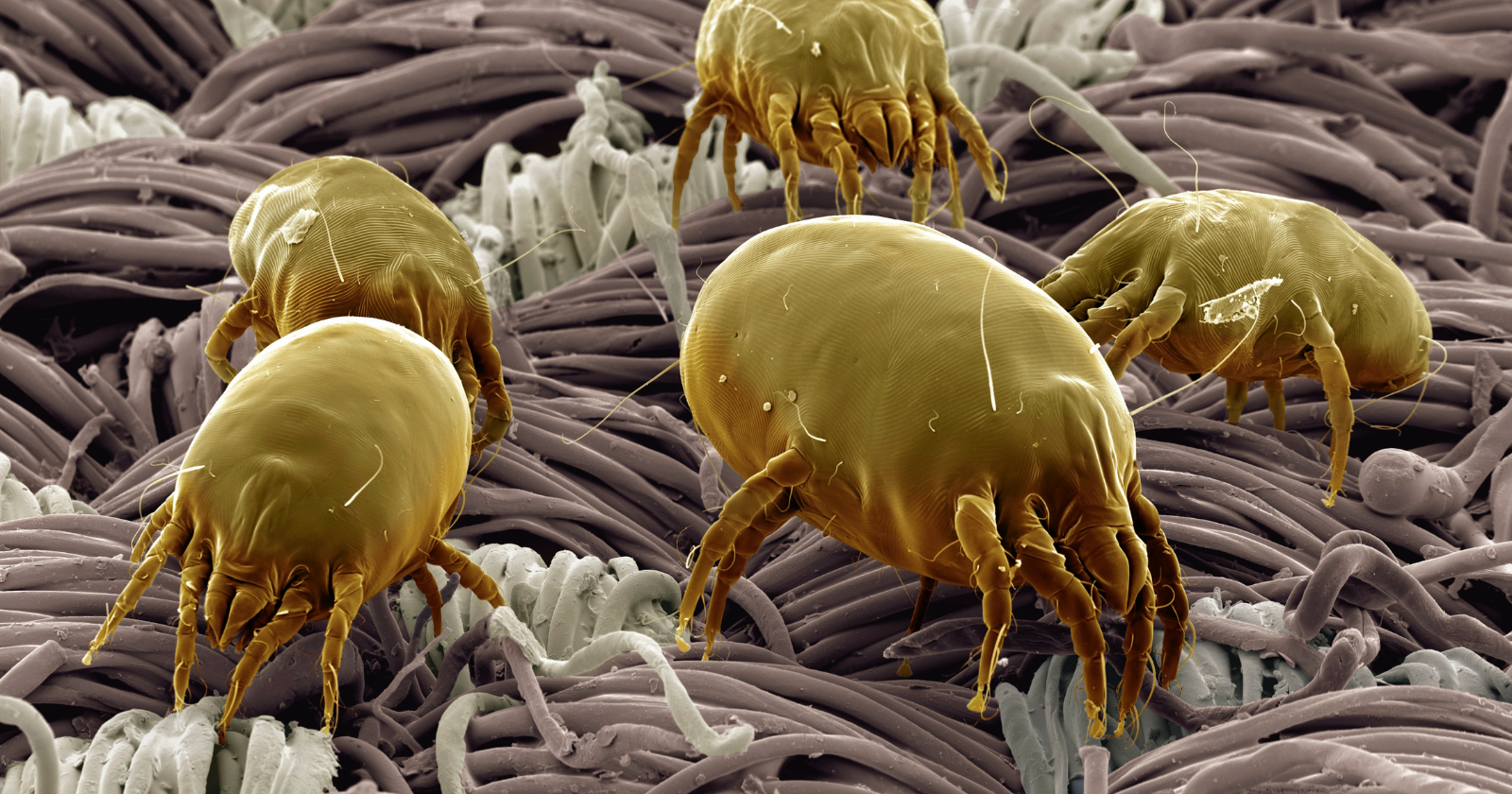
Fifty households in the Polish countryside let researchers vacuum their homes, and the tally came back at 5,340 bodies.
None of them from the bins or behind the fridge. They came out of beds, armchairs, bedroom floors and kitchen floors, the surfaces people shed skin onto all day.
Krzysztof Solarz of the Medical University of Silesia and Celina Pająk of the University of Bielsko-Biala ran the survey, published in Experimental and Applied Acarology. Their team took 250 dust samples from 50 single-family houses around Stryszawa in southern Poland across 2011 and 2012, vacuuming one square metre for a minute at five spots in every home. Each sample was soaked in ethanol and floated in saturated salt water to lift the mites clear of the grit. Every specimen was then mounted on a slide and identified under a microscope. Mites turned up in 74.8 per cent of samples.
What a gram of dust holds
Mite populations get reported as specimens per gram of dust, a convention recommended by a 1992 international workshop on mite allergens as the best available measure of exposure. In the Polish homes the average worked out at 29.9 house dust mites per gram. Counting the storage mites and other domestic species sharing the same dust pushed that to 73.8.
Top of the census was Dermatophagoides pteronyssinus, the European house dust mite, at roughly 36 per cent of everything collected. Second place went to a storage mite called Gohieria fusca, a reminder that a bedroom is no monoculture.
One hundred per gram
Thirty per gram sounds like plenty until you meet the benchmark.
Allergy researchers work with a rough figure of 100 mites per gram as the density at which exposure starts to carry a real risk of sensitisation. That is the point where the immune system decides mite protein is a threat and starts building antibodies against it. Expressed as allergen rather than animals, the same line sits at two micrograms of Der p 1 per gram. A second Polish team, reporting in Scientific Reports, sampled 16 flats in the city of Bytom. House dust mites there averaged close to 200 per gram, roughly twice the benchmark and nearly seven times the rural figure. Those flats were picked because a child in each already had asthma, so they are not a cross-section of city housing.
What that exposure does over a childhood is the harder question. A team writing in the New England Journal of Medicine followed British children from 1978 to 1989. All but one of the children with asthma at eleven had been exposed, at age one, to more than ten micrograms per gram. Relative risk came out at 4.8. Sixty-seven children, one damp stretch of the English south coast, one study.
American allergists have since grown wary of the whole idea of a cut-off. The 2013 practice parameter on dust mites, written by a task force of the two big US allergy academies, declines to name a threshold at all. No level of exposure looks entirely risk-free, its authors reason, and highly susceptible children can be sensitised well below the famous two micrograms.
Most of the allergen is in the droppings
An adult mite produces around twenty faecal pellets a day, each roughly 20 to 40 micrometres across and wrapped in a membrane carrying its digestive enzymes. Pellets account for more than 95 per cent of the allergen building up in laboratory mite cultures, with the rest coming from mite bodies and shed skins. One of those enzymes, Der p 1, is a protease that can cut the junctions between the cells lining an airway. That goes some way towards explaining why mite allergy and asthma keep such close company.
Pellets are heavy enough to settle out of the air within half an hour, so the spike in exposure arrives when somebody flips a doona or drops onto a sofa.
They drink the air
House dust mites are about 75 per cent water and they never take a sip. Glands at the base of the front legs concentrate salt, pulling water vapour straight out of the room, a trick that fails once relative humidity drops under roughly half and only works properly above about 65 per cent.
That single dependency is what every control measure leans on. Practice guidance points at a hygrometer, a humidity target of 35 to 50 per cent, weekly washing of bedding (most mites drown rather than cook, so scalding water buys little), sealed mattress covers and regular vacuuming. Chemical acaricides get an explicit thumbs down for knocking populations back only briefly while leaving pesticide on the bed.
Solarz and Pająk also found mite density rising with pets, coal stoves and less frequent cleaning. Correlations from one rural sample, not rules.
Nobody knew until 1964
For decades “house dust” was treated as an allergen in its own right, a mystery substance that set people wheezing whenever the sweeping started. Reindert Voorhorst, Frits Spieksma and Marise Spieksma-Boezeman at Leiden worked out that the active ingredient was an animal and put out a preliminary report in 1964, in an obscure East German journal, because Voorhorst refused to wait for a better venue. Plenty of allergists flatly declined to believe him.
Which makes the animal in the mattress a more recent discovery than the Beatles. Sixty years of research later, the most useful thing a household can do about it is keep the air dry enough that the mites cannot drink.