

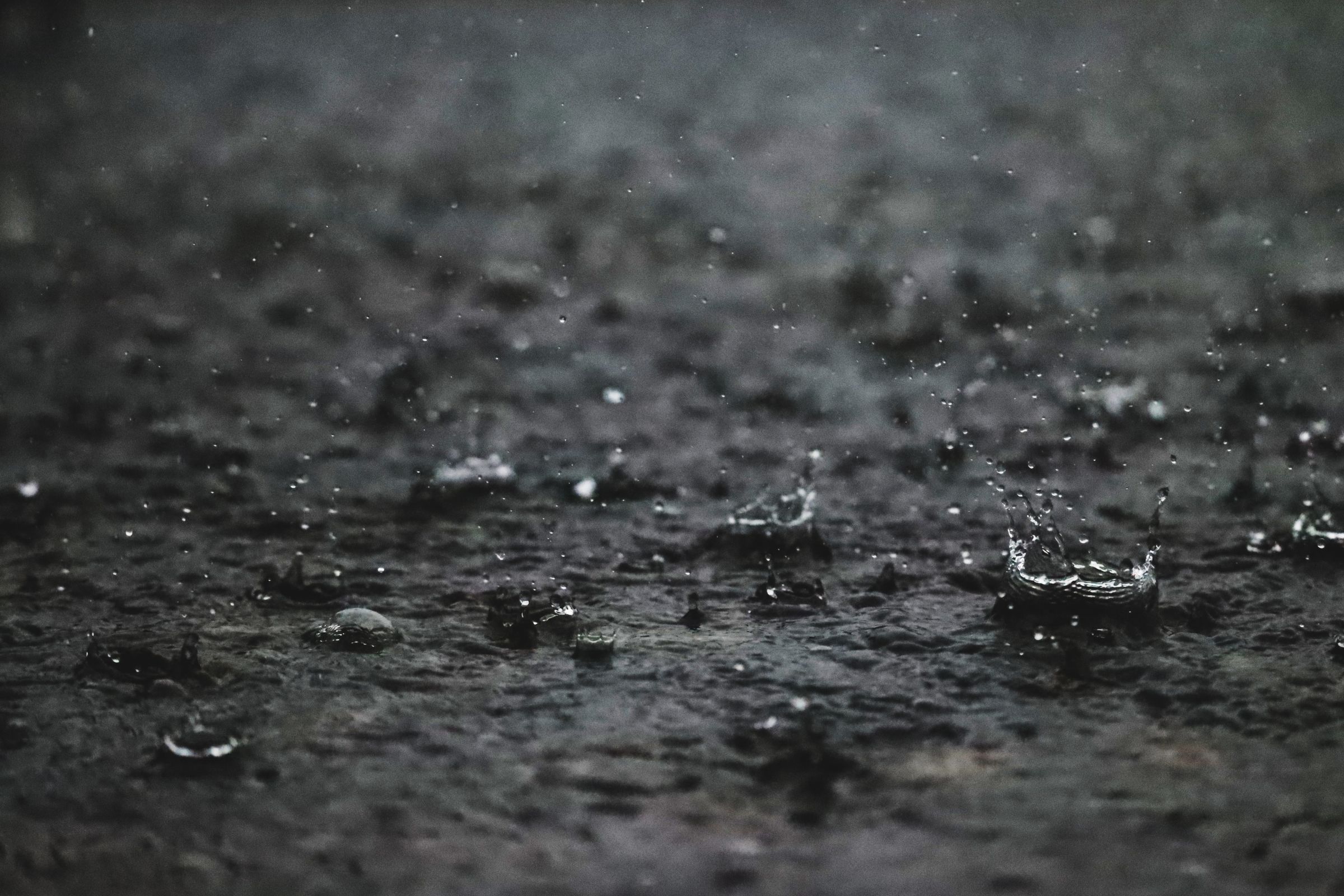
A hard downpour looks better equipped to throw material from the ground. Yet for one microscopic route into the air, a gentler impact can work better. When a raindrop lands on porous soil, it can trap pockets of air. Bubbles rise through the drop and burst, ejecting tiny droplets that may carry soil bacteria.
Researchers demonstrated that mechanism in a 2017 Nature Communications study using cultured bacteria, sterilized soils and individual drops. The work is nearly a decade old, so this is an evidence-led explanation of a revealing experiment, not a report of a new discovery.
The scope matters. Here, “light rain” means the drop-impact regime that favored bubble-made aerosols. “More” means more particles transferred by this route under controlled impacts, not necessarily more bacteria released per hour, per hectare or across an entire storm. This is one laboratory study, not settled evidence that every drizzle emits more bacteria than every downpour.
A raindrop becomes a microscopic aerosol pump
As a drop touches a partly dry, porous surface, its outer edge spreads across grains and pores. The moving contact line can leave tiny pockets of air pinned between water and soil. Those bubbles are commonly tens of micrometers wide, far smaller than the millimeter-scale drop above them.
The bubbles rise through the shallow layer. When one reaches the air-water boundary, its thin cap drains and breaks. The collapse drives a narrow liquid jet upward, and that jet fragments into aerosol droplets containing material collected from the soil-water interface.
The same family of physics appears in waves and other bursting surface bubbles, a process ScienceBlog has covered in another environmental setting. The soil experiment added a biological question: could these tiny droplets pick up living bacteria and carry them away from the ground?
An earlier 2015 study of raindrop impacts mapped the physical regime over a wider range of speeds and surfaces. Bubble-driven aerosol formation appeared under light and moderate impact conditions, but not in the heavy-rain regime tested there. The later work used the same basic mechanism to examine bacterial transfer.
More force eventually stops helping
For the bacteria experiments, the team released 2.8-millimeter water drops at speeds from 0.6 to 1.7 meters per second. Particle transfer generally rose toward a soil-specific peak around 1.4 to 1.7 meters per second, a range the researchers associated with light rain, then fell as impact speed increased.
Below that turning point, extra speed expands the wetted area and creates more opportunities to trap air. Above it, the drop flattens more violently into a thinner liquid sheet. The spreading surface can still cover more soil, but the geometry becomes less favorable for forming the bubbles that power this aerosol route.
The bacteria-loaded experiment itself did not extend into the greater than 7-meter-per-second range that the 2015 physics paper labeled heavy rain. The light-versus-heavy comparison therefore combines the bacterial transfer measurements with the broader physical map. It is not a direct bacterial census beneath two matched natural storms.
Drop speed is also not the same as rainfall intensity. A storm’s intensity depends on how much water falls across an area and time, while natural rain contains many drop sizes and impact speeds. Heavy rain can add direct splash, rapid saturation and far more water, all of which complicate any storm-wide comparison.
The soil decides whether bubbles can form
The researchers tested six soils: two clays, two sandy clays and two sands. Sandy clay produced the most bioaerosols. Clean sand absorbed the drops so quickly that the liquid could not trap and carry bubbles in the same way, and no bioaerosol was detected from the sandy samples in these tests.
That result is a warning against treating “soil” as one material. Pore size, particle size and the rate at which water enters the ground control how the drop spreads. Two surfaces under the same shower can therefore produce very different particle yields even before bacterial abundance is considered.
Moisture changes the route too. The experiment focused on partly dry surfaces. Once repeated drops create a water film, direct splashing can become the dominant way material leaves the ground. Continued rain can also capture suspended particles and return them to the surface, a process known as washout.
Surface temperature had a surprisingly large effect. The study found soil-dependent optima generally around 20 to 40 degrees Celsius, with particle transfer differing by as much as a factor of ten between favorable and unfavorable temperatures in some comparisons. Viscosity, surface tension and wetting behavior all change with temperature.
The bacteria survived the launch
The team sterilized its soils, added known concentrations of Corynebacterium glutamicum, Bacillus subtilis or Pseudomonas syringae, and allowed the prepared surfaces to dry for 25 minutes. The three species were chosen because they could be cultured and counted, not because they represented every organism found outdoors.
A collection plate sat 10 millimeters above the soil, with an opening through which the drop could fall. High-speed imaging recorded bubble formation and aerosol ejection. The plate captured the launched droplets, and the researchers then grew colonies to determine whether viable bacteria had arrived.
All three strains remained culturable after an hour. That is useful evidence that the impact and bubble burst did not automatically kill every cell. It does not establish how long the organisms would survive outdoors or how far they might travel.
Culturability is also much narrower than proof of infection. The study did not test disease transmission, and its three strains were handled as nonpathogenic laboratory organisms. Sunlight, changing humidity, wind, dilution and prolonged atmospheric exposure were outside the experiment.
What one favorable drop could carry
On clay and sandy clay, a single impact generated more than 100 aerosol particles smaller than 10 micrometers in some observations. Higher-magnification imaging also revealed submicron droplets. Particles in this size range can remain suspended longer than visible splash droplets, although the experiment did not follow their outdoor trajectories.
The study estimated that one favorable drop could transfer about 0.01 percent of the bacteria present on the relevant soil surface. That fraction sounds tiny, but rainfall acts over a vast number of impacts and enormous areas. It remains a conditional laboratory value, not a universal emission factor.
Individual aerosol droplets contained anywhere from no detected bacteria to several thousand cells, depending on soil type, surface concentration, temperature and impact speed. The wide span is part of the finding. A single average cannot describe every bubble or every patch of ground.
A 2016 field and irrigation study found that submicron soil-organic particles made up as much as 60 percent of atmospheric particles after some rain events. That supports rain-driven soil aerosolization outdoors, but it did not count live bacteria or compare light with heavy rain.
A global estimate with a deliberately wide range
Combining rainfall, land area and bacterial-density assumptions, the authors estimated that raindrop impacts might aerosolize 1.2 × 10²² to 8.5 × 10²³ bacterial cells worldwide each year. They compared that with roughly 1.6 to 25 percent of prior estimates for bacterial emissions from land.
The figures are an extrapolation, not an atmospheric census. The authors explicitly treated the estimate as an upper bound because successive rain can wash aerosols out. Uncertainty in bacterial surface density, soil coverage, moisture and the share of impacts that enter the favorable regime widens the gap further.
The mechanism could matter to atmospheric chemistry, ecology and the movement of microorganisms, but those consequences were not measured here. Similar care is needed when comparing it with bacteria carried in sea-spray aerosols. Showing how biological material becomes airborne is not the same as demonstrating a climate or health effect.
Natural ground is also far more diverse than a sterilized surface seeded with one strain. A previous ScienceBlog look at the density of life in healthy soil helps show why identifying which organisms are launched, in what state, is a separate problem from proving the transport mechanism.
What field measurements still need to resolve
The experiment did not measure an undisturbed landscape through a storm. It could not determine whether natural bacterial communities leave soil at the same rates, whether bubble bursting or splash dominates after the first minutes, or how wind and vegetation alter what reaches the open air.
A rigorous field comparison would track drop-size distributions, impact speed, rainfall rate, soil texture, antecedent moisture, temperature and airborne cells together. It would need to distinguish new emissions from background particles and measure both upward launch and rain-driven removal.
The strongest result is therefore narrower, and more interesting, than a simple claim that drizzle is dirtier than a downpour. A mild impact can be better than a hard one at trapping and bursting the bubbles that carry bacteria. Turning that per-drop mechanism into a storm-scale bacterial budget remains the unsolved part.