

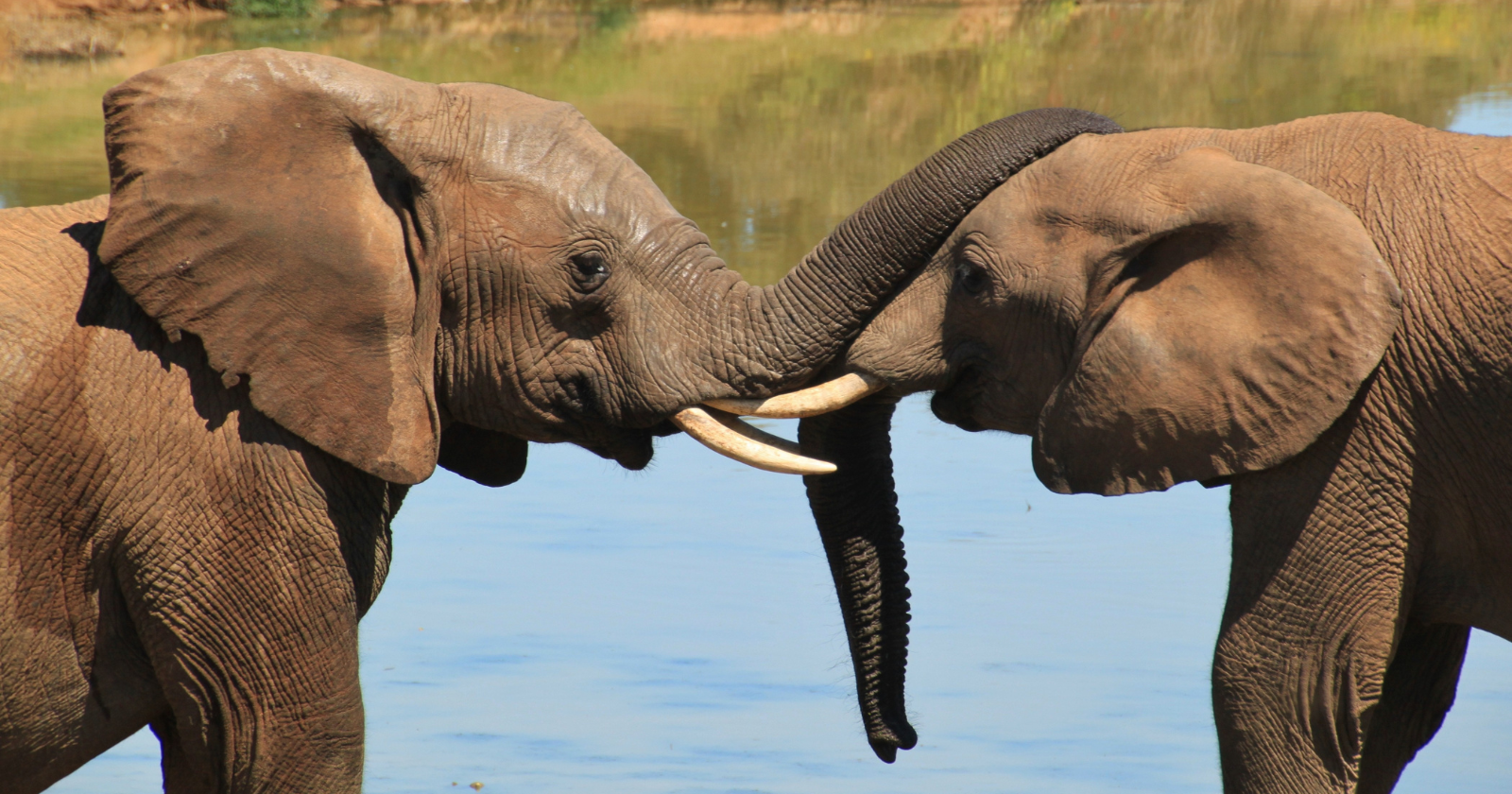
Picture three tonnes of elephant standing dead still in teak woodland at three in the morning, trunk hanging limp, eyes shut. That is what elephant sleep looks like, and it is over faster than a feature film.
Two matriarchs in Botswana’s Chobe National Park wore the trackers, and over 35 days they logged less sleep than any mammal on record.
The trunk is the tell
An elephant’s trunk holds about 113 kilograms of muscle. Paul Manger of the University of the Witwatersrand offered that figure in an interview with Science News Explores, explaining why an implant the size of a wristwatch goes unnoticed in there. All that muscle sniffs, swats, strips bark, tests the wind and pesters the calves, more or less without pause. When it goes still, something unusual is happening.
That insight dates back to observations of circus elephants in the 1930s, but it was useless on animals roaming free. Nadine Gravett, Manger and their colleagues managed it with an actiwatch, the motion logger strapped to human wrists in sleep clinics, implanted under the skin of each elephant’s trunk about 150 centimetres from the tip. Each matriarch also wore a collar carrying GPS and a gyroscope, which separated standing from lying down.
Five minutes or more of a completely motionless trunk counted as presumed sleep.
Two hours, taken in pieces
Over the recording period the pair averaged two hours of sleep a day, a finding published in PLOS ONE in 2017. One matriarch managed 2.3 hours, while the other, nursing a calf under a year old, managed 1.8. Captive elephants in zoos and circuses had been clocked at three to nearly seven hours, roughly what body size alone predicts.
Almost none of it came in one go. Sleep arrived in about five separate bouts: one main episode of roughly an hour, plus a scatter of short ones around it. Nearly all of it fell between 2am and 6am, and both animals woke before sunrise every time they slept.
Sunrise was the wrong thing to watch. Temperature and humidity, combined into a single measure called wet-bulb globe temperature, predicted waking times far better than light did, explaining about 94 per cent of the variation. The pair also chose a fresh bed each night, never once returning to an old sleep site.
Wild animals routinely sleep less than captive ones. Three-toed sloths fitted with portable brain recorders in a Panamanian rainforest slept 9.63 hours a day, more than six hours short of the captive figure, work published in Biology Letters by Niels Rattenborg’s group at the Max Planck Institute for Ornithology. Two hours is still an outlier. No mammal measured so far sleeps less.
Lying down is the rare part
Elephants sleep standing up, propped on their own architecture. Standing back up costs an animal that size real effort, and the gyroscope caught each matriarch lying down on ten of the 35 nights apiece, and not the same ten.
In the only detailed account of dreaming behaviour in elephants, Irene Tobler’s work on captive animals in the early 1990s, the twitches and jerks associated with REM sleep turned up only in elephants lying down. If the same holds in the wild, these two had a shot at dreaming every third or fourth night at best, with one stretch of nine nights offering no chance at all.
Elephant memory is proverbial and reasonably well evidenced, which makes the arithmetic awkward for theories that hang memory consolidation on nightly REM sleep. Nobody has recorded brainwaves from a wild elephant, though. Up to 30 centimetres of honeycombed sinus sits over the brain, and the surgery would be brutal. Trunk stillness is a proxy, and the researchers say it probably flatters the true figure.
The nights nobody slept
Across the 70 elephant-nights recorded, five produced no sign of sleep at all, spread over four dates.
On 17 April neither animal slept. The clearest case came on 8 May, when one matriarch’s movement speed jumped at about half past four in the afternoon and stayed high until five the next morning. In roughly ten and a half hours she covered 41.68 kilometres, putting 36.61 kilometres of straight-line distance between herself and wherever she started. Gaps between proper sleep bouts ran to about 46 hours.
Three explanations fit. Chobe holds lion prides with an unusual taste for elephant, and John Power and Shem Compion, writing in African Zoology, documented a pride of about 30 lions killing one elephant every three days in the late dry season, mostly youngsters who travel with a matriarch’s herd. Poachers are the second candidate. The third is a bull in musth harassing a herd holding females in oestrus, which would account for the distance and the persistence alike.
Then comes the twist: almost no catch-up. Sleep afterwards looked much like sleep beforehand, with only one of the five episodes followed by longer nights and only one by extra time on the ground. Wild olive baboons in Kenya, tracked with collars in a study published in eLife, did something similar after a leopard attack drove them to a new tree. They lost sleep and never obviously paid it back.
The limits of the data
All of this rests on two animals, both matriarchs, one of them nursing, watched across five weeks of mild autumn weather. No males, no juveniles, no dry-season extremes, no second site. Whether the species as a whole sleeps this little is a question for the next set of collars, and the authors are candid about that rather than defensive.
The headline number may even be generous. Motion loggers overestimate rest, because idling on the spot looks identical to dozing, which makes two hours a ceiling rather than a typical night.
Which leaves a better question than the one everybody asks. Forget how little a matriarch sleeps, and start wondering what a herd does when the animal leading it has been awake for two days.