

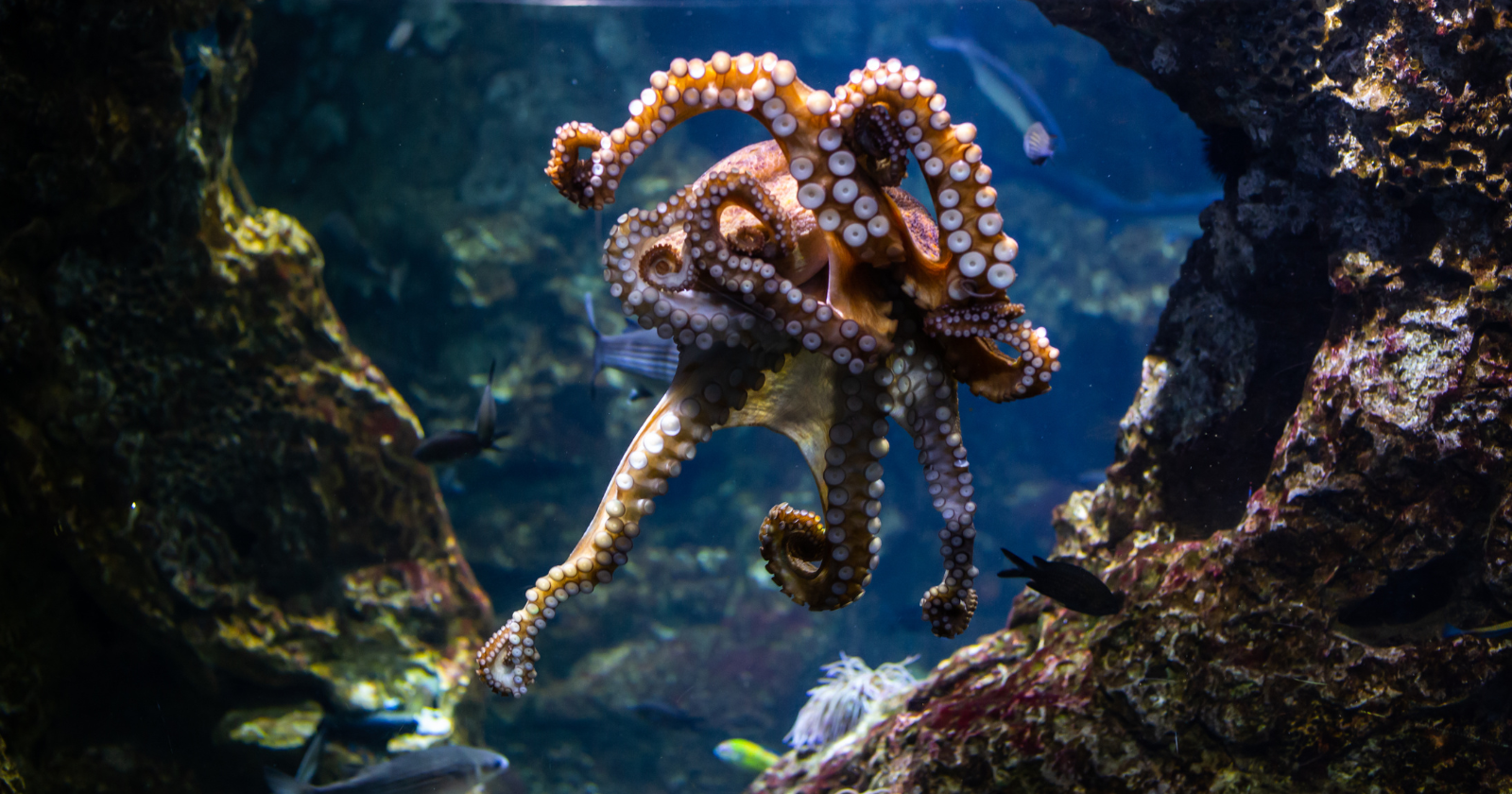
Seventeen metres down in Jervis Bay, the neighbours throw mud.
Shells and the odd clump of seaweed go flying too. In 21 hours of footage from GoPro cameras left on tripods in January 2015, roughly ten gloomy octopuses (Octopus tetricus) launched debris through the water 102 times, and 17 shots hit another octopus. A paper in PLOS ONE led by Peter Godfrey-Smith of the University of Sydney logged every one, the first formal description of throwing by any octopus.
How an octopus throws without a throwing arm
How does an animal with no shoulder and no bones pitch anything? Mostly with plumbing. An octopus gathers material in its arms and holds it against the web, the sheet of skin joining the arms at their base. It then swings its siphon, the flexible funnel it uses to breathe out and to jet away from trouble, down beneath that web between its two rearmost arms, and fires a hard blast of water as the arms let go.
The arms aim and the jet supplies the power. A strong blast can carry silt or shells several body lengths in still water, while a feeble one barely clears the doorstep. That tucked-under siphon is an unusual posture, part of why the researchers read the behaviour as purposeful.
Most of the throwing was housework
About a third of all throws happened during den cleaning, and another 8 per cent cleared away the leftovers of a meal. Just over half, though, came within two minutes of a run-in with a neighbour: a scuffle, a mating attempt, a probing arm. Females did almost all of it, 90 of the 102 throws, with two of them responsible for two-thirds.
Hardware took fire too. When one camera was set up closer to the dens than usual, the nearest octopus sent six throws its way over roughly 100 minutes and hit the tripod twice.
The case for aim, and its limits
“I think it is likely that some of the hits are deliberate,” Godfrey-Smith told National Geographic, and the paper lays out why. Throws made mid-encounter were harder than housekeeping ones and more often used silt.
Colour tells part of the story. Throws from octopuses in uniform colouring, especially dark, were more vigorous and landed more often. Earlier work in the bay tied darkening to aggression; in a 2016 University of Sydney release, Godfrey-Smith called colour change a signal of how aggressive an animal is.
Then there is the choice of exit. Most throws leave between the two front arms. Sometimes an octopus used a different pair, changing the angle, and those off-centre throws connected 43 per cent of the time, against 13 per cent for the standard version. Late on the longest filming day, one female threw 17 times in about an hour and landed nine hits, eight on the same neighbour, who at times raised an arm between them just before a throw.
None of that settles intent, and the authors say so. The team never saw a struck octopus throw back or a hit spark a fight, and some throws in heated moments sailed into empty water. The paper adds octopuses only provisionally to the short list of animals that aim at others. Writing in Learning & Behavior, Cambridge psychology researcher Alexandra Schnell argued an accidental-hit explanation struggles with the arm switching, the female bias and the colour link, though she treats intent as an open question. It is also one paper, from one site, built on about ten animals.
A male who learned to duck
In December 2016, a camera caught a female whose male neighbour in the next den kept trying to mate with her. In just over three and a half hours she let fly at him ten times, always with silt in the mix, and five connected. He ducked four times. His first two ducks came after the silt had left her arms, and the last two came earlier, while she was still winding up.
He had started reading the wind-up.
Throwing at members of the same population is rare enough that the paper’s precedents are all social mammals, chimpanzees, capuchins and dolphins among them. A 2013 study of bearded capuchins by Tiago Falótico and Eduardo Ottoni described females in a Brazilian national park pelting high-ranking males with stones during courtship. At Jervis Bay the roles ran the other way, with the courting male on the receiving end. Chelsea Bennice, a Florida Atlantic University marine ecologist outside the study, suggested in the same coverage that throwing may help octopuses manage close-quarters living.
Crowding is the backdrop to all of this. Food here is plentiful and good shelter beyond the site is scarce, so animals that normally hunt alone end up packed together, with throwing also recorded at a second high-density site nearby. The obvious next step is filming octopus neighbourhoods elsewhere, with the tripod parked a respectful distance from the dens.