

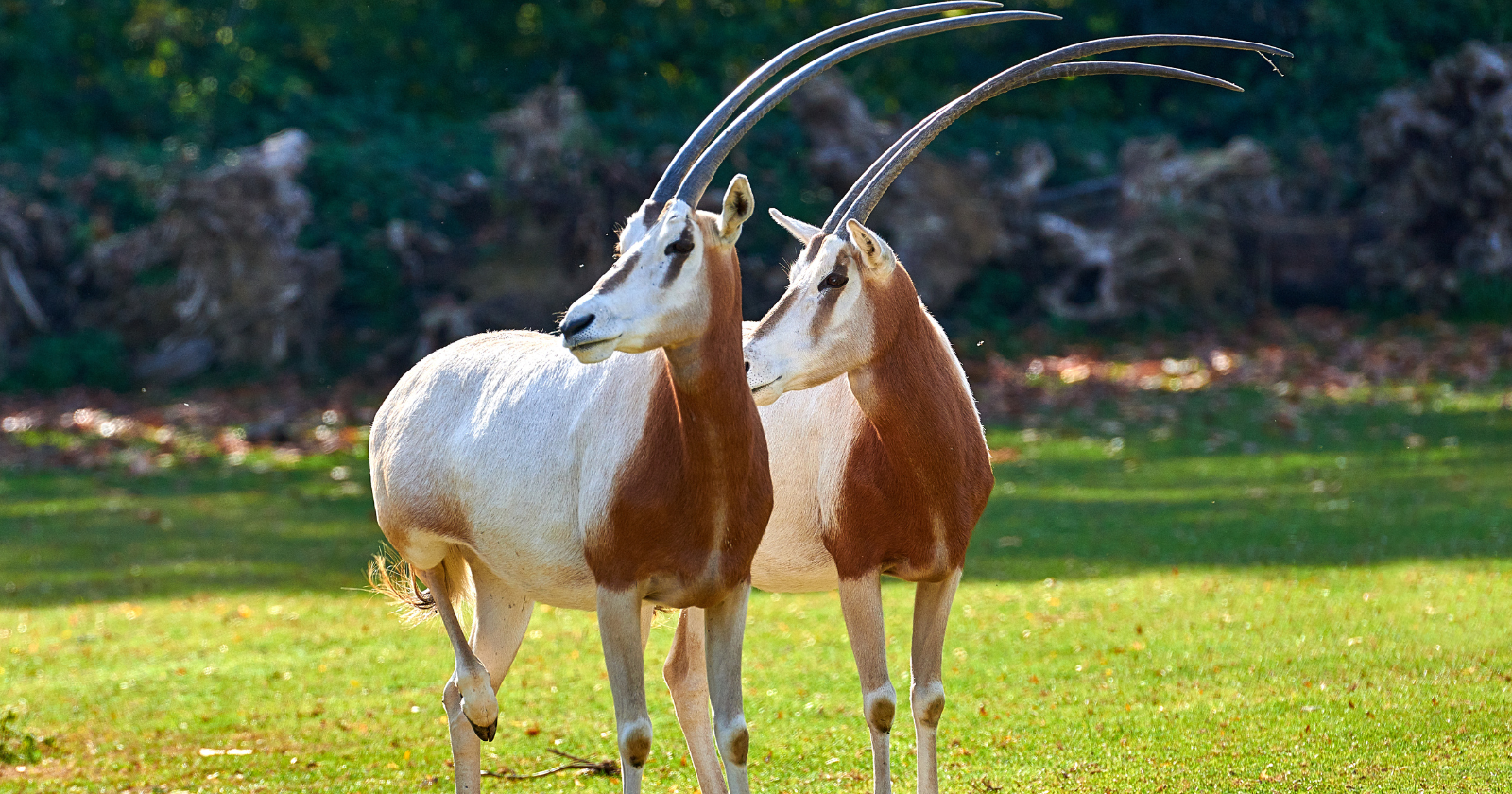
For about a quarter of a century, the scimitar-horned oryx existed everywhere except the one place it belonged.
A striking desert antelope — pale, with long curved horns that arc back like the sabres it’s named for — it once roamed North Africa’s grasslands in vast herds. Then hunting and drought erased it from the wild, and in 2000 the IUCN made it official: Extinct in the Wild. There were still thousands of them alive. Just not one of them free.
The species that lived only in captivity
“Extinct in the Wild” is one of the strangest categories in conservation — it means a species survives solely in zoos, ranches and breeding centres, with zero wild population. For the oryx, that safety net turned out to be enormous.
Even as the last wild ones vanished, the animal thrived behind fences. More than 220 zoos and breeding institutions around the world held scimitar-horned oryx, a scattered global population descended from animals taken into captivity decades earlier. The species wasn’t gone; it was warehoused — grazing paddocks in Texas, Europe and the Gulf while its homeland sat empty. The problem was no longer survival. It was reassembly: how to turn a scattered captive stock back into a wild herd.
Building a herd to send home
The answer was built in Abu Dhabi. Inspired by the conservation legacy of the UAE’s founding leader, the Environment Agency – Abu Dhabi assembled what conservationists call the “World Herd” — a genetically diverse breeding population drawn from those 220-plus institutions, deliberately mixed so the future wild herd wouldn’t collapse through inbreeding.
The Royal Zoological Society of Scotland ran genetic testing to pick the right founders; the Smithsonian, the Zoological Society of London, Saint Louis Zoo and the nonprofit Sahara Conservation joined a partnership with the government of Chad. And Chad supplied the destination: the Ouadi Rimé-Ouadi Achim Faunal Reserve, a protected wilderness of more than 78,000 square kilometres — one of the largest in the world — in the Sahelian grasslands where the oryx had last been seen.
Then, in 2016, the airlift began. A first group of 25 oryx was crated, flown from Abu Dhabi to central Chad, fitted with GPS satellite collars, and — after a period in holding pens to acclimatise — released onto the open Sahel, the first wild scimitar-horned oryx in roughly 25 years.
From 25 to 600
The desert took them back fast. The very first calf born in the wild arrived in December 2016, just months after release — proof the animals could not merely survive but breed on their old ground.
From there it compounded. Over the following years the program flew and released some 285 oryx in total, and the wild-born generations did the rest: more than 500 calves born in the reserve, and a wild population that has now grown past 600 self-sustaining animals. In 2023, the IUCN did something it had almost never done for a large mammal — it moved the scimitar-horned oryx up the Red List, from Extinct in the Wild to Endangered.
“Endangered” still sounds grim, and it is. But it is a promotion. It means the species now has a wild population substantial and self-sustaining enough to be judged on its own two feet again — the difference between a museum specimen and a living wild animal. Going from Extinct in the Wild to merely Endangered is one of the rarest upgrades in the whole of conservation.
What the comeback actually proves
It’s worth being clear-eyed about what happened here, because it cuts against the usual extinction story.
The oryx’s recovery was not a lucky accident of nature healing itself. It was manufactured, deliberately and expensively, over decades — a captive gene pool curated across three continents, genetic testing to avoid a bottleneck, an airlift, satellite collars, holding pens, and years of on-the-ground monitoring in a remote reserve, funded largely by a Gulf state. Take away any piece of that machine and the oryx is still a zoo animal. The wild herd exists because people built the conditions for it to exist.
That’s the hopeful part and the sobering part at once. Extinction in the wild was reversed — the category is not always a one-way door, and a species can be rebuilt from captive stock and posted back to its homeland if enough institutions cooperate for long enough. But it took a coalition of zoos, agencies and a national government the better part of two decades to reinstall a single antelope in a single reserve. The scimitar-horned oryx grazing the Sahel today is proof that “extinct in the wild” need not be the end — and a measure of exactly how much effort it takes to earn back the word “wild.” The herds that once managed themselves for free now exist because someone kept the receipts, tested the genes, and booked the flights.