

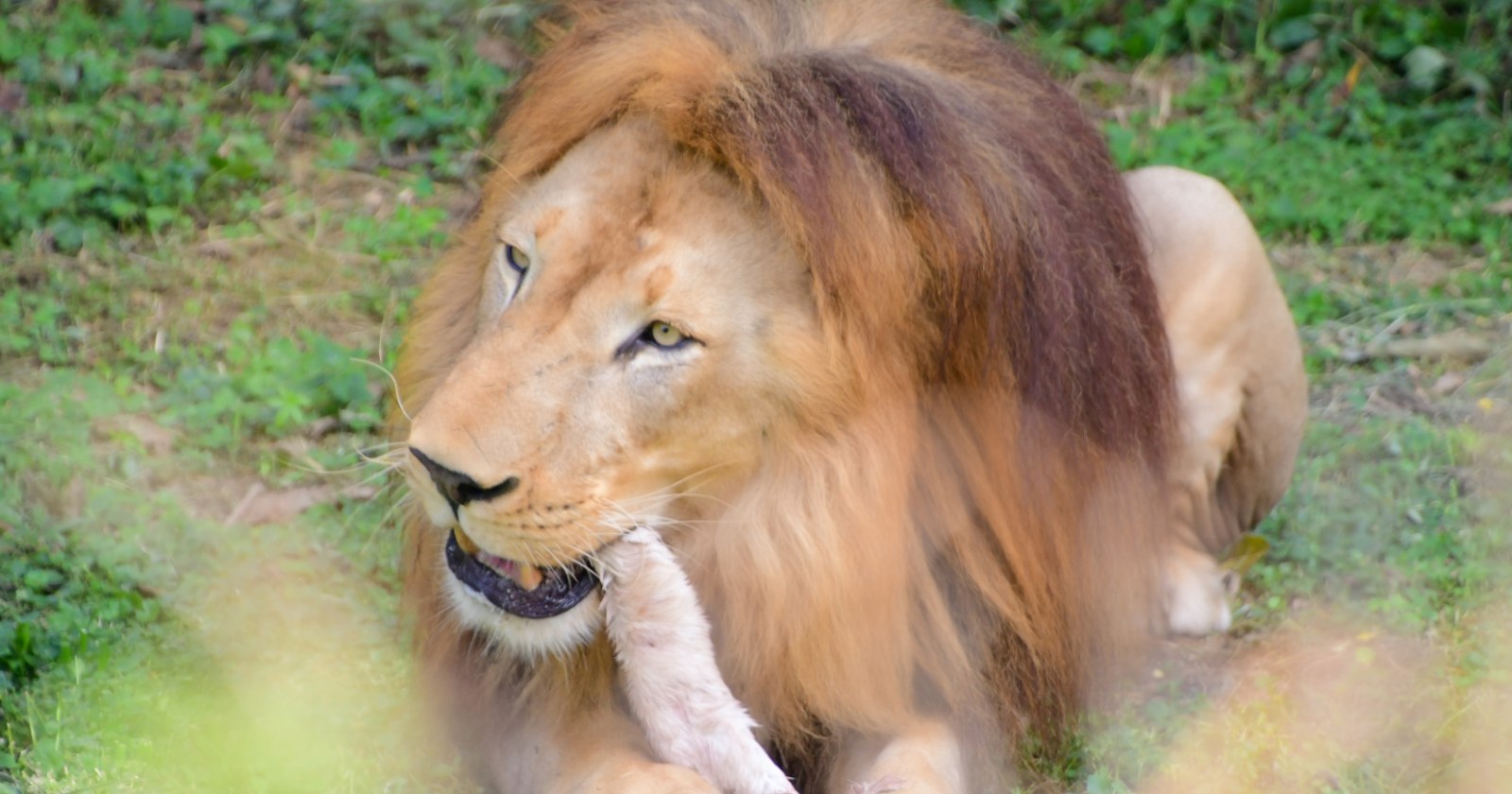
Adult male lions given about 200 kilograms of whole carcasses every nine days at Monarto Safari Park in South Australia spent almost three times as long feeding on carcass days as they had on their usual diet, and across the carcass-feeding months spent about twice as much time lying down. The study followed three males, all aged nine, with cameras recording around the clock for three months. Their pacing also went up over the trial, which the researchers had expected to go down.
The work, whose lead author is Lesia Hryhorenko of Adelaide University’s School of Animal and Veterinary Sciences and whose co-authors include Monarto Safari Park staff, was published in Applied Animal Behaviour Science. It describes how the lions’ behaviour reorganised itself around a feast-and-fast schedule. The authors are careful to say it documents behaviour and does not demonstrate that the lions were better off.
The study ran from 10 February to 10 May 2025. For the first four weeks the three males ate the park’s standard diet of horse, deer, rabbit, turkey and pig, mostly as cut portions or partial carcass sections. For the next eight weeks keepers instead placed whole kangaroo or goat carcasses, about 200 kilograms in total per feed, in an off-exhibit yard, typically between 9 and 10 in the morning.
The carcasses stayed available for two to three days and were then removed, leaving six to seven days without food before the next one. The authors cite earlier work reporting that lions in the wild typically feed every 1.5 to 2.5 days but have been seen fasting for up to eight.
Eight infrared cameras recorded a 10-second clip every five minutes, day and night. Two trained observers scored the footage, and on the 23.5 percent of sessions that both scored, their agreement averaged above 97 percent. Because individual lions could not be reliably told apart on camera, behaviour was scored for the group as a whole rather than for each animal.
Almost three times as long at the carcass
On the carcass days analysed, seven in the paper’s count, at least one lion was feeding for an average of 76.4 minutes a day, against 25.7 minutes a day at baseline, a ratio of just under three. The university’s news release says the lions spent “almost three times longer feeding than they normally would”. The lions began eating on average 16.4 minutes after the carcasses went in, and fed in more frequent bouts than before.
The span between the first and last feeding scan after a carcass went in stretched to as long as three hours and 35 minutes. The lions also ate at the same time far more often: scans with two or more lions feeding rose from 1.2 percent at baseline to 19.0 percent on carcass days. The authors add, as an anecdotal observation, that the three males usually split up to eat, each taking a carcass of his own rather than working on one together.
Feeding did not rise as a monthly average in a way the statistics could confirm. The measure tended to be higher in the first month of carcass feeding, but the overall effect across months was not significant. The increase shows up when carcass days are compared with baseline days, and within the carcass months feeding was concentrated in the first three days of each cycle.
A nine-day rhythm of lying down and moving
On days one to three of each cycle, which the paper treats as the feeding days, lions were recorded lying down in 52.5 percent of scans. That fell to 30.4 percent on days four to six and 17.0 percent on days seven to nine. Averaged by month, lying down roughly doubled, from 15.8 percent at baseline to 34.9 and 32.8 percent in the two months of carcass feeding.
Walking about moved the other way. It was lowest on days one to three, at 1.53 percent of scans, rose to 3.08 percent in the middle of the fast and stayed slightly raised at 2.39 percent near its end. The authors compare this with wild lions, which alternate heavy feeding with long spells of reduced activity broken by searching or waiting.
Pacing rose over the study instead of falling as predicted
Pacing, the back-and-forth walking along a fixed route that is often interpreted as a stereotypic behaviour in captive carnivores, did not follow the script. Based on earlier work, the team expected it to fall once carcass feeding began, while noting that any change might depend on the length of the study and the gap between feeds. Instead it rose, from 1.79 percent of scans at baseline to 3.83 percent in the second month of carcass feeding, a difference that was statistically significant.
The university’s release describes this as pacing that “increased slightly over the course of the study”. In the paper’s own figures it more than doubled, although from a low starting point, and both numbers describe the group rather than any one lion.
What pacing did not do was change significantly across the nine-day cycle. Averages went from 2.26 percent on days one to three to 3.78 and 3.81 percent on the later days, differences the statistical models did not find significant.
Plotted hour by hour, pacing peaked around 9 to 10 in the morning and 3 to 4 in the afternoon, when keepers arrived and moved the lions between enclosures. The authors read this as anticipation of predictable routines rather than a build-up driven by the fast.
The paper handles this point unevenly. Its abstract says pacing “rose toward the end of each nine-day interval, suggesting increasing anticipation before feeding events”, while its results describe that rise as small and not statistically significant, and its discussion refers to “the absence of escalation across fasting days”.
This article follows the results. The authors also note that their scoring could not separate pacing from other repetitive or potentially goal-directed movement, such as patrolling.
A control group that differed from the start
The study had four other lions, two males aged three and two females aged five, kept on the usual diet as a comparison. During the baseline month the two groups already behaved differently: the test males spent much less time inactive and more time active than the control lions.
The authors therefore did not compare the groups once carcass feeding began. The comparisons with baseline are before-and-after changes in the same three males, and the cycle comparisons are made within the carcass months.
That leaves other explanations open. When carcass feeding started, the three males were also kept out of public feeding encounters and moved between enclosures on a different pattern, which the authors say “may have contributed to some changes in pacing or visibility”. At night the lions were often in a large exhibit where parts of the ground were out of camera view. A check in the paper’s appendix found no significant link between time out of sight and recorded pacing, but it tested pacing only, and the paper notes that resting and lying down could also happen out of view in the larger enclosure.
Because the conclusions rest on changes within three males of the same age, the authors write that this “limits generalization to other social structures, such as mixed-sex groups or prides”. The results also come from one facility and a single three-month stretch from late summer into autumn, scored for the group rather than each lion.
The authors add that “behavioural change alone cannot be used to infer welfare outcomes”. They also report, without giving figures, that no increase in aggression or social instability was seen around the carcasses.
Why the authors question treating carcasses as mere enrichment
The release frames the study as showing that carcass feeding “encourages behaviours more closely aligned with those seen in the wild”. The paper goes further in its introduction, questioning whether whole carcasses should be treated only as enrichment. For obligate carnivores that evolved to eat whole prey, the authors write, providing carcasses “could be argued to represent a core component of meeting biological and behavioural needs rather than an optional ‘extra'”.
Their concern is with the label. Framing carcass feeding solely as enrichment, they argue, “risks lowering the perceived welfare baseline by implying that less natural feeding methods constitute an acceptable standard of care, rather than distinguishing between fundamental feeding requirements and additional forms of environmental stimulation”.
The three males at Monarto went from cut portions and partial carcass sections to whole kangaroo and goat carcasses, and the study’s own data cannot say whether that made their lives better. What it records is that they fed, rested and moved to a nine-day clock, set by the carcasses and by the changes in where they were kept that came with them.