

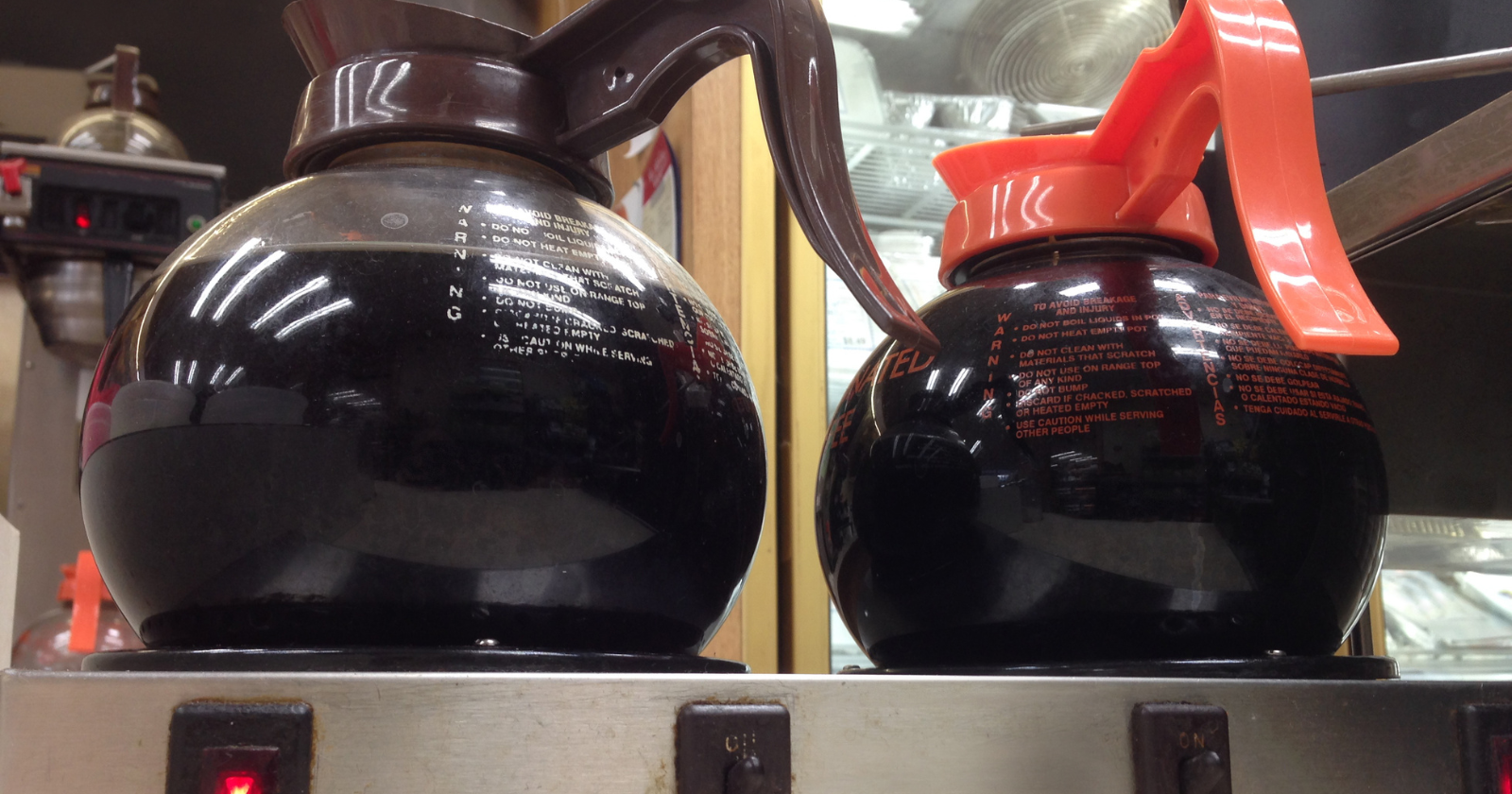
Every livestream, video call and doorbell camera on the planet has a common ancestor, and it spent its working life staring at a pot of filter coffee.
In late 1991, a camera clamped to a retort stand (the metal pole and clamp that holds flasks and test tubes in school chemistry labs) was aimed at a coffee machine in a corridor of the University of Cambridge Computer Laboratory. Its goal was modest. Nobody wanted to climb the stairs for nothing.
Quentin Stafford-Fraser, one of the researchers behind it, set out the problem in a short biography of the Trojan Room coffee pot first published in 1995. About 15 people shared a single machine outside a part of the lab known as the Trojan Room. Colleagues elsewhere in the building had to tackle several flights of stairs to reach it, and often found the room’s all-night regulars had got there first.
Turning a spare frame-grabber into a coffee monitor
What does a research group do with a frame-grabber gathering dust? A frame-grabber is a circuit board that pulls still pictures out of a video signal, and one was sitting unused on a test computer in the room. The team ran the camera cable under the floor to it. Paul Jardetzky wrote a server program to capture the images, and Stafford-Fraser wrote a client program that anyone in the group could run, which put a thumbnail of the pot in the corner of their screen. In plain terms, the server did the watching and the client did the showing.
Pictures refreshed about three times a minute, which suited a pot that filled slowly. They were also greyscale, a shortcoming Stafford-Fraser waved away because, in his words, “so was the coffee.”
Assembling the rig took a day or so. He later rated it more useful than anything else he produced during that stretch of networking research, and a much easier sell at dinner parties than the day job.
Putting the pot on the web in 1993
Early web browsers could only display text. That changed in 1993, when a program called Mosaic arrived with the ability to show images, as Stafford-Fraser recalled in a 2001 essay for Communications of the ACM, a magazine published by the Association for Computing Machinery.
The team then twigged something that sounds obvious today: a web server doesn’t have to send back the same picture every time it is asked. Daniel Gordon adapted the coffee server to do exactly that, so each visit to the page fetched a fresh snapshot. In November 1993, with help from Martyn Johnson, he put it online, and the coffee was open to inspection from anywhere with an internet connection.
The lab’s coffee pot page, still hosted on the university’s servers, carries a couple of housekeeping notes. A small lamp was usually left pointing at the pot so night-time viewers could see it, and anyone hoping to drink the stuff needed to join the coffee club first, travel costs not included.
Traffic snowballed. By around 1996 the image had passed a million hits, and one journalist pointed out that the pot had drawn more “visitors” than King’s College Chapel, making it, on paper, the top tourist attraction in East Anglia. Two million followed in 1998, per a timeline kept by Stafford-Fraser.
Selling a broken coffee machine on eBay
“It leaks water and we’ve cut off the mains plug.”
So ran the eBay listing in August 2001, as reported by The Register. The lab was moving to new premises, and the machine on offer, a Krups ProAroma owned by the coffee club rather than the university, had stopped working. Several pots had taken a turn on camera over the years, and this one had served longest, starring from October 1997 until March 2001. Club members hoped it might fetch a few hundred pounds, enough for a decent espresso machine.
Spiegel Online, the website of German news magazine Der Spiegel, won with a bid of £3,350. Tim Hill, who organised the sale, joked that the priciest coffee maker he could now find on the web was the one they had just sold. Stafford-Fraser’s timeline records that the money was meant for coffee facilities in the new building.
The last frame and a second life in Germany
At 10.54 on 22 August 2001, three people reached for the power switch on the Acorn Archimedes computer that had been capturing the pictures. The camera’s final image shows their fingers pressing it, closing a web run of seven years and nine months.
In the ACM essay, Stafford-Fraser explained why it had to go. The ageing hardware was the last surviving piece of the lab’s home-built network and increasingly hard to keep alive, and the Trojan Room itself would disappear once the lab moved to West Cambridge. News of the shutdown brought the pot its biggest burst of publicity yet, including front-page coverage in the London Times and the Washington Post. His conclusion was that nobody makes headlines by putting something online any more. Switching it off, on the other hand, works a treat.
The machine went to Hamburg along with its camera, a coffee grinder and other memorabilia, and Krups got it brewing again, as recounted by the Heinz Nixdorf MuseumsForum, a computer museum in Paderborn. The pot has been on permanent loan there since 2016, sitting in an eleven-metre wall display on the history of the internet with a live camera trained on it once more.
For an actual cup, the museum’s blog directs visitors to the café on the ground floor.