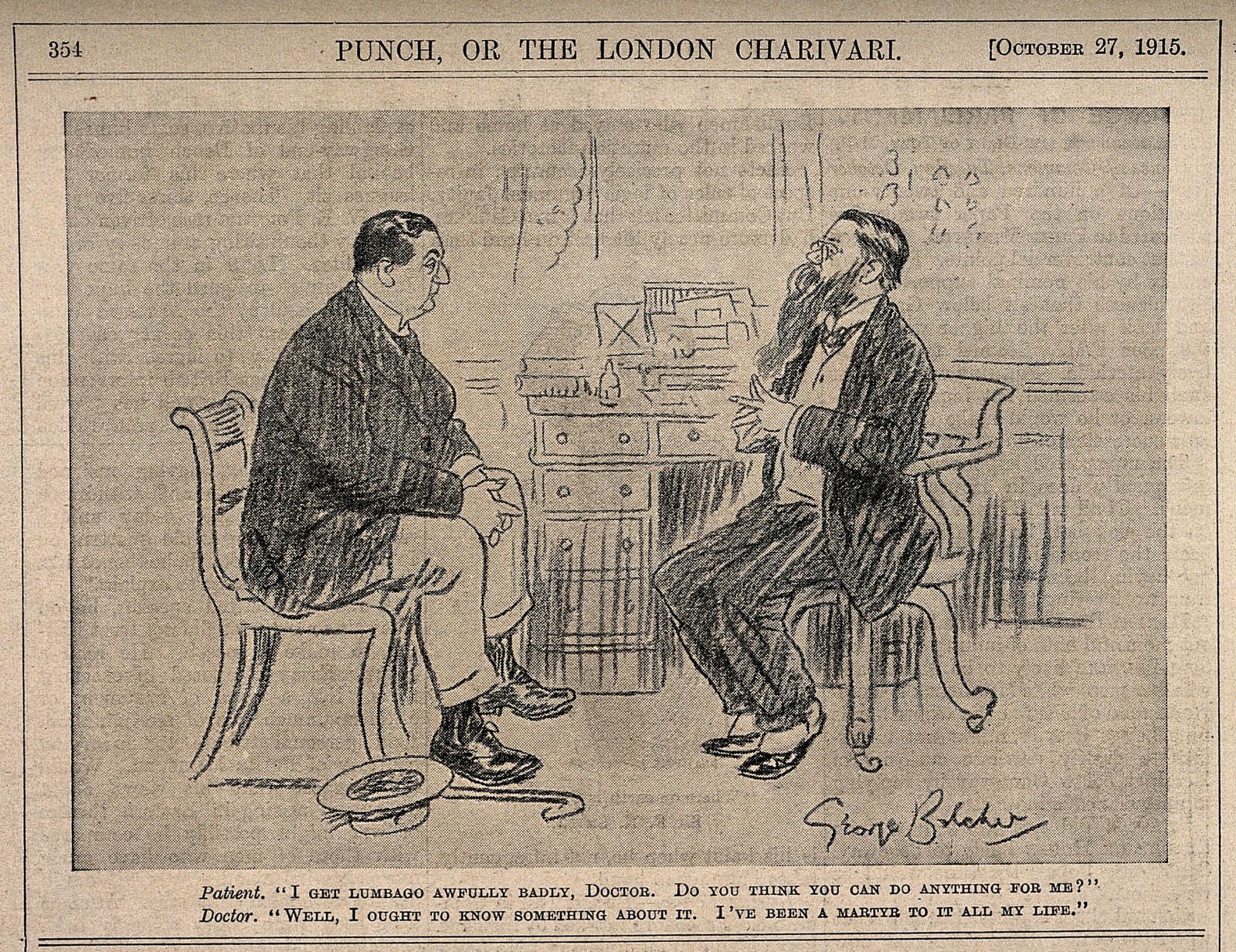
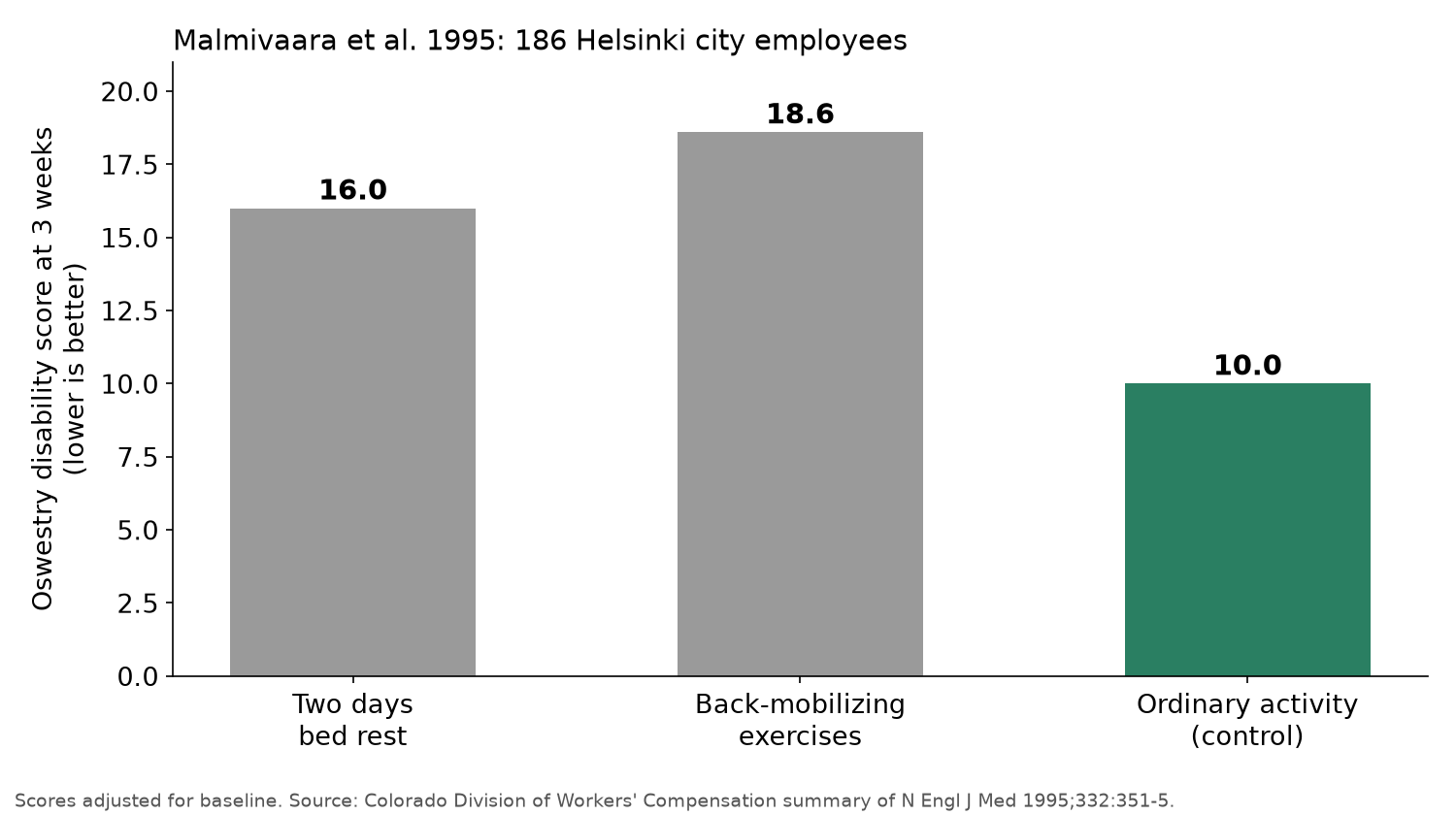
People with a recent bout of low back pain who were told to keep up their ordinary activities as far as the pain allowed recovered faster than people told to spend two days in bed. That was the finding of a trial in Helsinki that set out to test the standard advice of the day.
The trial was published in the New England Journal of Medicine in February 1995. A team led by Antti Malmivaara of the Finnish Institute of Occupational Health recruited 186 employees of the city of Helsinki, 124 women and 62 men, average age 39. All had come to an occupational health centre with acute nonspecific low back pain, meaning a recent bout with no clear identifiable cause. People with sciatica, the pain that runs down the leg when a nerve in the lower back is irritated, were excluded.
Each patient was randomly assigned to one of three groups. Randomising means chance decided who got which advice, rather than a doctor’s judgement, which is meant to keep the groups alike at the start. Sixty-seven people were told to take two days of bed rest, with only essential walking allowed. Fifty-two were taught back-mobilizing exercises by a physiotherapist. The other 67 were the control group, the comparison group, told to carry on as the pain permitted. The researchers went in expecting the exercise group to do best. Everyone was assessed at three weeks and again at twelve.
The result: the control group recovered better than both other groups at both check-ins, and recovery was slowest among those assigned to bed rest. On a back disability score where lower is better, the ordinary activity group averaged 10.0 at three weeks. Bed rest averaged 16.0 and exercises 18.6, in figures adjusted for where each patient started, according to a structured summary of the trial by Colorado’s Division of Workers’ Compensation. A later reanalysis in a Cochrane review puts the gap in sick days between ordinary activity and bed rest at about 3.4 days over the first three weeks.
So where did the advice to lie down come from? Mostly from expert opinion. A 1997 review in the journal Spine said recommendations to rest had historically been “largely based on ‘expert opinion'”. The Cochrane review’s plain summary says that until the late 1990s, advice to take it easy and rest was a common treatment approach, often meaning staying in bed full time.
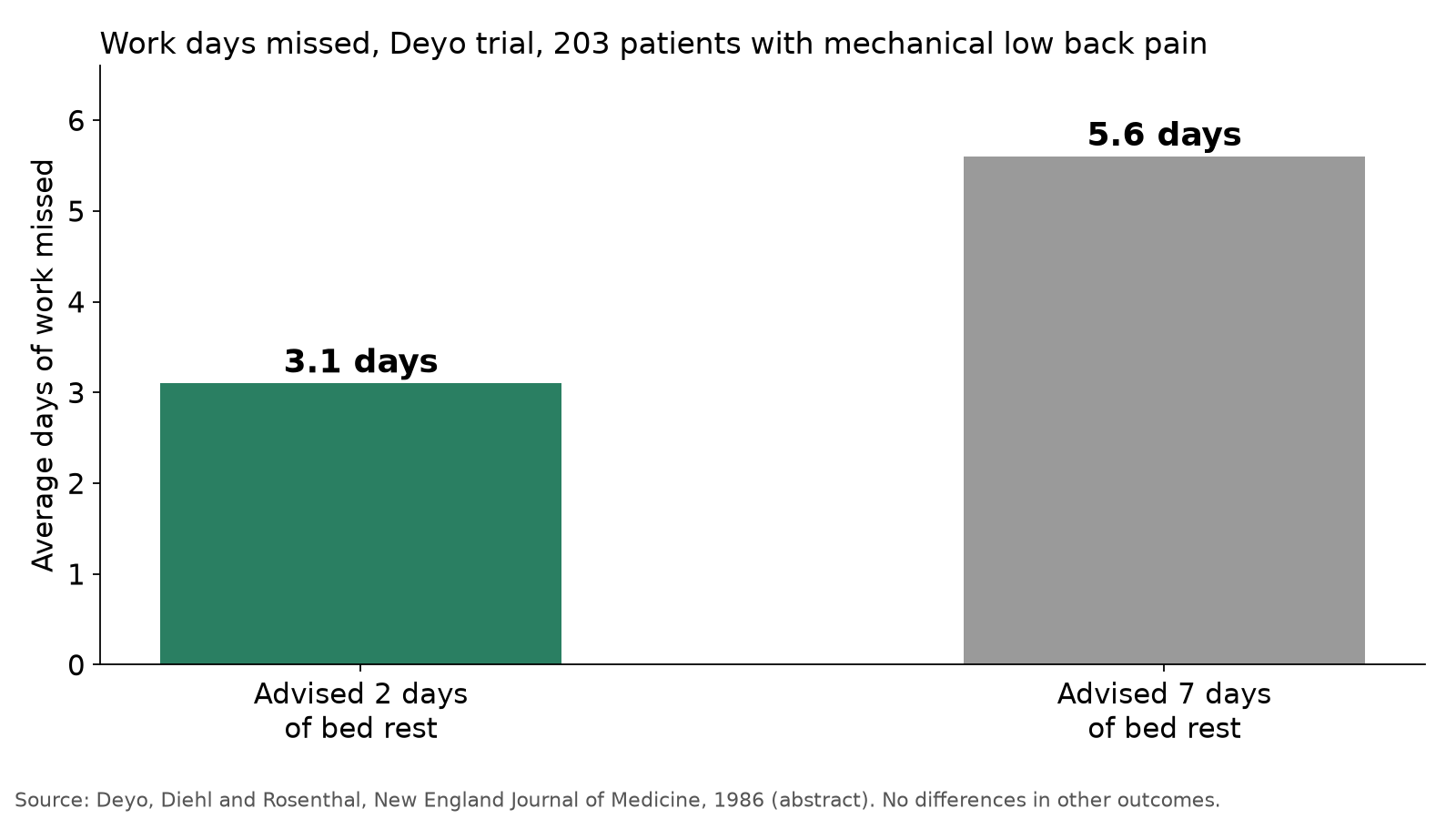
One of the first trials to test that was published in the New England Journal of Medicine in 1986. Its abstract opens with the line “Bed rest is usually recommended for acute low back pain.” It assigned 203 walk-in patients at random to a recommendation of either two days of bed rest or seven. The two-day group missed 45 percent fewer days of work, 3.1 against 5.6. That trial compared a short spell in bed with a long one and never tested staying active, which is part of why the Finnish study mattered.
Richard A. Deyo, professor emeritus at Oregon Health & Science University and lead author of that 1986 trial, said in an email that its first impact was probably to “spur several new randomized trials from several countries”. Those studies, he wrote, shaped guidelines from professional societies in several countries, all recommending little or no bed rest. “It took a couple of decades,” he wrote, but on the strength of many conversations with primary care doctors and some sparse literature, he thinks things have now substantially changed.
The closest thing to a verdict is a 2010 Cochrane review from researchers at the Norwegian Knowledge Centre for the Health Services. A Cochrane review gathers the trials on a question and, where they are similar enough, pools their results into one estimate. This one covered 10 randomised trials and 1,923 people. For acute low back pain it pooled two of them, 401 patients, and concluded that patients “may experience small benefits in pain relief and functional improvement from advice to stay active compared to advice to rest in bed”. Functional improvement here means getting on with everyday activities. For sciatica, the review found little or no difference between the two kinds of advice.
Document: The Cochrane review comparing advice to rest in bed with advice to stay active, full text
Chris Maher, professor at Sydney Medical School and director of the Institute for Musculoskeletal Health, who was not involved in these trials, was blunt in an email to ScienceBlog. “No current guideline recommends bed rest for back pain,” he wrote, pointing to that same Cochrane finding. He added that the side effects of bed rest, “deconditioning, increased risk of blood clots”, are a further reason it is no longer recommended. That is a point about bed rest as a treatment in general rather than about these back pain trials. The UK’s NICE guideline tells clinicians to give people with low back pain “encouragement to continue with normal activities”. A 2018 Lancet paper Maher co-wrote described gaps worldwide between evidence and practice, including “inappropriately high use of imaging, rest, opioids, spinal injections, and surgery”.
I think it’s worth being precise about the size of this. The benefit of staying active is small, and the Cochrane authors themselves called the difference one of limited clinical importance. They also said further research is likely to have an important impact on confidence in the estimate and may change it. The pooled estimate rests on two trials and 401 patients. Those patients could not be kept unaware of which advice they had been given, so expectation may have coloured how they rated their own pain and function. For sciatica there is little or nothing in it either way. None of the trials in the review reported significant side effects of bed rest. And how much everyday practice really changed is not something anyone can count, because as Deyo put it, “there’s no billing code or other standard way to study actual numbers over time in a large population”.
Sources:
- Malmivaara et al., The Treatment of Acute Low Back Pain: Bed Rest, Exercises, or Ordinary Activity?, New England Journal of Medicine, 1995.
- Deyo, Diehl and Rosenthal, How Many Days of Bed Rest for Acute Low Back Pain? A Randomized Clinical Trial, New England Journal of Medicine, 1986.
- Dahm et al., Advice to rest in bed versus advice to stay active for acute low-back pain and sciatica, Cochrane Database of Systematic Reviews, 2010.
- Atlas and Volinn, Classics from the spine literature revisited: a randomized trial of 2 versus 7 days of recommended bed rest for acute low back pain, Spine, 1997.
- Foster et al., Prevention and treatment of low back pain: evidence, challenges, and promising directions, The Lancet, 2018.
- National Institute for Health and Care Excellence, Low back pain and sciatica in over 16s: assessment and management (NG59), 2016.