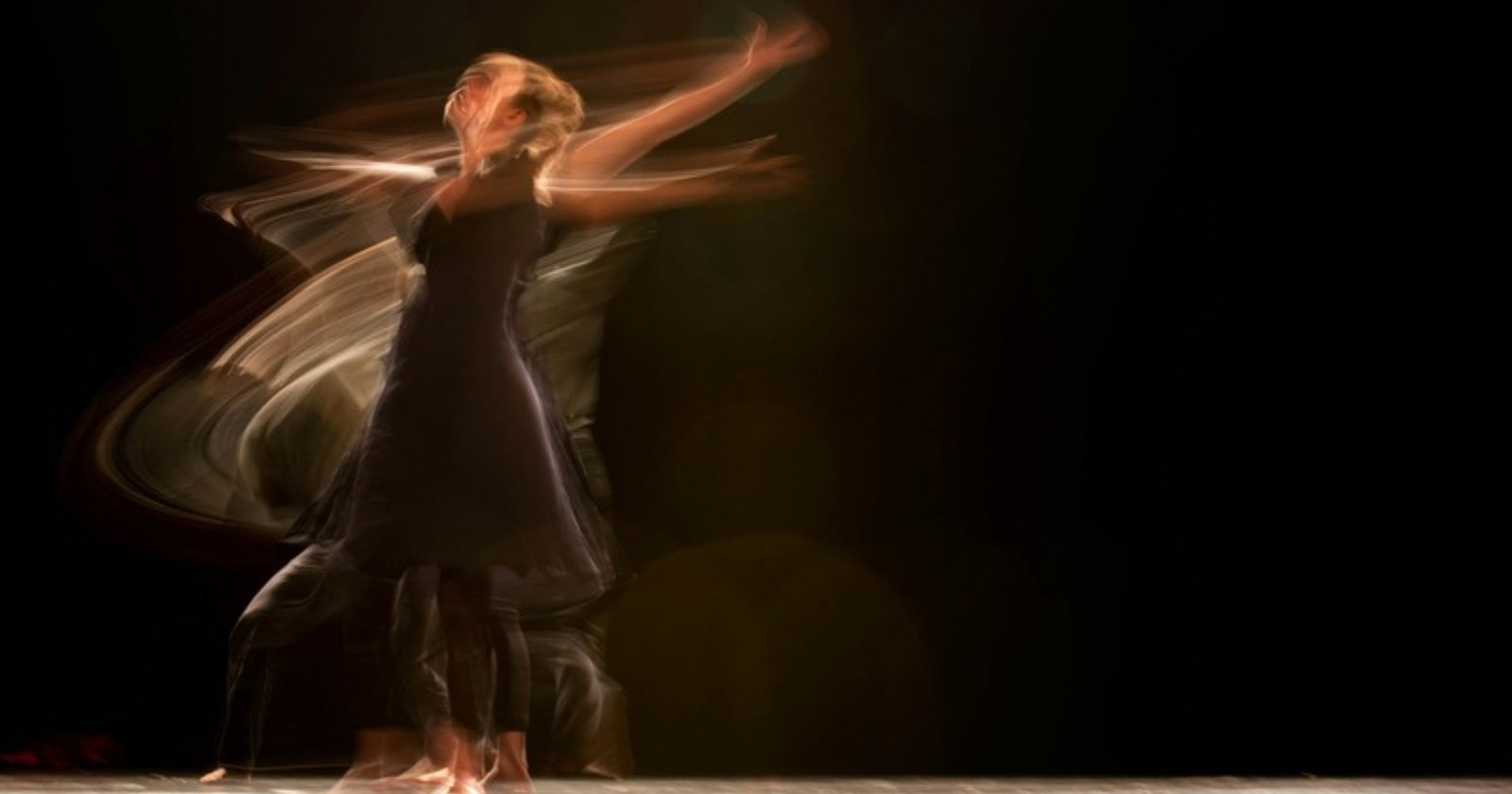
Dancing for me recently has become the place where I feel more present and alive than ever.
It started in the Czech Republic, and it wasn’t planned, I just took part in a very short, spontaneous session. I was shocked by the fact that the people around me were surprised by how free and alive I was. I knew that about myself inside. I just didn’t know it was so noticeable.
I never danced before. Ever in my life. But I always felt the need to move.
When I came back to Tbilisi, my friend introduced me to a certified teacher of 5Rhythms, a kind of ecstatic dance, so I decided to give it a try.
Back then, it was a tough time for me in general. I felt numb and couldn’t express what I was feeling. The way she led us through the dance helped me open up and let everything out. That was an altered state, and it was so powerful that it almost scared me, even though it was healing.
I tend to research whenever something is even slightly new to me. Call it curiosity, or call it being unable to enjoy anything without reading about it first, but when dance was about to become part of my life, I did what I always do and looked it up.
That’s how I came across a story from Strasbourg in 1518 that made me stop. In July of that year, a woman began dancing in a street in the city, and others started to join her. In the usual retelling, hundreds ended up dancing day and night and some reportedly died, while the city hired musicians to play for them. Five centuries later, nobody can say for sure what it was.
So I went looking for what the sources actually say.
What happened on a Strasbourg street in July 1518?
In mid-July 1518, a woman started dancing in a street in Strasbourg, outside her home. According to The Public Domain Review, she was called Frau Troffea, and she danced for four to six days without any music, collapsing from exhaustion and getting back up. Within days, other people were copying her.
Even her name is shaky. Georges Bischoff, a historian behind Strasbourg’s 2018 exhibition, writes in the museum’s press kit that Frau Troffea “never existed”: the name came from the physician Paracelsus and first showed up in print in 1565. I’d assumed her name was the one safe fact in this story.
How many people danced, and how many died?
Now the numbers, because the story splits in two:
- The popular retelling: hundreds danced and many died.
- The Public Domain Review says the Imlin family chronicle recorded four hundred citizens in the grip of the plague within a month, and that at its worst as many as fifteen people were dying each day.
- Writing in The Psychologist, the medical historian John Waller puts the outbreak at about 400 people with dozens dying.
- MinnPost (2016) quotes his Lancet article, which says one chronicle put the toll at about 15 lives a day for a brief period at least.
The records from 1518 itself are much quieter. In 2018, the Musée de l’Œuvre Notre-Dame in Strasbourg put on an exhibition about the outbreak, “1518 – La fièvre de la danse”. Rue89 Strasbourg, reporting on it, says the archives from that time mention no deaths and don’t count the sick. Only five cases are documented one by one, and only because their families had to testify to get financial help. The historian Élisabeth Clementz collected and translated the sources for the exhibition. As the same report puts it, she says readers should be far more careful with chronicles than with city records. I’d keep that in mind for the rest of this article: where a number comes from matters as much as the number.
Rue89 prints this passage in French, from the annals attributed to Sebastian Brant, Strasbourg’s city clerk. Here it is in my translation:
This year, around the feast of Saint Margaret, a dreadful sickness, Saint Vitus’s dance, spread, so that about fifty people were dancing day and night, which was painful to see.
That passage is where the figure of about fifty dancers comes from, and it mentions no deaths. Élisabeth Clementz gives the same figure in an extract from the exhibition catalogue: some fifty people started dancing to exhaustion in the city’s streets.
So the bigger numbers come from later chronicles, and the museum’s press kit says their distortions grew over the centuries. I’d be careful with the famous numbers.
Why did the city tell them to keep dancing?
The best-documented part of the story is what the authorities did, and if you ask me, it’s the strangest part.
According to The Public Domain Review, officials built stages in the horse market and the grain market and paid musicians to play, because they believed the dancers could dance themselves free of it. Yes, the city encouraged the dancing. Then more people joined in, and the city changed course: it had the stages taken down and banned almost all music and dance until September. The council also sent the worst-affected on a three-day journey to the shrine of Saint Vitus at Saverne, where priests put small crosses in their hands and red shoes on their feet. Rue89 gives dates for two of these steps: pilgrimages to the sanctuary from 23 July, and a ban on dancing issued on 2 August 1518.
Waller thinks the first response made things worse. In The Psychologist he argues that by gathering the dancers and leaving them to dance in some of the most public spaces in the city, the authorities made sure the outbreak got out of control, and that each new victim made people more convinced that something supernatural was behind it. It’s an uncomfortable idea, that the help made it bigger.
Poison, sickness, or something else?
Three explanations come up most often, and there is a fourth I didn’t expect:
The oldest is medical. According to The Public Domain Review, the city’s guild of physicians called it “a natural disease, which comes from overheated blood”. By the medical theory of the day that meant bleeding the patients, but they recommended dancing instead, the treatment given to earlier victims. Paracelsus, writing some years later, blamed the woman’s deception and desires rather than anything supernatural or physical.
The modern explanation you’ll hear most is ergot, a fungus that can grow on rye. Waller rejects it. As The Public Domain Review reports his argument, ergot cuts blood flow to the arms and legs, so a poisoned person could hardly dance for days in a row. It’s a simple point, and it’s hard to argue with.
Waller’s own explanation is mass psychogenic illness. That’s when stress and suggestion set off real symptoms across a whole group. He describes a community worn down by a decade of famine, sickness and terrible cold, with bread prices at their highest in a generation, which believed Saint Vitus had unleashed a dancing curse. In that setting, he argues, a trance with a dramatic loss of self-control spread from person to person by suggestion. In The Psychologist he calls the dancing plagues “classic instances of a very different phenomenon: mass psychogenic illness”. I’ve felt a group dance carry me into an altered state myself, so the idea that a crowd can carry people along doesn’t sound strange to me. But feeling it and proving it for 1518 are two different things.
The fourth surprised me because of who holds it. Robert Bartholomew is a medical sociologist who studies mass psychogenic illness, so I asked him how far we can go in calling a 500-year-old outbreak by that name. He doesn’t think Strasbourg was one.
“I am skeptical that the events in Strasbourg were an illustration of stress-induced mass psychogenic illness or mass psychosis or ergot poisoning. I view it as much more ritualistic,” he told me.
Why ritual?
He pointed me to his own research. After reading the medieval chronicles in translation, he argues in a 1998 paper in Feminism & Psychology that the dances weren’t spontaneous at all. Many of the dancers were pilgrims on the road, going from shrine to shrine, linked together with cloth, clapping and calling on saints. In a 2000 piece for Skeptical Inquirer, he describes them as “deviant religious sects who gained adherents as they made pilgrimages through Europe during years of turmoil in order to receive divine favor.” Neither paper is about 1518 itself. They cover the dancing manias across medieval Europe, mostly the big wave of 1374, but the argument carries over.
And the fainting, the shaking and the visions? He thinks that is what you would expect from any large crowd that dances for days, fasts and worships at full emotional pitch, with little sleep and, often, a lot of drink.
One detail made me look at Strasbourg differently. He writes that German magistrates hired musicians to play for the dancers and dance alongside them, to cut down on injuries and mischief on the way to the St. Vitus chapel. Strasbourg’s council did something very similar in 1518. Read his way, the city was managing a ritual as well as treating a sickness.
He also takes on who the dancers were. Textbooks often present the dancing manias as hysteria in women, but he argues the chronicles show men and women taking part about equally. He even quotes a Strasbourg chronicle from 1636 that says the 1518 dancing “occurred among men”, although he notes that “men” there probably meant people in general. It made me wonder how much the “one woman” at the start of the story says about the people who retold it.
What is happening when people dance themselves into another state on purpose?
People still dance themselves into altered states today, and they do it on purpose. Ecstatic dance is a loose name for freeform, often long, music-led dancing that people use to reach an altered state. 5Rhythms is one well-known kind, and it’s the kind I tried in Tbilisi. A class page on the official 5Rhythms site lists the five rhythms as flowing, staccato, chaos, lyrical and stillness, and says they come together to create the Wave, a “movement meditation practice”. It grew out of Gabrielle Roth’s work, and the site says she founded The Moving Center in New York in 1977.
It has spread far.
The official site says there are over 400 certified teachers worldwide, and one of them taught the class I joined in Tbilisi and as far as I witness, it keeps on spreading to many countries.
Put the two side by side and the differences are big. People in a 5Rhythms room choose to be there, a teacher guides the session, it has a start and an end, and anyone can walk out. The Strasbourg dancers, as far as the sources say, were frightened, hungry and in public, and some were sent on a three-day journey to a shrine. Nothing I found shows that one explains the other. And if Bartholomew is right that ritual played a large part in Strasbourg, the line gets blurrier, because some of those dancers may have chosen to dance too.
Either way, the same movement can mean very different things depending on where you are, whether you chose it and whether you can leave. The exit is the part that stands out to me. In a room you chose, you can leave when it gets too much. I can’t tell from the sources whether they could.
So what do we actually know about Strasbourg in 1518?
So what can you fairly take from all this? Three things:
- People really did dance in Strasbourg in the summer of 1518, and the city took it seriously enough to build stages, ban music and send people to a shrine.
- The records closest to the event describe something smaller than the legend: about fifty dancers at once and no recorded deaths.
- What caused it hasn’t been proven. The experts still disagree on whether it was mass psychogenic illness or ritual, and both Waller and Bartholomew doubt it was ergot.
Nothing I found says that dancing today carries any of the risk of 1518.
Putting my own story next to this one, what stays with me is how much the body leads. I’d never danced before that short session in the Czech Republic, and the people around me saw something in me that I hadn’t known was visible. In Tbilisi, a teacher took me into an altered state so strong that it almost scared me, and it still helped me.
Strasbourg makes me wonder what that same pull is like in a frightened, hungry city, in public, with no teacher to bring you back. I don’t think the two are the same, and nothing I found says they are. But it does look like something people everywhere have always walked into, sometimes by choice, and maybe sometimes not.
If you have ever felt music take over your body, did it feel like something you chose, or something that happened to you?
Sources:
- Pennant-Rea, The Dancing Plague of 1518, The Public Domain Review, 2018.
- Musées de Strasbourg, 1518, la fièvre de la danse (exhibition press kit), 2018.
- Ruhlmann, Strasbourg célèbre et se penche sur l’étrange épidémie de danse de 1518, Rue89 Strasbourg, 2018.
- Miller, Divine Punishment or Disease? Medieval and Early Modern Approaches to the 1518 Strasbourg Dancing Plague, Dance Research, 2017.
- Waller, Dancing plagues and mass hysteria, The Psychologist, 2009.
- Bartholomew, Dancing with Myths: The Misogynist Construction of Dancing Mania, Feminism & Psychology, 1998.