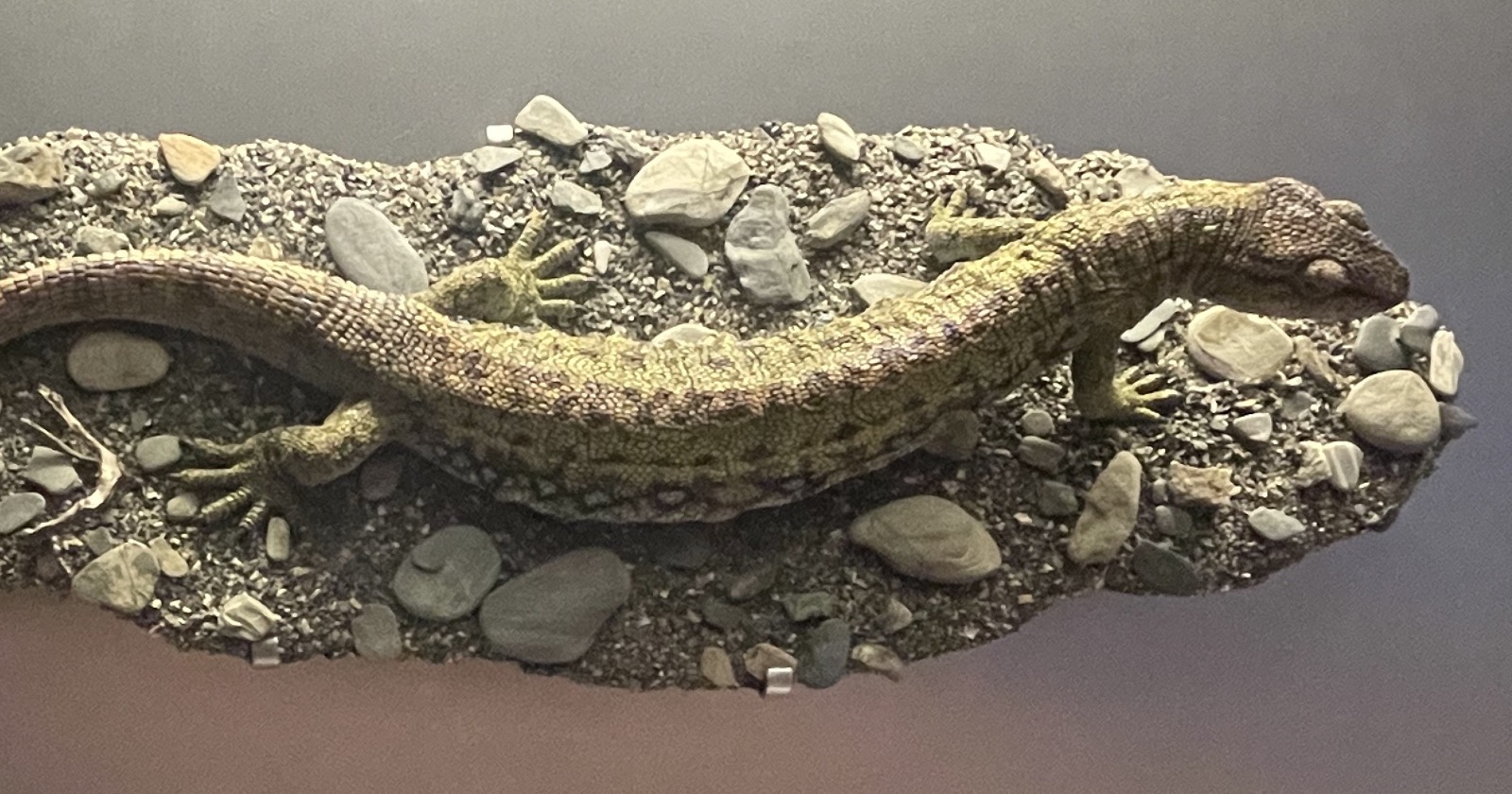
In the Survival gallery of the National Museum of Scotland in Edinburgh lies a skeleton less than 20 centimetres long, preserved across the two halves of a split slab of limestone. It was nicknamed Lizzie because it looked so much like a lizard, and for more than 30 years it has been cited as one of the oldest reptiles ever found, or at least one of the oldest close relatives of reptiles and other amniotes.
A study published in Nature on 30 September 2026, led by Ben Igielman and Xavier Jenkins, says it was neither. Synchrotron X-ray scans revealed an ossified internal gill skeleton and “extensive denticles,” small tooth-like points, on the palate and lower jaw of Westlothiana lizziae. The team’s analyses place it among the stem tetrapods, limbed animals on branches that split off before the last common ancestor of living amphibians and amniotes (reptiles, birds and mammals). That ancestor and all its descendants make up the tetrapod crown group. The paper calls Lizzie “a crownward stem tetrapod, far removed from amniotes”: fairly close to that ancestor on the family tree, and well away from the amniote branch.
The peer review file that Nature published alongside the paper shows that the version the team first submitted still placed Lizzie on the amniote branch. The reclassification came after a reviewer argued that the scans had been misread and the family-tree analysis was flawed, and the authors went back into the data.
Gill bones in a crushed skull
The fossil is crushed flat, which makes much of it hard to read from the surface. The team scanned it on the ID19 beamline at the European Synchrotron Radiation Facility in Grenoble, France, a particle accelerator that produces extremely bright X-rays, then separated each bone from the surrounding rock digitally and rebuilt the skull on screen.
The gill evidence comes from bone. Gill tissue itself is rarely preserved, but the bony arches that support gills can be. The scans show at least two pairs of gill arches, and grooves on them for the afferent gill artery, the vessel that carries blood to the gills, indicate “that the arches were vascularized, most plausibly indicating functional internal gills,” the paper says. Working gills are inferred from that skeleton rather than seen directly.
Elsewhere in the skull, the abstract reports “unexpected plesiomorphies,” traits held over from far more distant forebears, in the skull roof, palate, braincase and lower jaw. The paper’s supplementary information describes a palate that is “almost entirely denticulate” and a lower jaw that is “extremely denticulate,” with patches of denticles reaching back as far as the articular, the lower-jaw bone at the hinge.
The American Museum of Natural History, where two of the seven authors work, sums this up as “a fish-like mouth filled with thousands of tiny teeth.” The paper counts the ordinary teeth along the jaw edges but not the denticles; “thousands” is the museum’s word. The paper likens the denticles to the velvet-like tooth patches of living fishes and concludes that Lizzie “fed subaqueously,” under water.
How Lizzie became the earliest reptile
Lizzie came out of East Kirkton Quarry near Bathgate in West Lothian. National Museums Scotland describes the site as a small lake fed by volcanic hot springs, whose chemicals settled as layers of rock over the animals and plants that ended up there. Water-dwelling animals are rare in those layers, the museum says, probably because the lake was “scalding hot or poisonous.” The new paper notes that Lizzie’s original reading as a land animal leaned partly on that picture of East Kirkton as “a predominantly terrestrial fauna.”
In December 1989, T. R. Smithson introduced the specimen in Nature under the title “The earliest known reptile.” A year later Smithson and W. D. Ian Rolfe gave it its scientific name in the Scottish Journal of Geology, in a paper titled “Westlothiana gen. nov.: naming the earliest known reptile,” whose abstract called it “the most primitive known reptile.”
The reptile label lasted only until 1993. The full anatomical description published that year, also led by Smithson, judged Lizzie “a stem-group amniote,” a close relative of the first amniotes rather than a reptile itself. That stem-amniote position is the one the 2026 abstract describes as widely cited.
Smithson, now at the University Museum of Zoology in Cambridge, is one of the new paper’s seven authors; the Edinburgh Geological Society’s Clough Medal page credits him with the 1989 description.
A museum date older than the zircons allow
Both museums give Lizzie’s age as 345 million years. The first radiometric date for the layer that held it comes out younger than that, though the dating team reads it as older than earlier fossil-based estimates.
A team led by Hector Garza of the University of Texas at Austin dated zircon crystals from Unit 82 of the East Kirkton Limestone, the layer that held Lizzie, and reported in PLOS One a maximum depositional age of 341 ± 3 million years. A maximum depositional age is a ceiling; in the paper’s words, “the true depositional age could be younger.” Earlier estimates from fossils in the rock, including plants and spores, had put the site at roughly 330 to 335.5 million years.
The same paper traces the 345 figure to the museum. National Museums Scotland, it says, has “traditionally assigned” that age “for public communication,” about a million years older than the upper limit of the zircon estimate. The new Nature paper’s own age table brackets Lizzie at 344 to 338 million years.
The version Nature’s reviewers saw first
The manuscript first went to the journal under the title “Synchrotron tomography of a Carboniferous tetrapod informs stem amniote diversity.” Referee 3 summarised its result as placing Lizzie at the base of the lepospondyls, a loose collection of small early tetrapods, which that analysis put on the amniote stem.
Referees 3 and 4 were enthusiastic. Referee 5, an anonymous reviewer who joined in the second round, was not. “Unlike some of the previous round of referees, I do not recommend publication,” the reviewer wrote.
Referee 5 listed two “critical flaws”: the segmentation, the step in which each bone is traced and separated from the rock in the scan data, and the phylogenetic analysis. “It appears to me that the segmentation is primarily showing cracks rather than sutures.” Sutures are the seams where skull bones meet. The reviewer concluded that “all of the anatomy here implies an animal that sits in a relatively crownward part of the tetrapod stem group, perhaps just crownward of baphetids,” that is, a little closer to the crown group than the baphetids, another group of early tetrapods.
The authors’ letter to the editor describes what followed. They brought in Xavier Jenkins of the American Museum of Natural History as an additional corresponding author, resegmented the skull and “reconstructed previously overlooked elements of the braincase and gill arch.” The reinvestigation, they wrote, “revealed numerous stem tetrapod features originally overlooked in earlier drafts of this manuscript,” and they noted that “not all of the reviewers anatomical suggestions were correct, but many of them were.”
A family tree rebuilt from the scans
The reclassification rests on phylogenetic analysis, a statistical reconstruction of the family tree from anatomical traits scored one by one. Each score depends on how a bone is read on a crushed, deformed specimen, which is what Referee 5 disputed.
The authors ran Lizzie through three datasets: their own, and versions of two published trait datasets from Clack and colleagues in 2019 and Mann and colleagues in 2026. All three put it firmly outside the crown group. Their own places it beside Utaherpeton, a puzzling Late Carboniferous animal, closer to the crown group than the embolomeres but not as close as the baphetids, a step short of where Referee 5 had guessed. The two published datasets leave it in unresolved clusters of stem tetrapods, and the abstract warns of “substantial gaps in anatomical knowledge, especially for small-bodied taxa.”
The study also removes a second East Kirkton specimen, NMS G.1991.47.1, from the species “pending further examination,” citing a different number of vertebrae and different bones in the foot. Lizzie’s own scans and 3D models are on MorphoSource, though downloads need approval from National Museums Scotland.
Land-style feet on an aquatic or amphibious animal
Lizzie still has the feet that made it look reptilian: five toes with a toe-bone count of 2, 3, 4, 5, 4, the amniote-like pattern that impressed earlier researchers. The paper’s larger argument concerns the order in which such land-living features appeared. Its abstract says Lizzie shows that “an amniote-like pedal formula, loss of fin-like forelimb function and superficially claw-like terminal phalanges evolved in a mosaic fashion,” in “a transitional, amphibious context before the origin of the tetrapod crown group.” Terminal phalanges are the last bone of each toe.
That could matter for fossil footprints. In 2025 a team led by John Long reported clawed tracks from Victoria, Australia, in rock “securely dated to the early Tournaisian,” the opening stage of the Carboniferous. They attributed the tracks to “a crown-group amniote with clawed feet, most probably a primitive sauropsid,” an early member of the branch leading to reptiles and birds, and said this “pushes back the likely origin of crown-group amniotes by at least 35–40 million years.”
The New York museum’s summary says that if animals like Lizzie already had claws, such tracks “may have been made by more primitive amphibious relatives instead.” The paper is more careful about the claws and blunter about the tracks. Lizzie’s curved toe bones lack the side grooves that hold a horny sheath, which the authors read as a sign it had none. Still, bones of that claw-like shape on a stem tetrapod show the shape evolved before the crown group, so pinning the Australian tracks on amniotes, “or even crown tetrapods,” is “unsupported,” they write: “there is currently no evidence of crown amniotes before the Late Carboniferous, at least 30 million years later.”
The anchor left at East Kirkton
That last line is the one Referee 1, Claudia Marsicano of the University of Buenos Aires, who signed her report, picked up. Because the amniote branch sits inside the tetrapod crown group, Lizzie’s old position had made it one of the oldest crown tetrapods on record. With Lizzie gone, she wrote, “all that’s left is Balanerpeton,” another East Kirkton animal, “after which the oldest crown tetrapods are basically from the Joggins Fm.,” rocks in Nova Scotia. That, she wrote, means the calibration point molecular-clock studies use for the group’s minimum age “is likely to shift approx. 17 million years from East Kirkton Fm. to Joggins Fm. times.”
For now the anchor stays in Scotland. The authors replied that the timing “hinges upon the identification of Balanerpeton,” and the published paper keeps it as “the sole remaining crown tetrapod from the Early Carboniferous,” the fossil that “provides the minimum age constraint for the tetrapod crown group.” Balanerpeton came out of the same layer as Lizzie, and its “anatomy and phylogenetic affinities have not yet been evaluated with high-resolution tomography.” The authors expect surprises when that happens. Their scans found “numerous unexpected anatomical features” in Lizzie, they write, “and the same could probably be true of other Early Carboniferous tetrapods.”