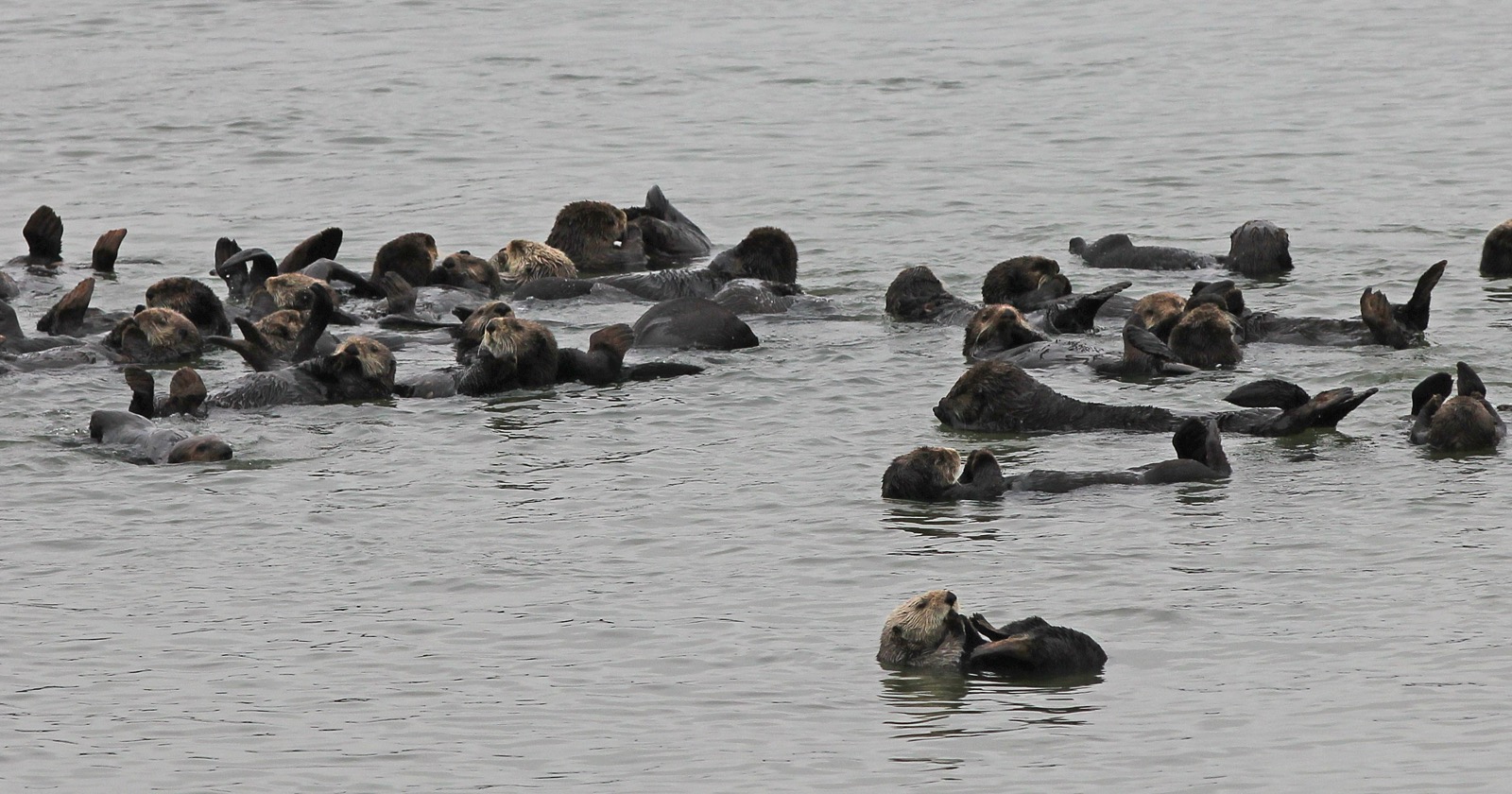
Between 2009 and 2017, the number of sea otters in Elkhorn Slough, an estuary on California’s Monterey Bay, roughly doubled. Over the same years, the banks of its tidal creeks wore away about half as fast. The otters eat crabs that burrow into those banks. The erosion figure is worked out from the data posted with a 2024 study in Nature led by Brent Hughes of Sonoma State University.
In the 13 creeks the team tracked, banks lost an average of 0.23 metres a year before the otters spread through them, and 0.12 afterwards. The University of California, Santa Barbara put the drop at 69 percent, a figure that rests on a narrower comparison between creeks. The paper’s main measures agree that erosion slowed on average. They differ on how much, and not every creek followed the pattern.
A marsh eaten from below
By 2003 the slough had lost about half its salt marsh, counted from 1930 in one part of the paper and from 1956 in another. Levees built for Moss Landing Harbor in 1947 helped speed up tidal flow, and the estuary, which once closed off from the sea from time to time, now stays open all year.
Heavy farming nearby has been linked to extreme nitrogen levels in the water. The sea has kept rising too, by about 1.57 millimetres a year in the region between 1973 and 2018.
The striped shore crab, Pachygrapsus crassipes, makes things worse. It digs burrows along the creek edges and eats the roots of pickleweed, the main marsh plant in the region. The paper suggests two ways the crabs likely speed up erosion: their burrows take soil out of the bank, and with fewer roots, less is left holding the rest together.
For decades, though, there were no otters here to eat them. Sea otters were once close to extinction, and they only began returning to the slough in the mid-1980s. Survey records and field reports suggest they rarely hunted in the narrow marsh creeks until the mid-2000s, and by 2013 they were feeding there widely.
The slough held an average of 62 otters between 2009 and 2012, and 128 by 2017. In water this cold, an otter eats more than a quarter of its body weight every day, around 10 kilograms of prey.
From 24,632 feeding dives the team logged, the paper reports otters eating as many as 47 shore crabs per hectare per day, about 18 percent of what they ate by weight. Shore crab parts also turned up in 84 percent of the 61 otter droppings collected along the banks.
Three years behind a fence
To test the link, the researchers built fences that kept otters out of small plots along five creeks but let crabs pass through. The experiment ran from September 2013 to December 2016, and each fenced plot had an open one nearby.
After three years, traps in the fenced plots caught more shore crabs than traps in the open ones; the paper reports a 68 percent difference. In the second year, the fenced plots also had less plant mass above ground, less root mass and less dense soil, with reported differences of 48 percent, 15 percent and about 8 percent respectively. The posted code calculates these percentages using the average of the two values being compared as the denominator, not the open-plot value alone.
Camera traps went up in 2020, after the experiment ended but while the fences were still standing. Near the plots at two of the creeks, they recorded otters foraging 23 times, never inside a fence.
Both university press releases said this work ran “for nearly a decade”. The paper gives three years for the experiment, and neither release says what the longer span covers.
The paper’s abstract says the experiments showed reduced erosion. But the fence results it reports cover only crabs, plants and soil, not how fast the bank itself wore back. The plots also sat half a metre to a metre and a half from the creek edge. What the fences show directly is that otters thin out crabs, which leaves more roots and denser soil. The link to slower erosion relies on the long-term records and on comparing creeks.
Eight decades of aerial photographs
Those long-term records start with earlier work by Eric Van Dyke and Kerstin Wasson, who measured creek widths at 196 points on aerial photos going back to the 1930s, long before the otters returned. Hughes’s team extended that record to 2018.
From 1937 to 2000, the creeks widened by about 0.09 metres a year. Between 2000 and 2007, that jumped to 0.35. The paper notes this coincided with a drop in otter numbers in the slough and the wider bay after a major El Niño in 1997 and 1998.
The team’s census shows the slough’s count falling from 41 in 2000 to 11 in 2004, though the paper’s text puts that low in 2005. As the count climbed past 100, widening eased to about 0.10 metres a year from 2008 to 2018, close to where it had been before the spike.
The team then built a statistical model linking otter numbers to creek widening. It assumes otters were the only thing slowing erosion, and on that basis, around 100 otters were linked to widening falling from 0.38 metres a year to 0.10.
Counting the 13 creeks
UC Santa Barbara’s release said creek bank erosion “slowed on average by 69%” once the otter population fully recovered. Duke University’s release went further, saying erosion at sites with many otters had slowed “by as much as 80% to 90%”, a figure that doesn’t appear in the paper.
The paper’s own discussion puts the drop at two thirds. The 69 percent is from a comparison of creeks in 2015 to 2017: eight with lots of otters averaged 0.05 metres a year, and five with few otters averaged 0.16.
The creek-by-creek figures the team posted give a smaller gap. The five low-otter creeks match the paper exactly, but the eight high-otter creeks average about 0.09 metres a year, which puts the difference at roughly 45 percent. No split of the 13 creeks into groups of eight and five produces both of the paper’s numbers.
The paper may have worked from slightly different figures. Its high-otter range stops at 0.5 otters per hectare, for instance, while one posted creek logged about 0.6. Hughes, who is on sabbatical, had not replied to an emailed question about the grouping when this piece was filed.
The posted figures also show how uneven the effect was. Two high-otter creeks had banks that were building outward, which pulls that group’s average down, while the two creeks with the most otters eroded fastest of all 13 in 2015 to 2017.
Over time, the picture is clearer. Measured in 2009 to 2011 and again in 2015 to 2017, the same 13 creeks slowed by about half, the comparison behind the figures in the opening. The paper calls that drop statistically significant but doesn’t give a percentage, so the “about half” is worked out from the posted figures.
Ten of the 13 creeks slowed down, and two, including the one with the most otters, eroded faster. The thirteenth had banks that were building outward, and they kept doing so at about the same pace.
Across the 13 creeks in 2013 to 2015, the number of crabs otters ate didn’t line up with erosion in any statistically meaningful way. The team then set aside one creek, where harbour seals haul out on the banks and seem to make erosion worse. Without it, the paper calls the relationship significant at a P value of 0.054, just above the usual 0.05 cutoff.
A brake on the losses
The experiment makes a clear case for the crab and root part of the story, and the long-term record fits with it. The claim that holds up is narrower than the press releases made it sound, though, and Hughes’s own summary was measured. “The return of the sea otters didn’t reverse the losses, but it did slow them to a point that these systems could restabilize despite all the other pressures they are subject to,” he said in the UCSB release.
Hughes has also looked at where else otters could live. A 2019 analysis he led estimated that San Francisco Bay alone could support about 6,600 sea otters, more than double California’s whole population in 2018. That analysis looked at prey and population growth, not at how marshes there would respond.
Kerstin Wasson, research coordinator at the Elkhorn Slough National Estuarine Research Reserve, has looked at crabs more widely. Her 2019 study across 15 US estuarine reserves found crab burrows linked to sparser marsh vegetation at only four of them, Elkhorn Slough included. Across all the reserves, the results suggested that sea-level rise is generally a bigger threat to marshes than crabs, though the two will likely interact.
Wasson still sees sea-level rise as the biggest future threat to the slough’s marshes. “Bringing back top predators is an essential part of restoring healthy estuaries, but sea otters only help marshes a little bit at the margins,” she wrote in an email. “They don’t solve the fundamental threats facing our marshes.”
A healthy marsh, she explained, sits at the right height relative to the sea, so its plants get flooded by the tide every day, but not for too long. In the past, the biggest threat here was diking, which cut marshes off from the tides, and “they sunk as they dried.” “We now have vast mudflats where we used to have marshes,” she said. The only way back, she added, is to add soil and raise the ground, as the reserve has done at its Hester Marsh restoration site.
Marshes also have to build themselves up faster than the sea rises, she said. They can do that with mud that settles out on high tides, or with plant matter they make themselves, which works best where some fresh water flows in. Both are harder here, she wrote. Farming has overdrawn the region’s groundwater, and the major river that once flowed into the estuary, bringing fresh water and flood sediment, has been diverted.
In 2024, UC Santa Barbara reported that Kathryn Beheshti, a co-author based there, had started a project to restore eelgrass in natural and restored tidal creeks, to see whether it slows bank erosion further. Otters and eelgrass may help hold the creek edges. But can anything raise the marsh as fast as the sea is climbing?