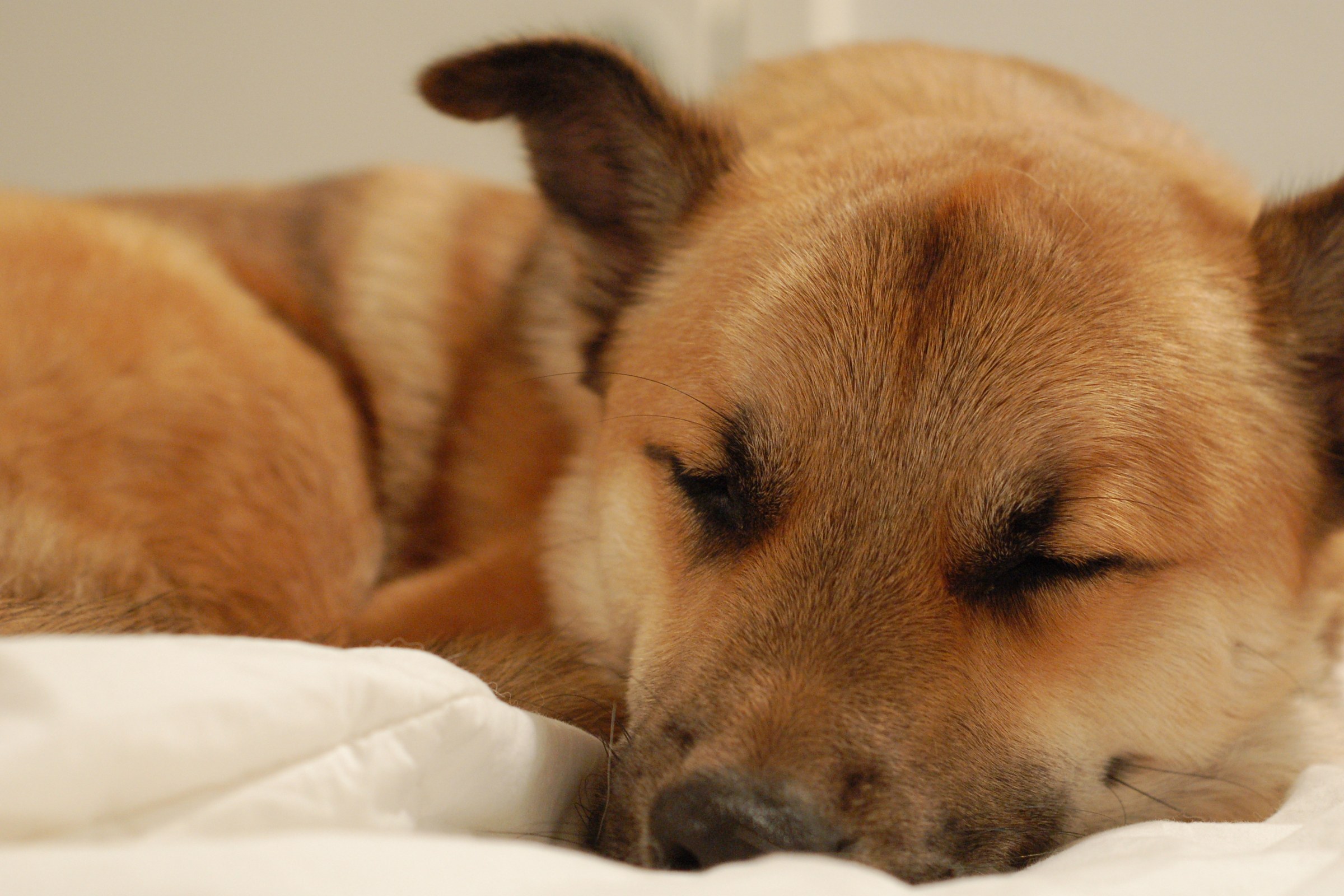
Husky and malamute owners who let a dog onto the bed showed no significant difference in tracker-measured sleep duration or efficiency from owners who said the dog never slept there, in a four-week University of Toronto study of 25 people and 38 dogs in southern Ontario.
The study, published 7 October in PLOS One, sorted owners by their own end-of-study reports. Four said a dog always shared the bed, 10 said sometimes and 11 said never. Across 777 tracked nights that habit had no significant effect on total sleep time or sleep efficiency.
The result runs against a 2017 study by Patel and colleagues in Mayo Clinic Proceedings, cited in the paper’s discussion, which found lower sleep efficiency in owners whose dog slept on the bed than in those whose dog slept elsewhere in the room.
The Toronto team wanted to know who disrupts whom, so it tracked the dogs as well. In 22 of the 36 owner-dog pairs with usable tracker data, owner and dog stirred together within a five-minute window. In those 22 pairs the owner moved first in 10, the dog first in four and both in the same minute in eight.
“Using movement data, we did not find strong evidence that dogs were disrupting human nighttime sleep,” Ming Fei Li, the paper’s lead author and now a postdoctoral associate at Duke University, said in an email. If dogs were doing the disrupting, Li said, dog activity would come before the owner’s in more pairs than it did. An earlier tracker study, also cited in the paper’s discussion, pointed the other way: Smith and colleagues in 2018 found dog movement came up to 2.5 minutes before owner movement.
The owners wore a CamNtech MotionWatch 8 on the non-dominant wrist. It counts movement in one-minute blocks, and software scores each minute as sleep or wake from the count. Sleep efficiency is the share of each night’s sleep period, marked by hand from lights out to getting up, that the device counts as asleep.
Each dog wore the same sensor on a nylon collar. Because the device has not been validated for telling sleep from wake in dogs, the authors report only activity and inactivity, and in the minute-by-minute comparison with the owner any minute with a count above zero was logged as active.
What the watch cannot count is comfort. Our two whippets sleep in the bed with me and my partner, and I sleep better with one there. Good sleep, for me, is feeling comfortable and at peace with a loved one near. The one self-report measure in the models, the Pittsburgh Sleep Quality Index, is the closest the study gets to that question, and it showed no significant effect of where the dog slept either.
Bed-sharing itself was reported once, as a habit, on the questionnaire owners filled in at the end of the four weeks, which the authors say likely introduced recall bias. That questionnaire also produced the figure NBC News and the PLOS press release both drew on: 12 of 25 owners said their dog interrupted their sleep, the paper’s summary table shows.
Li said the split comes from a general question on how often the dog causes a waking, with anything but “Never” counted as yes. Follow-up questions about barking and noise from the dog moving drew “no” from more than 80 per cent of owners.
The models did not use the answer. In early data exploration, Li said, owners who felt their dog woke them did not differ from the rest on sleep measures, and neither group showed a clearer owner-dog movement link.
The who-moved-first result has a limit Li raises herself. The device sampled once a minute, “which means we could not capture cases whereby dog activity preceded human activity at smaller time increments.” The paper calls the question of who disrupts whom “inconclusive,” and it did not test the split statistically. Rebecca Spencer, a professor of psychological and brain sciences at the University of Massachusetts Amherst who was not involved, said in an email that such a test would not find the split significant.
Spencer also objects to the zero threshold for dog movement. A dreaming dog twitches and kicks while sound asleep, she said, and without a threshold the study “would call these ‘dream’ bouts awake.” The paper concedes the approach “may have overestimated dog activity” but argues any dog movement could still have influenced an owner’s movement.
The bed also held people the watches never saw. Only the primary or co-primary caretaker wore one, yet 16 of the 25 owners shared the bed with another human, the paper reports. If that unrecorded person woke, Spencer said, it could trigger the owner and then the dog. The models included a human co-sleeper as a yes or no and found no significant effect, but the paper’s limitations section says other people’s activity was not accounted for.
Spencer also doubts these breeds can stand for dogs in general. The paper says huskies and malamutes were chosen because the project also compares dogs with wolves, and these breeds descend from an ancient Siberian line. Spencer pointed to a 2023 owner-questionnaire study of more than 11,000 Finnish dogs in which the sled dog group scored well below average on human sociability, and below average on insecurity.
Spencer’s own scenthound is at least around average on insecurity, she said, and in her view such dogs are likelier to crave a person’s closeness than these sled dogs. My whippets are very people-focused dogs, and nothing in this study covers a breed like that. The authors themselves caution that the results may not generalise across breeds.
The NBC subheadline read “Letting dogs sleep in your bed may improve your rest, new study suggests.” The study found no significant effect in either direction, and with no dog-free group it could not assess whether dogs affect sleep at all, the authors write.
Owning more than one dog was linked to worse self-rated sleep on the Pittsburgh index, at p = 0.042, but the trackers showed no significant effect of having more than one dog, and the paper says the Pittsburgh model as a whole was not significantly better than one with no predictors.
The confidence intervals printed in the supplement for the bed-sharing rows of the total sleep time model did not match their p-values. The authors told ScienceBlog those intervals were a typo and that they have asked the journal for a correction.
The sample is 25 owners, 21 of them women, two breeds and one region. Recording ran from 2 November to 9 December 2021, with routines shaped by COVID-19 lockdown. The watch mode used has not been validated against laboratory sleep recording, though the authors argue within-group comparisons still hold. The movement link is an association, and it says nothing about cause. For the next round, the authors suggest nightly diaries and five-second or 10-second sampling.
Sources:
- Li MF, Nagendran L, Kiru C, Schroeder L, Samson DR. 2026. Who is disrupting whom? Examining the nighttime activity patterns of humans and their dogs. PLOS One 21(10): e0358453. https://doi.org/10.1371/journal.pone.0358453