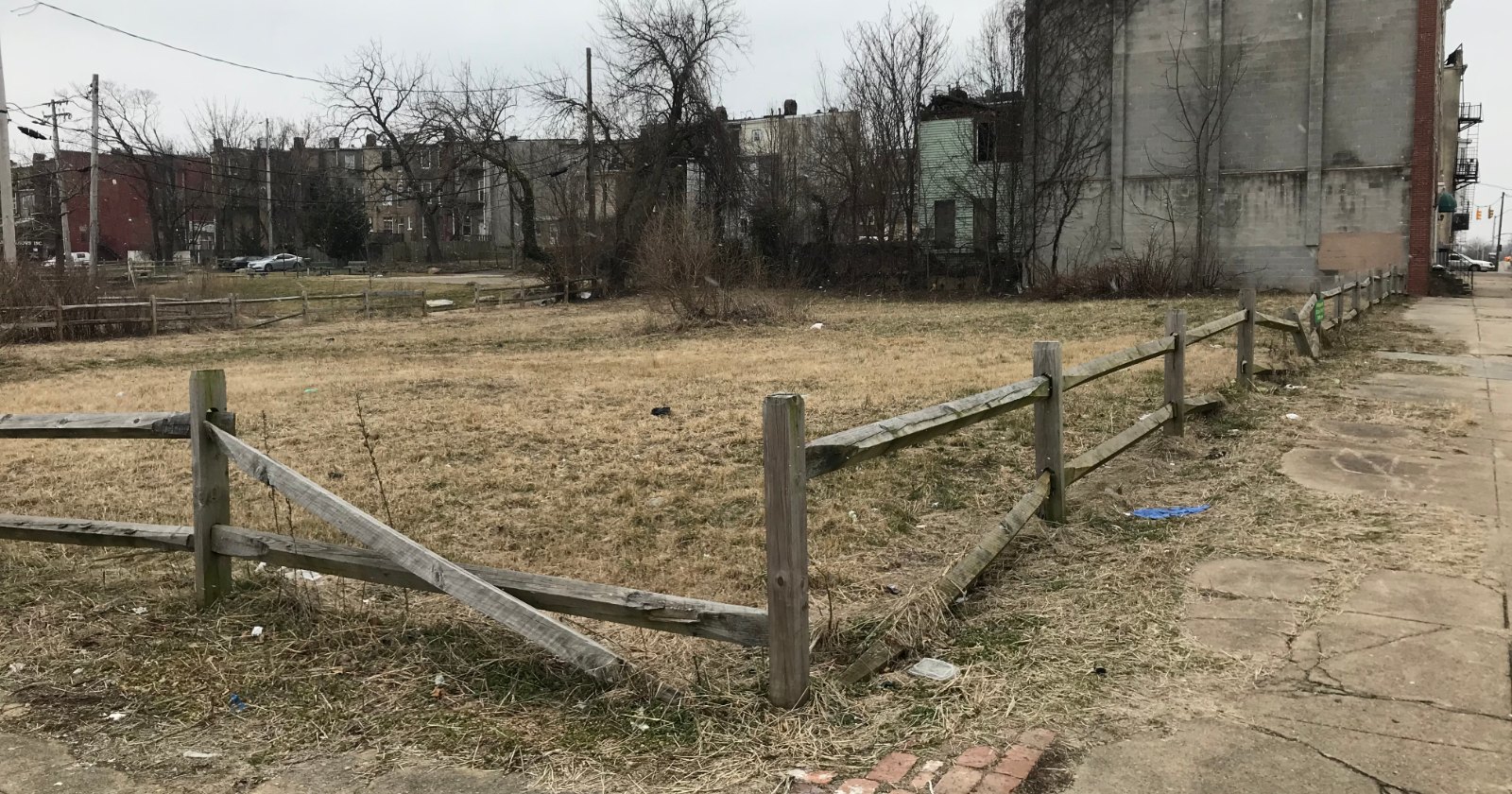
In the spring of 2013, landscaping crews spread out across Philadelphia’s empty lots, and which lot got what was decided at random. Some were left exactly as they were. Others had their trash hauled away. And the rest were transformed: rubble and weeds became fresh green lawns, with young trees and a neat wooden fence around the edge.
Eighteen months later, the difference showed up in police records. In the city’s poorest neighbourhoods, gun assaults near the treated lots fell by as much as 29 percent. The results were published in PNAS in 2018.
So how does grass on an empty lot stop a shooting down the street? It isn’t the grass. The answer, it turns out, is about who is watching, and what an empty lot lets people hide.
A lottery for empty lots
About 15 percent of the land in US cities is vacant or abandoned, according to the paper, an area roughly the size of Switzerland. Residents of poor neighbourhoods often name these lots as one of the biggest threats to their safety.
To test whether fixing them helps, a team led by epidemiologist Charles Branas, with researchers from the University of Pennsylvania, Columbia University and the US Forest Service, picked 541 vacant lots at random from across Philadelphia. They grouped them into 110 clusters and split those clusters three ways.
The first group got the full treatment. Crews removed trash, levelled the ground, sprayed down grass seed and planted a few trees. Then they put up a low wooden fence, about a metre high, with open gaps so people could still walk in. The fence was a visible sign that someone cared for the lot. The second group was only cleaned of trash and mowed. Both groups were kept up regularly after that. The third group got nothing.
The researchers then compared police reports from the 18 months before the work and the 18 months after. They also surveyed 445 people living nearby.
Less fear, more people outside
Residents felt the change. Near the greened lots, they were 58 percent less likely to say they avoided going outside because of safety worries. Hanging out, relaxing and socialising outdoors rose 76 percent.
Police records backed this up. Across the city, crime near treated lots fell only slightly. The big changes came in neighbourhoods below the poverty line. That is where the 29 percent drop in gun assaults was found, along with fewer burglaries and nuisance complaints.
That top figure comes with a caveat. Not every lot stayed as planned: some treated lots slid back into neglect, and some untouched lots got tidied up by someone else. The 29 percent is the researchers’ estimate after adjusting for those mix-ups. Going simply by which lots were meant to be treated, gun assaults fell about 10 percent.
Some crimes, however, didn’t budge. Robberies and drug offences stayed about the same. And the violence didn’t simply move a few streets over. When the researchers looked at the blocks just beyond each treated lot, crime there hadn’t gone up.
Where guns wait
So why would a tidy lot mean fewer shootings? To find out, a team of ethnographers spent time in two neighbourhoods, watching and listening.
In both, they saw drug dealers choose to work in front of vacant lots, not occupied homes, to avoid being “snitched on” by neighbours. Residents told them they didn’t dare confront dealers unless they were selling right outside their own row home. When a dealer was shooed away from someone’s door, he simply moved down the block and set up again in front of an empty lot. Overgrown lots also gave cover for drug use and escape routes during police raids.
Police and residents called vacant lots “storage lockers” for illegal guns. Young people in the poorer neighbourhood described something more careful. A gun was too valuable to leave in the weeds, where someone else might find it. So guns were hidden in cars, and the cars were parked in front of vacant lots, where dealers could keep them in sight without upsetting the neighbours.
A cleaned lot with a fence and grass takes away some of that cover. And when more people sit outside, there are more eyes on the street. In poorer neighbourhoods near the greened lots, the share of residents who said people watch out for each other more than doubled, though that estimate was less precise.
“When there are trash and weeds and dumping, it signals that no one is watching, that no one cares,” Melissa Stutzbach, director of the Pennsylvania Horticultural Society’s LandCare program, told Reasons to be Cheerful this year.
Calmer, not just safer
The same trial also asked residents about their mental health. In a separate paper in JAMA Network Open, people living near greened lots were 41.5 percent less likely to report feeling depressed than those near untouched lots. Below the poverty line, the drop was 68.7 percent.
Here, the grass did matter. Picking up the trash alone made no measurable difference to mental health.
Cheap, but not self-funding
For gunfire, though, the simpler option held up well. A follow-up study looked only at shootings that injured or killed someone. Both treatments cut them significantly, by about 7 percent for greening and 9 percent for trash cleanup and mowing.
The work is cheap. Cleaning and greening a lot cost about $1,600, plus about $180 a year to maintain, according to a 2016 study by the same team. That study estimated that every dollar spent greening a lot saved taxpayers $26 in gun-violence costs.
A 2022 analysis pooling eight studies gave a much less rosy answer. It found greening cut gun violence by about 6 percent, and mowing alone had no clear effect. But in a city that greened all its vacant lots, the savings from less gun violence would cover only 8 to 21 percent of the cost.
The two studies were asking different questions. The 2016 study looked at Philadelphia, where gun violence is high, and the few thousand lots it had already treated. The 2022 study modelled other cities, with less violence, slowly greening every vacant lot over 20 years. Its authors still concluded that the health and environmental benefits could make up the difference.
The catch
The trial has limits. It followed neighbourhoods for 18 months, so it can’t say how long the effects last, although earlier studies of the same treatment found drops in gun violence lasting more than three years.
There is also a harder question. A nicer neighbourhood can draw developers and push out the people who live there. In one area that was changing fast, the ethnographers recorded racial tensions and some hostility to the greening. In the poorer area, almost everyone they spoke to welcomed it.
The researchers note that fewer than 5 percent of lots treated this way had been turned into homes or businesses, and that the city had passed a law to limit property tax rises for longtime residents. But the worry hasn’t gone away. “Gentrification is starting,” Linda Lloyd, a West Philadelphia block captain, told Reasons to be Cheerful. “We have to fight predator[y] developers.”
From experiment to city habit
Philadelphia hasn’t waited for every answer. LandCare now looks after about 12,000 lots, around a third of the city’s vacant land, at a cost of about $7 million a year. In 2025, Mayor Cherelle Parker’s budget proposal included $8.5 million over five years for the Horticultural Society to keep cleaning vacant lots.
This year the model began to spread. In June, the society took LandCare outside Philadelphia for the first time, starting on about 100,000 square feet of vacant land in Chester, Pennsylvania. In August, the Pew Charitable Trusts gave $1.15 million over four years for greening in the North Philadelphia neighbourhoods of Nicetown and Tioga, with a University of Pennsylvania team set to study the effect on violence.
For decades, American cities have tried to fight disorder with policing, under the broken windows idea that small signs of neglect invite bigger crimes. The Philadelphia trial agreed that neglect matters. It just changed who showed up to fix it. Instead of police, it sent landscapers. And in the city’s poorest neighbourhoods, the shooting slowed.