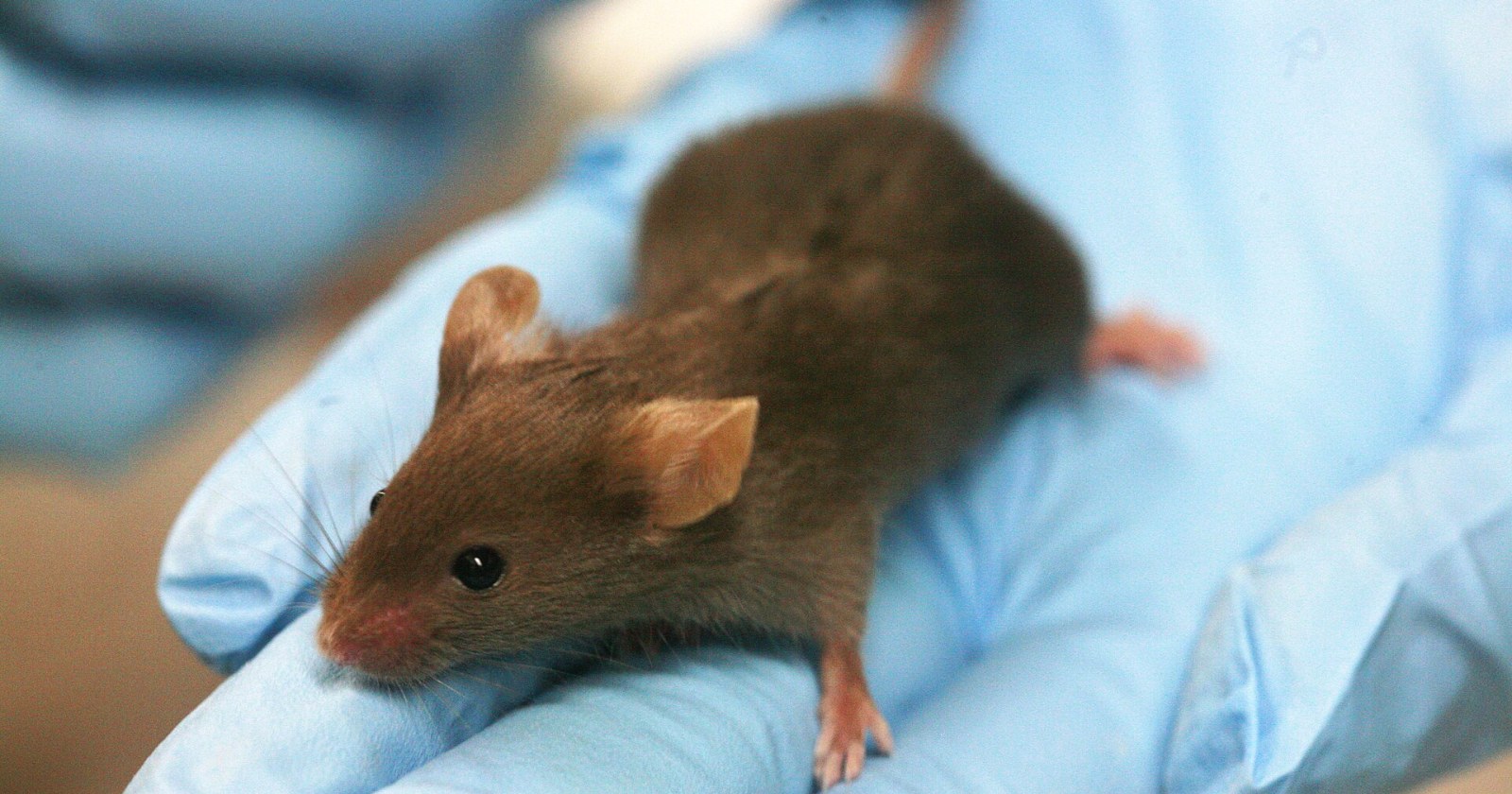
In 2009, a team at the Max Planck Institute for Evolutionary Anthropology in Leipzig gave mice a human gene. The gene was FOXP2, and the human version differs from the chimpanzee’s by just two amino acids, the building blocks of proteins. The team swapped those two changes into the mouse’s own copy and watched.
Mostly, nothing happened. Across roughly 300 tests, the team reported in Cell, the vast majority showed no difference from ordinary mice.
The exceptions sat deep in the brain. In the striatum, a region that helps control movement and build habits, nerve cells had grown longer branches, and when the team grew those cells in a dish, the branches came out about 80 percent longer than normal. The edited mice also explored less and had lower dopamine in all five brain regions measured.
Then there were the babies. Recorded through their first two weeks, 32 edited pups called out just as often as 39 ordinary ones, but their most common squeaks came out slightly lower in pitch, and flatter.
Two amino acids, and parts of the brain grow differently. No wonder FOXP2 became famous as the gene that lets us talk. That reputation is not quite deserved, and the real story is stranger.
The master switch
FOXP2 does not carry instructions for language. It is a master switch, a protein that turns other genes on and off. A 2011 study found it latching onto 264 genes in the developing mouse brain, pointing to networks involved in growing those very branches.
Nudge the switch and everything wired to it shifts a little.
The gene is also old. Mice have it. So do songbirds. The mouse and chimpanzee proteins differ by a single amino acid, and the human one by two more.
The family that started it
The trail began with a London family, known to scientists as the KE family. Across three generations, about half of them have a severe inherited speech disorder. In 1990 they became famous for trouble with plurals and tenses, read at the time as a problem with grammar, a story later retold in Steven Pinker’s The Language Instinct, as The Transmitter recounted.
A closer look told a different story. In 1998 Faraneh Vargha-Khadem and colleagues reported in PNAS that every affected member struggled with the same three things: repeating words, repeating made-up words, and making quick sequences of mouth and face movements. The core problem was coordination, not grammar.
Brain scans added a clue. In affected members, the caudate nucleus, part of that same striatum, was smaller on both sides.
Simon Fisher and colleagues at Oxford traced the disorder to a single mutation in FOXP2 in 2001. A year later, Wolfgang Enard and colleagues reported in Nature the two changes that set the human version apart, along with signs that natural selection had swept them through our ancestors.
“First language gene discovered,” ran the BBC’s headline. Fisher pushed back in the same article: “We don’t think this is THE speech gene.” The label stuck anyway, and Fisher later told The Transmitter it irked him.
Why the language gene label fell apart
Take the phrase “a gene for language” at its word. If two changes gave humans speech, those changes should belong to humans alone. They don’t. In 2007, Johannes Krause and colleagues sequenced FOXP2 from Neanderthal bones and found, as they reported in Current Biology, the same two changes.
That puts them before the last common ancestor of Neanderthals and modern humans, who lived about 300,000 to 400,000 years ago. Whatever the human version does, Neanderthals had it as well.
The sweep went next. A team led by Brenna Henn reanalysed the whole gene in hundreds of genomes from around the world, and in 2018 reported in Cell: “We do not find evidence of recent positive or balancing selection at FOXP2.” The original signal, they concluded, came from a sample made up largely of people of Eurasian descent.
None of this undoes the biology. Co-author Sohini Ramachandran said in the press release that the story of FOXP2 “is really more complex than we’d ever imagined.”
Even the squeaks proved slippery. In 2015, Kurt Hammerschmidt, Enard and colleagues recorded 68 adult males and found no change in their calls, concluding that the pup effect “appears to be transient.” A 2021 study with a different setup did find differences in adults, so that question stays open.
Mice are a limited stand-in for speech anyway. Their calls, the 2015 team noted, are hardly shaped by vocal learning.
A gene for practice
The more interesting clue came from a maze. In 2014, Christiane Schreiweis, Ann Graybiel at MIT and colleagues, Enard among them, tested the edited mice in PNAS. A mouse could find food by remembering where it was, using landmarks, or by learning a fixed routine that eventually runs on autopilot.
Where either strategy worked, the edited mice learned faster. Tested on each strategy alone, they were no better than normal mice. They stood out in the handover: pushed from the deliberate, landmark-based approach to the automatic one, they made the switch faster.
Graybiel told MIT News the gene may be tied to “a special kind of learning, which takes us from having to make conscious associations in order to act to a nearly automatic-pilot way of acting based on the cues around us.”
Now think about what talking is. Every sentence is a rapid run of tongue, lip and jaw movements, practised until no one has to think about them. It is precisely the skill the KE family struggles with.
Songbirds fit the pattern. When researchers reduced FoxP2 in young zebra finches, the birds copied their tutor’s song poorly. The errors lasted into adulthood, and the researchers likened the birds’ abnormally variable syllables to word production in children with a developmental speech disorder.
A caution belongs here. The maze-switching result rests on groups of seven or eight mice per genotype and a modest statistical margin, and a search for this article turned up no independent replication. Still, one study in mice points somewhere more interesting than a gene for words: a gene that helps turn effort into habit.
Many small changes
FOXP2 is not alone. In 2025, Robert Darnell’s lab at Rockefeller University described in Nature Communications a human-only change in another gene, NOVA1, absent from Neanderthals. Mice given the human version squeaked differently as well. The pups’ simplest calls came out quieter, and adult males courting females made more complex high-pitched calls.
Darnell said in the university’s release that NOVA1 “may be a bona fide human ‘language gene,’ though certainly it’s only one of many human-specific genetic changes.” Same story shape as FOXP2 in 2009. Same caution.
What emerges is not one gene that switched language on, but many small adjustments to the brain’s machinery for learning sequences of movement. It makes a less tidy story for the dinner table. It is also closer to the truth.
Fisher, who helped find the gene, has the last word. “It’s not this magical, mythical thing,” he told The Transmitter. “But it’s still a really exciting piece of biology.”