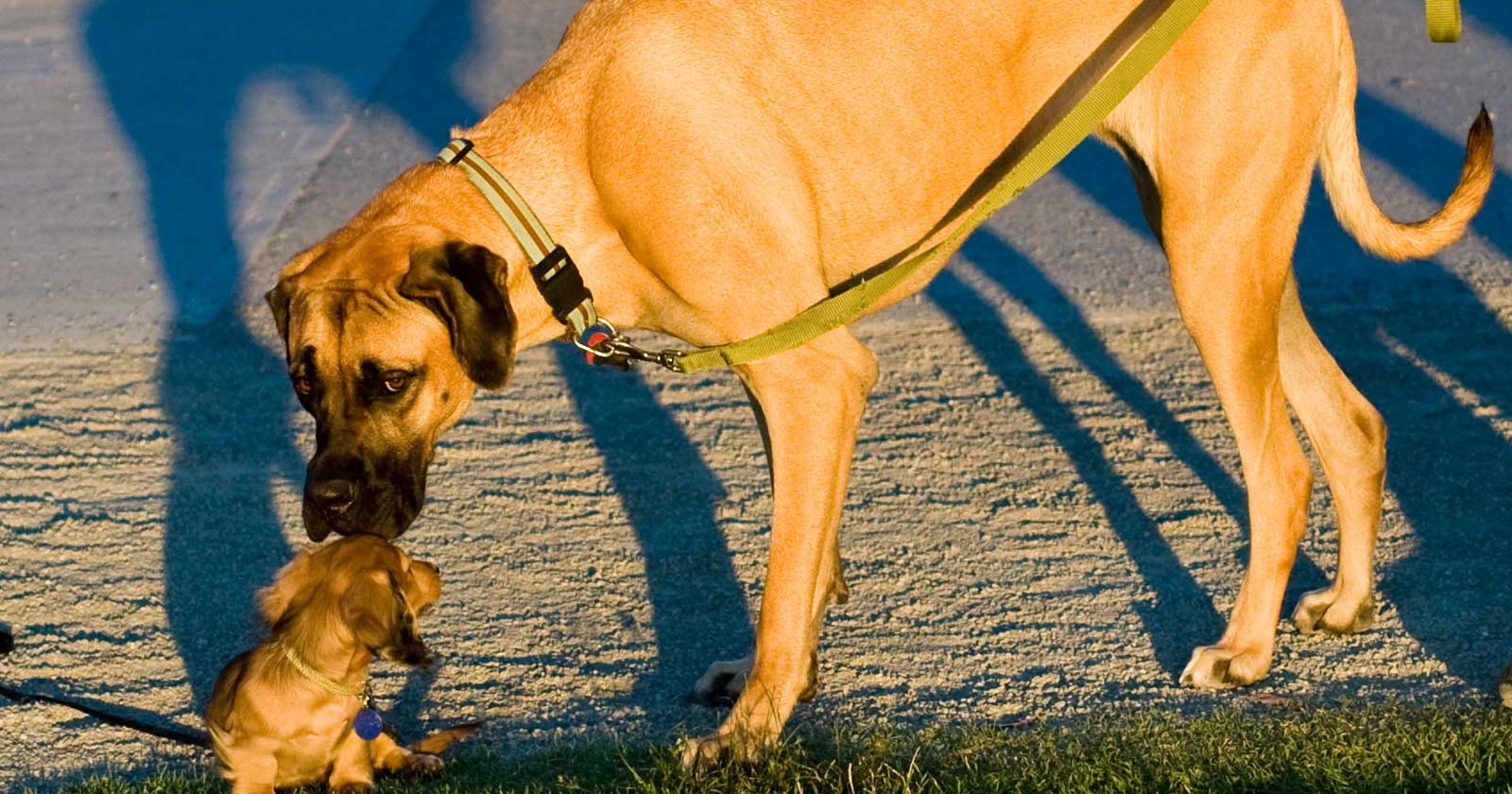
People, not millions of years of evolution, decided how big dogs would be. Breeders stretched a single species from a 2-kilogram Chihuahua to an 80-kilogram mastiff, and the big end of that range pays for it in years.
In a 2024 study of more than half a million dogs in the UK, the typical Great Dane lived to 10.6 years. The typical miniature dachshund reached 14.
A study published in Science on 8 October suggests part of that cost is written in the dogs’ DNA. A team led by Noah Snyder-Mackler at Arizona State University (ASU) read 1,640 blood samples from 894 dogs in the Dog Aging Project. In larger dogs, the chemical marks that keep “jumping genes” quiet faded 31% faster with age than in smaller ones.
That is about a third faster. It may be part of why big dogs age sooner, although the study cannot yet show that it is the cause, and the figure describes the marks, not the dogs themselves.
A rule that breeders broke
In nature, size usually buys time. Across mammals, lifespans run from a couple of years for mice to almost 200 years for some whales, as ASU’s press release notes.
Within a species, the rule tends to flip, and dogs show it more starkly than almost any other animal. Their size range was built in breeders’ kennels, not over evolutionary time.
Part of the job came down to a single gene. A 2007 study in Science found that one variant of a growth gene, IGF1, is a major reason small breeds are small. At the other end of the scale, big breeds tend to grow faster and die younger.
The price of every 2 kilograms
The cost of that choice can be put in months. In 2013, Cornelia Kraus, Samuel Pavard and Daniel Promislow examined ages at death across 74 breeds. Every extra 2 kilograms of body mass, they reported in The American Naturalist, cost about a month of life expectancy.
Big dogs did not mainly start out at higher risk. Their risk of death climbed faster with age. “Their lives seem to unwind in fast motion,” Kraus told LiveScience at the time.
Run that rule on two familiar breeds. A Labrador weighs around 30 kilograms and a Great Dane around 65, a gap of 35 kilograms, which works out to about 17 or 18 months by Kraus’s estimate.
The real gap is wider. In the UK data, Labradors lived a median of 13.1 years, two and a half years longer than Great Danes. The 2013 rule came from veterinary teaching hospital records, so it is a rough guide rather than a forecast for any one dog.
Reading the bill in blood
If big dogs age faster, the speed should leave a trace inside the body. One place to look is DNA.
DNA carries small chemical tags, called methyl groups, that help switch stretches of it on or off. Their pattern shifts with age. Read enough of them and they give an estimate of age known as an epigenetic clock.
The ASU team built such a clock for dogs. It predicted a dog’s age to within about a year, and dogs whose clock ran ahead of their real age were more likely to die over the next two years, Nature reported.
By that clock, larger dogs aged faster, and so did males, even those neutered young. The clock also ran fastest in young dogs, which the paper takes to mean that epigenetic ageing is fastest early in life.
Where the jumping genes come in
The size effect was largest in an odd corner of the genome. Jumping genes, or transposons, are stretches of DNA that can copy themselves and paste the copies elsewhere in the genome, sometimes damaging genes where they land. One of the largest families is called LINE1, and methyl marks normally keep these elements switched off.
In the dogs, those marks thinned with age, and they thinned faster the bigger the dog. The effect showed up across many kinds of jumping genes. It was strongest in the evolutionarily young LINE1s, the most recent arrivals in the dog genome.
The raw changes are tiny. In a 2024 preprint of the work, LINE1 methylation in giant dogs fell by about 0.24% a year. In small dogs it rose slightly, by 0.08% a year.
Two sets of numbers
The figures circulating about this study do not all match. The press release cites 864 dogs and says giant breeds lost “approximately 35% more LINE1 methylation per year than small breeds.” The 864 matches the 2024 preprint.
The peer-reviewed paper is larger. It reports 1,640 samples from 894 dogs and a 31% stronger loss of these marks with age in larger dogs, measured across jumping genes generally. Where the two disagree, the published paper is the one to trust.
“Larger” in the paper does not mean giant breeds. Borbála Turcsán, who studies ageing dogs at Eötvös Loránd University in Budapest and was not involved in the work, pointed out in an email to ScienceBlog that size was estimated genetically, from variants linked to stature, and that the analysis split the dogs at the median of the sample. “The result should not be interpreted as applying specifically to giant breeds,” she said.
Nor is 31% a measure of how fast a dog ages. “It does not mean that larger dogs age 31% faster overall, or that they will develop age-related health problems 31% earlier,” Turcsán said.
The release also calls the result “the first compelling molecular explanation” for why large dogs live shorter lives. The paper’s own abstract is more careful, describing jumping genes as “potential mediators” of the size effect.
Where the evidence stops
The study links size, age and these marks. It does not show that breeding for size caused the loss, or that the loss shortens lives.
The preprint describes its data as “cross-sectional in nature” and says it does “not quantify the degree to which LINE1s are transposing with age.” No one watched a gene jump.
Cross-sectional means the study largely compares young dogs with old ones at a single point in time, rather than following each dog from puppyhood to old age. A gap between a young dog and an old one may reflect ageing, or how those particular dogs were bred, fed or raised.
So “per year” here describes a trend across many dogs, not a change tracked through any one dog’s life.
The samples were also limited to immune cells in blood, so the pattern in other organs is unknown. In the preprint, body size was tied to methylation at only 375 regions of the genome, about 1.5% of the number tied to age. Even the press release concedes that more research is needed to determine “whether LINE1 activity is a cause or consequence of aging.”
Two disclosures are worth knowing. Snyder-Mackler is an inventor on a pending US patent application for a canine epigenetic clock. Promislow, a co-author, founded the Dog Aging Institute and serves as its treasurer, and the institute is among the study’s funders.
What dog owners can do now
No one can breed the size back out of a Great Dane already on the sofa. Nor does any treatment target this loss yet.
Turcsán would not have owners change anything for now. She reads the study as “an interesting finding suggesting that body size is indeed associated with molecular processes of aging, rather than as a reason to change how they care for their dogs.” The missing step, she said, is tying these molecular changes to “clinically meaningful outcomes,” such as illness or physical and cognitive decline, “before drawing practical conclusions for individual dogs or specific breeds.”
Until that work is done, the nearest thing to help for an ageing dog lies in two drug trials.
Loyal, a San Francisco company, is developing a daily pill called LOY-002 for dogs aged 10 or older and weighing at least 14 pounds. On its website, the company says the FDA has accepted two of the three main parts of its application, with manufacturing still in review.
“FDA approval not guaranteed,” the site adds. Its main efficacy trial runs until around 2029.
The Dog Aging Project is also running TRIAD, a placebo-controlled trial of rapamycin, a drug that has extended lifespan in laboratory animals. It is aimed at medium and large dogs. Those aged seven or older and weighing at least 44 pounds take it weekly for a year, then are followed for two more.
The trial aims to enrol 580 dogs and is due to conclude in November 2029, so final results are not expected before then. Owners who want to help can enrol their dog at dogagingproject.org through a short online survey, joining about 55,000 dogs so far, according to Nature.
A choice that shows in the blood
For researchers, a working clock may matter as much as the jumping genes. A test that reads a dog’s biological age could tell a trial whether a drug is slowing ageing years before anyone would see a difference in lifespan.
The pattern also echoes what Turcsán has seen in behaviour. In her own study, dogs over 30 kilograms began to show behavioural decline two to three years earlier than smaller dogs. “It provides a molecular background for something we also observe at a behavioural level,” she told Nature.
Her dogs held a twist, though. The larger ones started to look old sooner, yet their cognitive decline was slower. One possible reading, she said, is that big dogs wear out first in the body, through joints, muscles or senses, rather than in the brain. “A dog may appear ‘old’ because it moves more slowly or has sensory impairments, without necessarily showing the same degree of cognitive decline.”
That fits where the ASU team looked. They read immune cells in blood, not brain tissue. If the clock is tracking ageing across the body “rather than brain-specific aging,” Turcsán said, the two findings “could therefore fit together quite well.”
The Great Dane slowing on the stairs may, in other words, be older in its joints than in its head.
Breeders chose size, not long life, and the small end of the range kept its staying power. Brianah McCoy, a co-lead author now at the University of North Carolina at Chapel Hill, still remembers her grandmother’s Chihuahua.
“That dog lived for like 20 years,” she told Nature. “And she was not nice.”