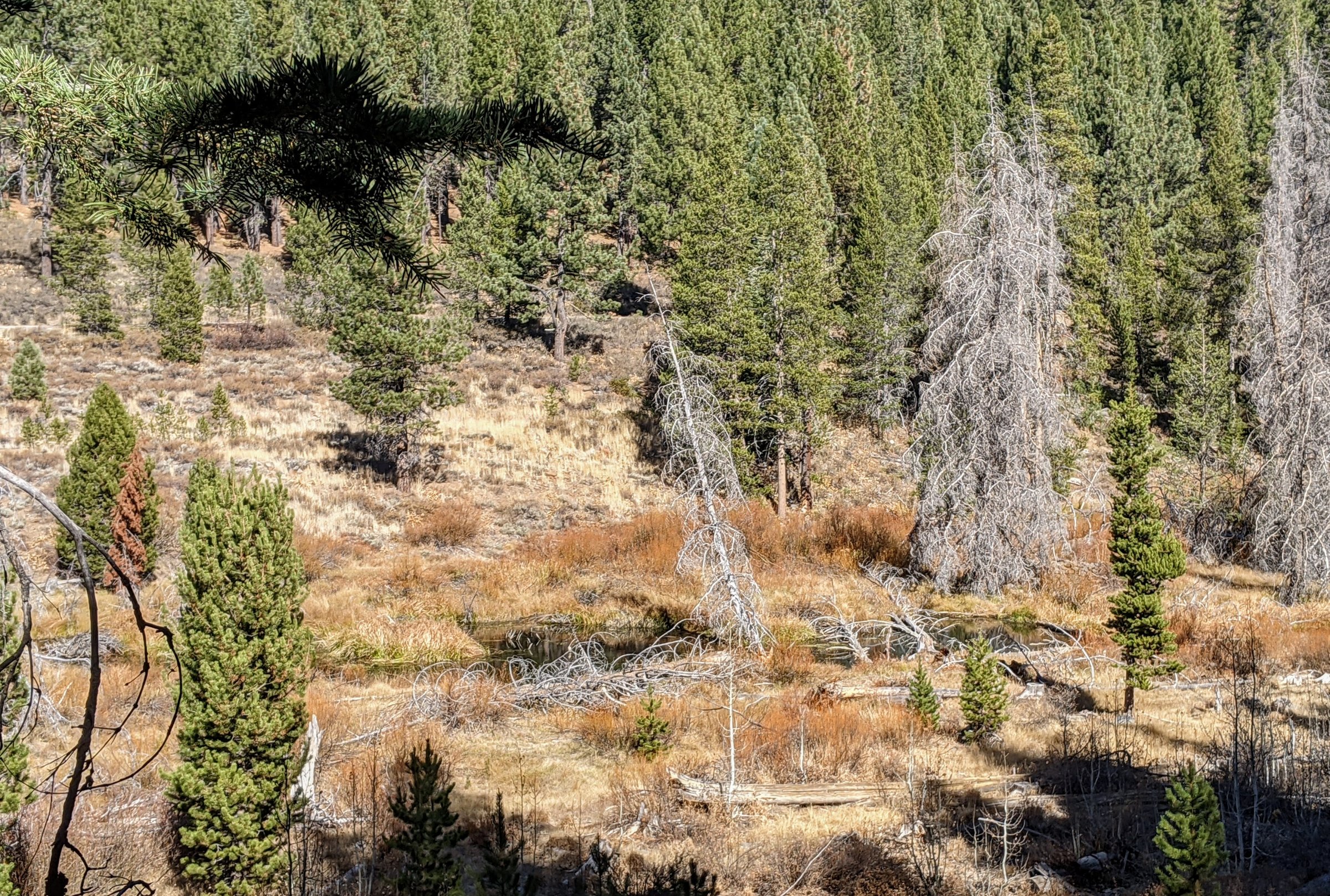
California released a family of seven beavers into a mountain meadow in Plumas County on 18 October 2023, the state’s first beaver conservation translocation in nearly 75 years, the California Department of Fish and Wildlife said.
Between 1923 and 1945, government programmes relocated 338 beavers to 29 of California’s 58 counties, according to a 1946 state report, as summarised in a 2012 review in California Fish and Game.
That earlier effort aimed to extend the beaver’s range into non-agricultural areas, both to produce “a valuable fur crop” and in the hope of gaining “water storage, erosion control and aesthetic values”, the 1946 report said, as quoted in the review.
“Beavers help retain water on the landscape, which increases groundwater recharge, improves summer baseflows, extends seasonal flows and increases fuel moisture during wildfire season,” Charlton H. Bonham, the department’s director, said in a December 2023 news release announcing the release.
The resulting green belts “can serve as wildfire buffers or breaks and provide refugia for wildlife”, he said.
The department worked with the Maidu Summit Consortium on the release, at a site the tribal community knows as Tásmam Koyóm. The beavers had been trapped in Sutter County, where their activity was damaging lands supporting several threatened or endangered species, the release said.
The group was made up of an adult breeding pair, one subadult and four kits from two litters, according to an April 2025 department status report. An eighth beaver caught with them, a related adult male, was euthanised in captivity after developing symptoms.
The seven joined a single resident beaver in the valley. Nine days after the release the subadult male moved downstream to that animal, and the report says the department believes the two formed a mated pair.
The breeding pair produced at least one litter of kits in 2024.
Four further translocations followed between June and September 2024: five beavers went to a second Maidu Summit Consortium site and 16 to three sites on the Tule River Reservation in Tulare County.
The goal at the Plumas site is a breeding population that will maintain the meadow ecosystem, the department said.
Beavers were given full protection in California in 1911 as they neared extirpation, the 2012 review says. A 1921 estimate put the statewide population at 1,000, confined to the lower Central Valley.
Limited trapping allowed again by 1925 depleted the population and full protection returned in 1933. A 1942 estimate found only 1,300 beavers remained.
At the Plumas site the beavers had built at least seven dams as of the report, whose data run to February 2025, the longest nearly 100 metres. A dam one metre tall diverted streamflow onto the floodplain, the status report said.
Sources:
- Lanman, Perryman, Dolman and James, “The historical range of beaver in the Sierra Nevada: a review of the evidence”, California Fish and Game 98(2):65-80 (2012): https://nrm.dfg.ca.gov/FileHandler.ashx?DocumentID=67444&inline=1
- CDFW news release, 13 Dec 2023: https://wildlife.ca.gov/News/Archive/cdfw-releases-beavers-into-the-wild-for-first-time-in-nearly-75-years
- CDFW, Status Report on Beaver Restoration Pilot Projects, April 2025: https://nrm.dfg.ca.gov/FileHandler.ashx?DocumentID=231105