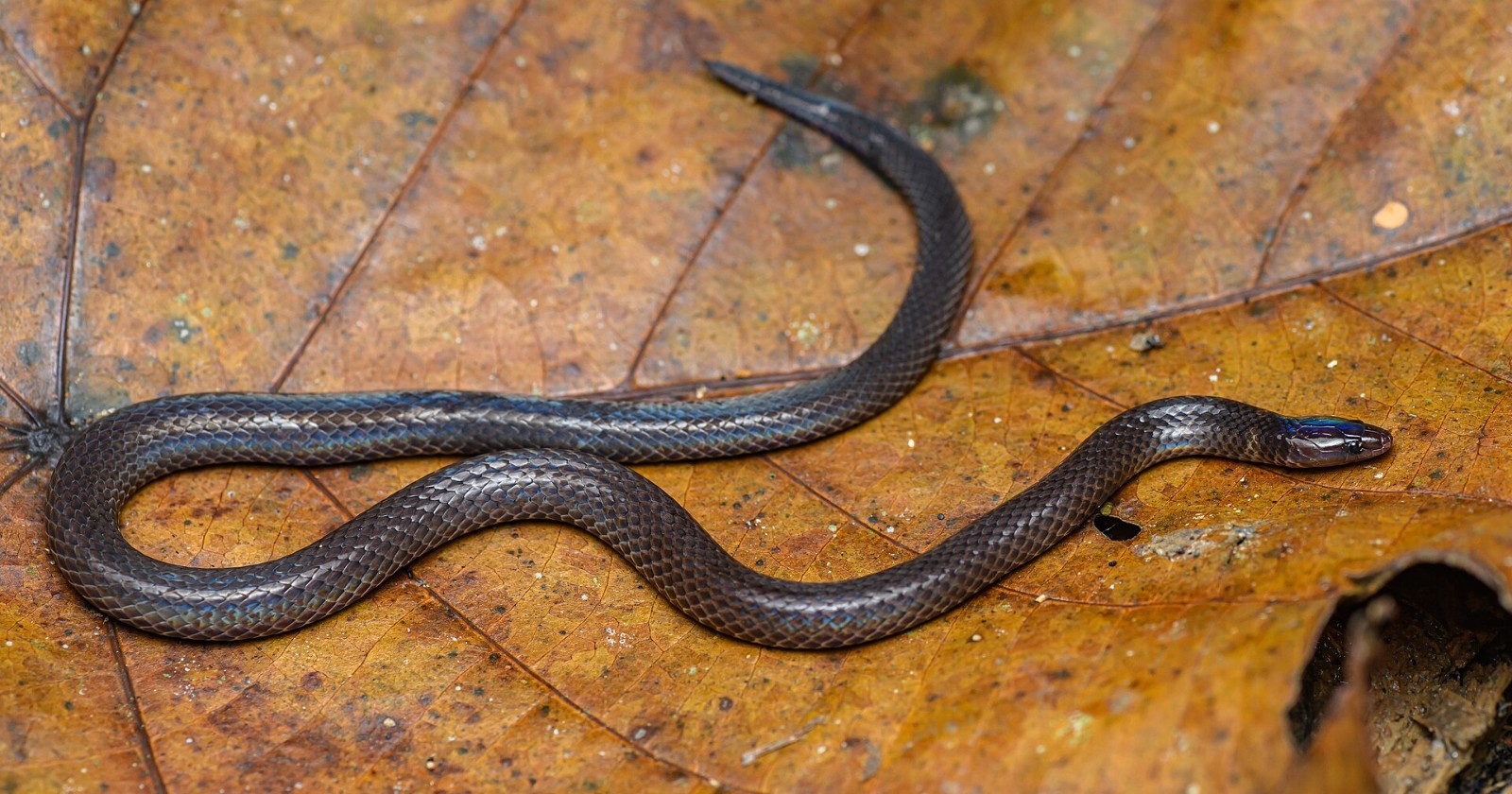
You give a tiny snake a gentle tap. You expect it to slither off, like every snake in every nature documentary you have ever seen.
It does not.
Instead, it curls the back half of its body into a loop, shoves off with its tail, and takes to the air for a split second. Then it lands and starts rolling away like a runaway wheel. Left side, right side, left side, right side. All the while, its head stays up and steady, like a tiny driver steering a tiny car.
Then it often dives under the nearest thing it can find and disappears.
Meet the dwarf reed snake of Borneo: lighter than a nickel, shorter than a school ruler, and a lot more dramatic than it looks. A team led by Yosuke Kojima of Toho University filmed it at 120 frames per second to see how it pulls this off, and published the results on 19 October in Current Biology. The fastest moment they recorded was 3.69 meters per second, about 8.3 mph. For a snake this small, that is a sprint.
How do you film a rolling snake?
Very carefully, and with sandpaper. The researchers worked with 13 dwarf reed snakes from Kubah National Park in Sarawak. They ranged from about 4 to 10 inches long, and the heaviest weighed just over 4 grams, according to the paper’s supplement.
Each snake went onto a track 2.2 meters long and 20 centimeters wide, lined with sandpaper, while two cameras recorded every move. The “danger” was a gentle tap from a human hand. No real predator was involved.
Every one of the 13 snakes rolled. Six reed snakes from a different genus, tested as a comparison, never did.
A wheel without an axle
The paper says the back of the snake rolls on the ground “like a wheel.” But a real wheel spins around an axle, and a snake does not have one.
Here is what the cameras saw instead. The snake rolls on one side of its body, then swings an arched section down past the side of its head. On the next turn it does the same thing on the other side, and the two sides take turns all the way down the track.
The strangest part is the head. It doesn’t tumble. It stays pointed where the snake is going, and in the fast rolls it is held up high and steady while the tail whips around behind it. Imagine running while your head spun like a wheel. These snakes roll and still keep their eyes on the road.
So how fast is 8.3 mph, really?
Here’s the honest version. The 8.3 mph belongs to one snake at its single fastest instant. The average of everyone’s best moments was 2.29 meters per second, or about 5.1 mph.
The “four times faster” part is also peak against peak. The paper found that top rolling speed was on average 4.0 times top slithering speed. It says only five snakes also slithered before or after rolling, so that comparison probably rests on a small group.
Now for the fun math, and this part is ours, not the researchers’. The supplement lists the study’s fastest snake, ID1, at 16.5 centimeters long. At 3.69 meters per second, that is about 22 of its own body lengths every second.
The top speed recorded in a study of wild cheetahs was 25.9 meters per second, and cheetahs in that study usually held their top speed for only a second or two. Cheetahs measure between 1.12 and 1.5 meters from nose to rump, so that works out to roughly 17 to 23 body lengths per second.
So the snake is not faster than a cheetah. A cheetah is far quicker in plain meters. But best burst against best burst, measured in body lengths, this snake lands in cheetah territory. Not bad for an animal that fits in your palm.
No hill needed
In 2023, scientists reported the first photographed cartwheel of a dwarf reed snake. That snake was seen rolling down a slope on a road in Malaysia, and the museum noted that these snakes can use downhill slopes to help them roll. That same snake, once caught and placed on flat ground beside the road, cartwheeled there too.
The lab racetrack was a flat lane, and the methods describe no slope. No hill, no gravity lending a hand, and the snakes still hit those speeds. So the roll is something the snake powers itself.
Nature almost never rolls
If rolling is so fast, why doesn’t everything do it? Stephen Jay Gould wrote an essay about it in 1981, and Richard Dawkins asked the same question in 1996. The usual answer is that a true wheel needs a part that spins freely, and a living body has to keep every part supplied with blood and nerves.
Animals that roll anyway are a short and strange list:
- Mother-of-pearl moth caterpillar: when threatened, it flips backward and rolls at about 39 centimeters per second, nearly 40 times its walking speed.
- Flic-flac spider: this Moroccan spider cartwheels at an average of about 1.7 meters per second, with a best of 2.
- Namib golden wheel spider: it rolls down sand dunes to get away from wasps, but only downhill.
- A beach-stranded mantis shrimp: it does backward somersaults, and for about 40 percent of each turn it rolls like a true wheel.
- Dwarf reed snake: about four times its slithering speed, on flat ground, with a steady head.
Don’t read this as a race. The caterpillar’s 40 times and the snake’s four times are measured against different things.
What we still don’t know
The short report doesn’t say how much energy the rolling costs or how far a snake can keep it up. It reports no wild snake using it against a real predator. And that 8.3 mph came from a lab track, not a chase.
So the snake is not a tiny cheetah. It is something odder: an animal that found a way around one of nature’s oldest rules, using nothing but a very clever curve.