Hey honey–remember when I accidentally left the chicken coop open and they all flew away? Well I think they’ve come back home to roost!
Last summer, we did an analysis of the 23andMe commercial promoting their genetic testing service and the egotistical identity politics it both taps into and contributes to. The ad was all about how your genes were “You” and knowing about them would enable you to predict your genetic future. Genetic profiling can in some cases give robust statistical estimates of likelihood of certain genetic conditions, but it is safe to say that we rarely know what that means. And it’s presented as though we do.
Now we find that FDA is ordering 23andMe to stop marketing their tests.
The 23andMe saliva sample kit, says FDA, is a “medical device,” “intended for use in the diagnosis of disease or other conditions or in the cure, mitigation, treatment, or prevention of disease, or is intended to affect the structure or function of the body.
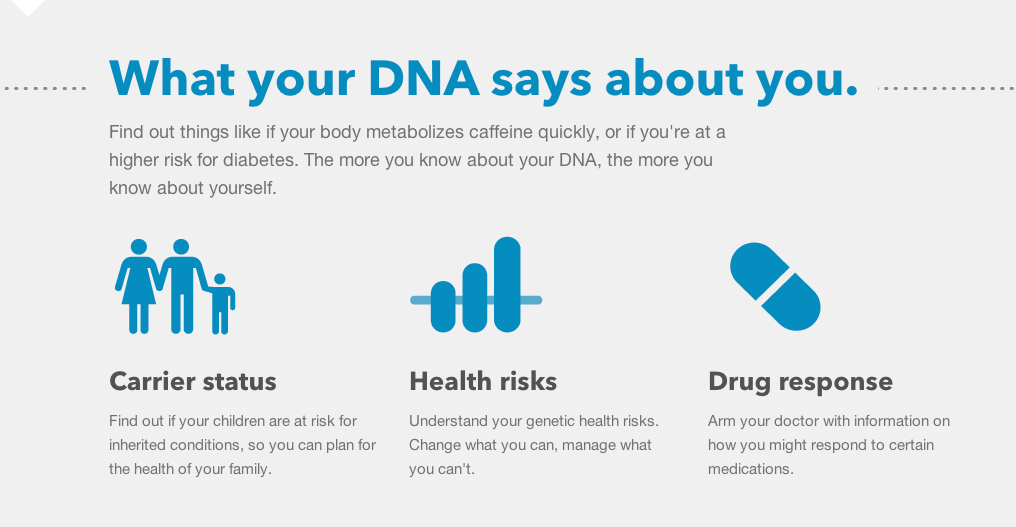
They cite the company’s claims to allow patients’ genome profiles to help them assess “health risks,” and “drug response,” and specifically as a “first step in prevention” that enables users to “take steps toward mitigating serious diseases” such as diabetes, coronary heart disease, and breast cancer.
This is not a shot over the bow–it’s the last straw. FDA has warned 23andMe repeatedly, going back to July, 2012, that they were making health claims about their product that they couldn’t back up.
The company offers two types of products: a genealogical “panel” or profile, and a health panel. The genealogical panel is popular but is apparently considered a harmless hobby, or at least outside the purview of the Public Health Service. It is not clear whether FDA (which, like the National Institutes of Health and the Centers for Disease Control) falls under the sprawling PHS will have any concerns about genealogical applications of the saliva test, but that would seem unlikely. The problem for 23andMe is that, as shown by the ad we analyzed earlier, they have been pushing the health panel very hard. Family trees are a hobby; health is where the real money is.
Direct-to-consumer medicine trails an appealing democratic, anti-authoritarian perfume that seems to make people slightly drunk. Mild intoxication can be pleasant, need not be dangerous, and sometimes can be a spur to creativity. But it can also impair your judgment. When you’ve gotta drive the kids home, you may need a couple cups of good strong regulatory coffee and a couple hours to sober up before getting behind the wheel.
A good deal of “preventive, participatory, personalized” medicine is profit-driven, and stockholders don’t necessarily have the public’s health foremost in mind. The FDA warning is a good illustration of why it’s important to balance the goal of stimulating innovation and economic growth with the goal of maximizing health. For the former, the free market can be a powerful tool. But for the latter, sometimes you need a little good old-fashioned meritocratic oversight.
h/t Robert Resta, Mark Largent