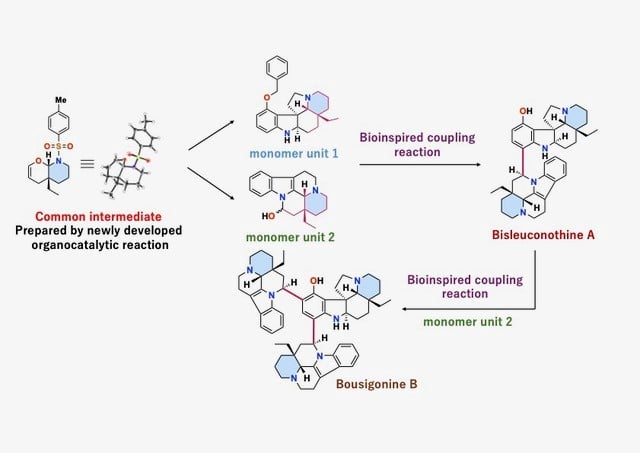
Bisleuconothine A was first isolated from plant bark in 2010. Prior laboratory work reported cytostatic activity in cultured breast- and lung-cancer cell lines, meaning it slowed cell proliferation under those experimental conditions. That is preclinical evidence, not proof that the molecule kills tumors in patients.
That wait may be over. A team at Chiba University in Japan has assembled bisleuconothine A in the lab atom by atom, the first time the compound has ever been built from scratch.
To understand why this took so long, you have to look at what the molecule actually is. Bisleuconothine A belongs to a sprawling family called monoterpenoid indole alkaloids, or MIAs, and it is one of the awkward oligomeric ones, meaning it is stitched together from more than one alkaloid unit into a big, lumpy three-dimensional shape. That bulk is precisely what makes it interesting to drug developers. Conventional small-molecule drugs tend to be flat and tidy, and they are not much good at jamming themselves into the interfaces where two proteins meet, but a large, contorted molecule like this one might just be able to wedge itself in there and break the contact.
Disrupting those protein-protein interactions is a long-standing dream in oncology. The trouble has always been getting hold of enough of the molecules that can do it.
Plants assemble these things effortlessly, of course, through enzymes refined over millions of years. Chemists, working without that machinery, face a structure riddled with interlocking rings and a fistful of stereocenters, the points where the molecule’s atoms have to be arranged in one specific handedness and no other. Get a single one wrong and the biological activity can simply vanish. So drug research on oligomeric MIAs has limped along, starved of material.
One Building Block to Rule Them All
The Chiba group, led by Hayato Ishikawa, went after the problem sideways. Rather than grinding out a bespoke route for each molecule, they built a single versatile fragment first and worked outward from there.
The fragment in question is a chiral 3-ethylpiperidine scaffold, a small ring system that crops up again and again across the MIA family, and the team coaxed it into existence using what is known as organocatalysis: chemistry driven by small organic molecules rather than the metal catalysts that dominate so much of synthesis. The reaction runs as a cascade, several transformations firing in sequence in a single pot. A chiral amine catalyst nudges a Michael addition along, locking in the correct handedness from the off, and a couple of further steps (a cyclization, then an acetalization) tidy the piece into a pure, reusable intermediate. Crucially they needed only a whisker of catalyst to do it. From that one common building block they then fashioned two different alkaloid fragments and stitched them together with a coupling reaction deliberately designed to mimic how a plant might do the join itself.
That biomimetic step is the elegant bit. It delivered bisleuconothine A in 20 steps.
And then it kept going. With one additional step the same approach produced a second, even more elaborate molecule called bousigonine B, a trimeric MIA built from three alkaloid units rather than two, marking the first time anyone has completed the total synthesis of a trimeric MIA at all. The work, published in Angewandte Chemie International Edition on 23 May, also quietly corrected the record: the team found that the accepted absolute stereochemistry of bousigonine B was wrong, and their synthesis revises it.
From Bench to Bedside, Eventually
None of this makes a cancer drug tomorrow. A total synthesis is a proof that the molecule can be made and made cleanly, not a finished therapy, and there is a long road of biological testing between a flask of pure compound and anything a patient might receive. Still, having a reliable supply changes what is possible to even attempt.
“The present method for total chemical synthesis is expected to facilitate the development of new pharmaceutical agents. In particular, bisleuconothine A has exhibited potent anticancer activity, highlighting its potential as a lead compound for anticancer drug development,” says Ishikawa.
The bigger prize, arguably, is not either molecule on its own but the strategy that yielded both. Because so many alkaloids share that 3-ethylpiperidine core, a single well-behaved intermediate could in principle open the door to a whole shelf of related natural products, the sort of compounds that have tantalized chemists precisely because they were too fiddly to make in any quantity. The team is already pressing in that direction. “Current efforts are directed toward the collective total synthesis of additional MIAs based on this newly established methodology, as well as subsequent biological evaluation for drug-discovery applications,” says Ishikawa. Which is a careful way of saying they intend to make a lot more of these molecules, and then find out what they do.
DOI / Source: 10.1002/anie.6698305 (Angewandte Chemie International Edition)
Frequently Asked Questions
Why does building a molecule in the lab matter if it already exists in a plant?
Plants produce these compounds in small quantities. A completed 20-step laboratory route gives chemists access to material for further study and modification, but the paper does not demonstrate dependable manufacturing-scale supply.
How does a big, awkward molecule fight cancer differently from an ordinary drug?
Most small-molecule drugs are compact and struggle to interfere with the broad contact points where two proteins bind. A large, three-dimensional alkaloid like bisleuconothine A may be able to wedge into those interfaces and break the interaction. Disrupting protein-protein contacts is a target conventional drugs often cannot reach.
Is a cancer treatment now close at hand?
Not yet. A total synthesis proves the molecule can be made cleanly, but extensive biological testing still stands between a pure compound and an approved therapy. What changes is that researchers finally have enough material to do that testing properly.
What makes the trimeric molecule, bousigonine B, a notable first?
Bousigonine B is built from three linked alkaloid units, and no one had ever completed the total synthesis of a trimeric MIA before. The Chiba team also discovered that the compound’s accepted three-dimensional handedness was recorded incorrectly, and their work revises it.