

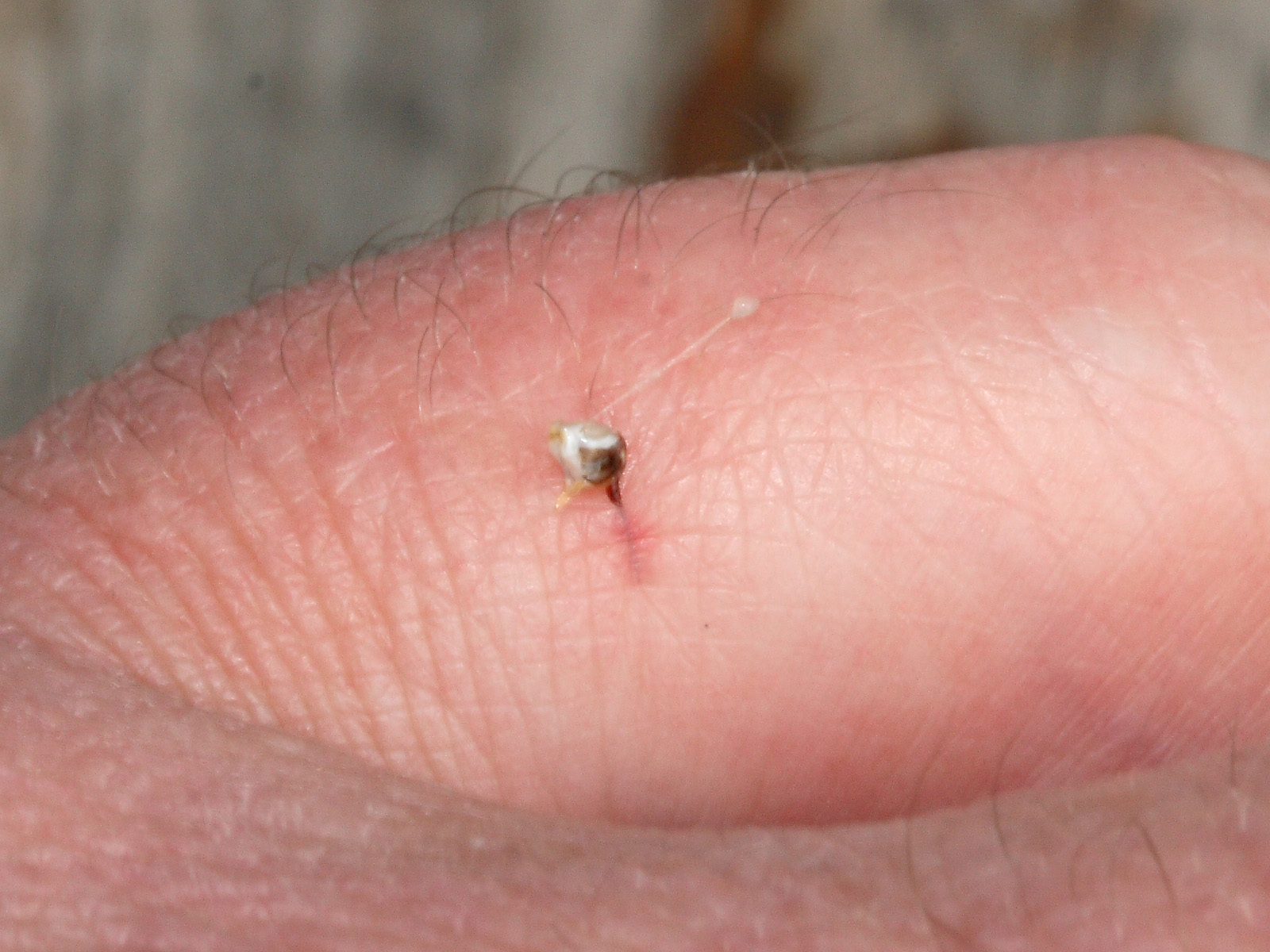
A honey bee stinger keeps pumping venom after it has been separated from the bee. In a study published in PNAS on 12 October 2026, Fiorella Ramirez-Esquivel and colleagues at Macquarie University and UNSW Canberra set detached stingers in a clear, skin-like gel and filmed them at high speed as they drove themselves deeper. Inside each one, two flexible valves take turns pushing venom towards the tip, working like a double-piston pump.
The footage shows how that pump runs once a sting is under way. How a sting begins is a separate question, and it is still open.
Two pistons taking turns
A honey bee stinger contains two slender lancets that slide back and forth along interlocking rails. Each carries a flexible valve inside an enlarged chamber called the bulb, which fills with venom from the venom sac. The same strokes that work the stinger deeper also drive the pump.
On the downstroke, towards the tip, each valve inflates against the chamber wall and pushes venom towards the exit. Macquarie University’s press release likens this to a parachute opening. On the upstroke the valve deflates so the chamber can refill, and that collapse may reduce how much venom is drawn backwards.
Because the two valves move in opposite phases, one is pushing while the other returns. Midway through their strokes they deform again to squeeze past each other, which keeps venom moving while the chamber refills.
Dr Sridhar Ravi, the project lead at UNSW Canberra, compares the design with a syringe in the UNSW release. A single plunger pushes fluid out when advanced but can draw it back when withdrawn. Two collapsible pistons working in opposition avoid that simple reversal.
Honey bees are not the only insects that pump venom this way. Ants also have paired valves on their lancets, while most wasps squeeze venom out with muscle around the venom sac instead, according to a 2026 study in the Journal of Morphology. What sets the honey bee apart is a stinger that keeps working after it leaves the body, powered by its own muscles and venom supply.
Footage from the study (Ramirez-Esquivel et al., 2026) can be watched on YouTube.
Watching the pump from the inside
The researchers pulled stingers from live worker bees with forceps, AAP reported, and set each one partway into the transparent gel. From there, the stinger drove itself deeper as its lancets alternated, giving the team a clear view of machinery normally hidden inside the bee and the tissue being stung.
They filmed at 100 and 300 frames per second in the gel, and at 500 frames per second without it. Honey bee stingers suit this kind of work because they are large and translucent enough to see into, and they detach from the bee on their own.
Six stingers, each from a different worker, were tracked through their full pumping sequence, with both valves followed for as long as they stayed visible, according to the study’s supplementary information.
Micro-CT scans gave the team a three-dimensional reconstruction of the internal parts. From those scans they built a scaled-up, 3D-printed working model to test how the pump should behave.
The valves themselves are not a new discovery. Ramirez-Esquivel told New Atlas that scientists have known about them since as early as 1910, “but until now we didn’t know exactly how they work.”
What isn’t settled yet
Even within the filmed cycle, one detail is unresolved. The team identified two possible ways the valves could change shape as they cross, and more work is needed to tell which is right, New Atlas reported.
The materials are another open question. According to Ars Technica’s report on the study, the team’s artificial valve only reproduced the right deformations when it was highly elastic and slid with little friction, which makes the properties of the real valves a natural next target.
The Journal of Morphology study raises a question about timing. Working on the ant Diacamma nr. indicum, its authors froze workers at the start of a sting and found both valves pushed forward together rather than alternating. They propose a cycle that begins with both lancets moving in step and shifts to alternating strokes on the return, and they say this challenges the strictly alternating model built on honey bees. Their evidence comes from stingers fixed in different positions, not from video of a live sting.
Alexandre Casadei-Ferreira of the University of Greifswald, first author of the ant study, told ScienceBlog: “Placing the stinger into the substrate, as in the PNAS videos and in most commonly used puncture methods, may bypass the initiation of stinging, which is precisely where I would expect an in-phase stage. Their results provide strong evidence for antiphase pumping once stinging is underway in honey bees, but whether an in-phase stage occurs at initiation is hard to say without an experiment designed specifically to capture that first moment.”
Whether bees share that opening stage, or it turns out to be particular to ants, has yet to be tested.
Why the pumping matters
For anyone with a stinger left in their skin, the practical point is speed. The UNSW release reports strong, regular pumping for 15 to 70 seconds, with twitching continuing for minutes. The study measured mechanics, not venom dose, so it cannot say how much venom enters a person in that time.
A 2020 systematic review in Cureus, based on two eligible studies, concluded that a retained stinger should be removed quickly and that pinching and pulling it out appeared to offer no disadvantage. On that limited evidence, there is no reason to delay while looking for something to scrape it off with.
Engineers may take note too. Two flexible pistons sharing one small chamber could inspire micropumps for moving liquids through tiny channels. Ramirez-Esquivel told AAP that people had suggested the design could help with “something like an insulin pump”, though that is an idea rather than a result of this study.
The next experiment would start earlier than these recordings, at the first moment of a sting. Filming that moment in bees as well as ants would show whether lancets that start in step give way to alternating strokes.
