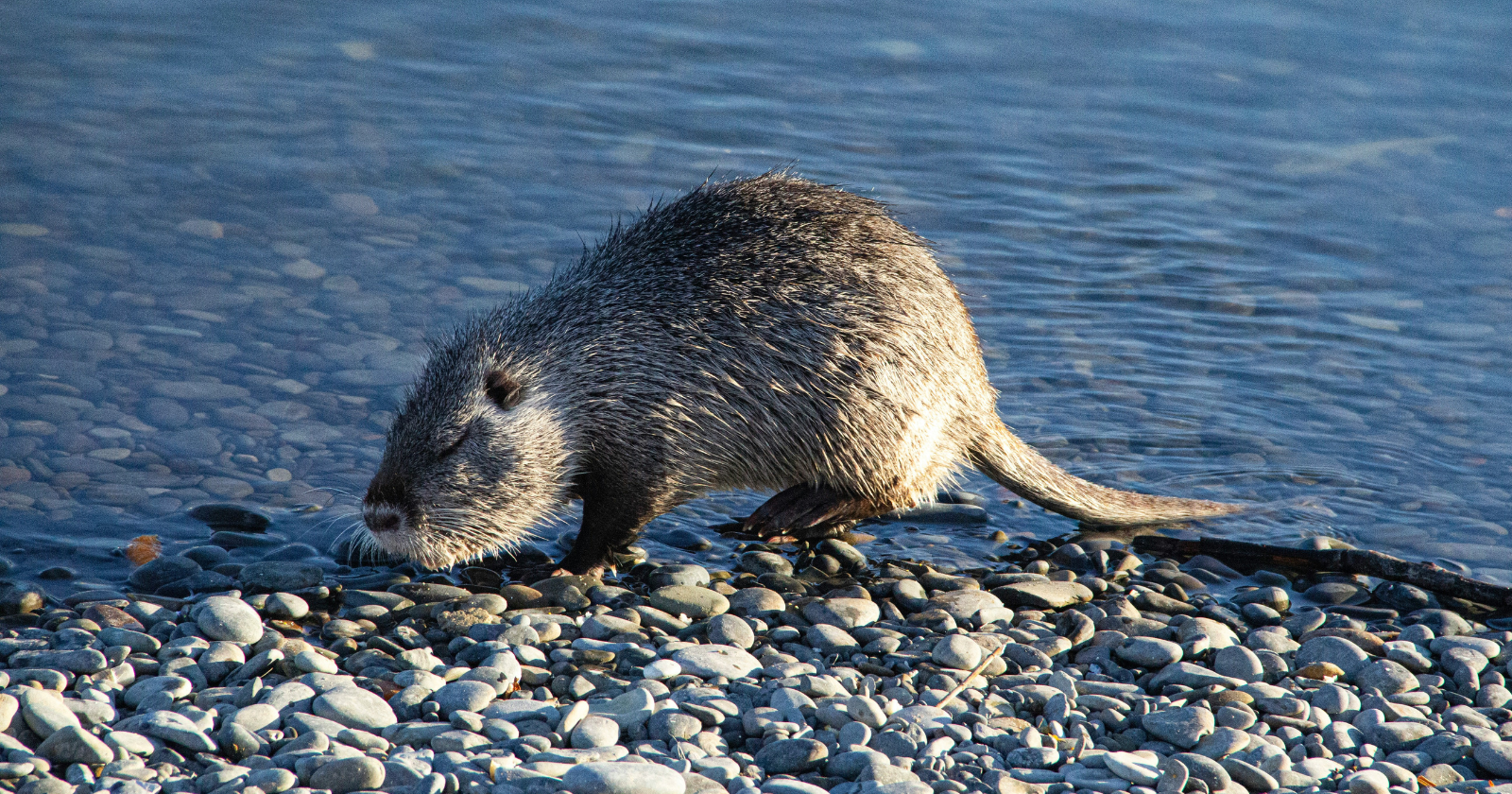
A twenty-pound rodent with bright orange teeth has its own nickname in Louisiana, a handful of recipes in a 1963 LSU cookbook, and at least one nonfiction book named after it, Swamp Rat. I stumbled onto all of this while reading about something else entirely and lost an afternoon to nutria history, which should tell you how strange the actual story is.
Most invasive species show up by accident. This one was brought in on purpose, then kept around on purpose a second time, for a completely different reason than the first, and both of those purposes eventually stopped making sense at almost the same moment.
A market invented on purpose
Nutria are native to South America, and Louisiana brought them in during the 1930s to stock private fur farms, part of a wider fur-farming push happening around the country at the time, according to the state’s Department of Wildlife and Fisheries. A 1959 report from that same agency’s predecessor, the Wild Life and Fisheries Commission, as the Historic New Orleans Collection has recounted, described the animal as a “voracious and prolific vegetarian,” which is a fairly polite way to introduce something that chews through rice fields, sugarcane, and levees. Within a couple of decades, officials had also started promoting nutria as a biological control for aquatic weeds, according to a wildlife-damage report later prepared for the state, so by the late 1940s the same animal was being defended for two unrelated reasons at once, one economic and one horticultural.
Even the origin story got a little embellished along the way. Edward Avery McIlhenny, the Avery Island businessman usually credited with popularizing nutria in the state, liked to say he had personally imported his breeding stock straight from Argentina. According to Shane Bernard, the historian who went back through McIlhenny’s own purchase records, that isn’t what happened. In March 1938 McIlhenny bought his first twenty nutria from an existing fur farm in St. Bernard Parish, Louisiana, a few hours up the coast rather than a few thousand miles south, through a middleman fur dealer. It’s a small detail, but it fits the pattern of this whole story. The version people told about nutria tended to be a little tidier than the paperwork behind it.
For a long stretch, the economic case held up regardless of who deserved credit for it. Edmond Mouton, a biologist program manager for coastal and nongame resources at Louisiana’s wildlife agency, told a U.S. Senate committee in December 2009 that “the harvest peaked in 1976 at 1.8 million pelts worth $15.7 million to coastal trappers.” Trappers didn’t fall off much after that peak, either. A wildlife-damage report prepared for the state put the average take at 1.3 million pelts a year between 1962 and 1982, with more than 1.2 million taken in the 1980-81 season alone. For thousands of coastal families, that was real, dependable income, built entirely on top of a fashion decision being made somewhere else.
What that number was actually measuring
I’m not an economist, a wildlife biologist, or a historian, and my most hands-on experience with fur trapping is watching a nature documentary next to my toddler, so take this next part as an opinion and not a finding. What gets me about the nutria boom is that none of it was really about Louisiana. The price of a pelt was set by what fashion houses in Paris or New York decided people should wear that season, not by anything a trapper in Terrebonne Parish could influence or predict. He could be the most skilled, hardest-working trapper on the coast and it would not matter one bit if buyers three thousand miles away lost interest in fur.
I think about success in a more personal way. Mine looks like financial security and a calm, healthy household, not winning some outside scoreboard I don’t control, and I’ve come to think other people’s versions of success are just as valid for them, even when they look nothing like mine. I’d guess that’s part of why the nutria trade came apart so completely once it started to slip. When your entire livelihood depends on someone else’s taste, you don’t get a vote when that taste changes, and you usually don’t get much warning either.
The buyers disappear
The taste changed fast. Synthetic fabrics undercut fur prices, the animal-rights movement made fur culturally toxic in a lot of markets, and then a run of unrelated economic shocks, the 1987 stock market crash, a 1991 luxury tax, the recession tied to the 1992 Gulf War, finished off what was left of demand, according to the state wildlife agency’s own account. The harvest numbers show exactly how fast it happened. From over 1.2 million pelts in the 1980-81 season, the take fell to just 134,000 by the 1990-91 season, according to the same wildlife-damage report, a drop of roughly ninety percent in a single decade. Plenty of trappers didn’t stick around to see if prices would come back. Oil and gas jobs paid better and more reliably, and people took them, as the Historic New Orleans Collection has documented.
The rodent that didn’t get the memo
Nutria, obviously, had no idea their own fur had gone out of style. Once trapping pressure eased off, the population did what an unchecked population does. Complaints about marsh vegetation damage, rare during the boom years, started appearing in 1987 and were routine by the early 1990s, Mouton testified. The numbers he reported to that same Senate committee are hard to argue with. Aerial surveys tracked coastal marsh damage climbing from around 45,000 acres in 1993 to 80,000 acres by 1996, then to roughly 90,000 acres in 1998 and nearly 105,000 acres by 1999, all of it land quietly turning from marsh into open water.
The state’s response was to rebuild, by hand and with a checkbook, something the fashion market used to do on its own for free. The Coastwide Nutria Control Program launched for the 2002-2003 season, paying trappers four dollars for every tail turned in, according to the historical archive 64 Parishes. Mouton reported that once the program was running, damaged acreage fell back down to around 20,000 acres coastwide, a fraction of where it had peaked. Two decades earlier, that same pest control had simply been a side effect of people wanting fur coats. Once nobody wanted the coats anymore, the state had to pay, out of its own pocket, for something the market used to hand over for nothing.
The cookbook recipes are still floating around if you’d like to try nutria yourself. The fur market that once made the whole arrangement profitable is not. The rodent, entirely unbothered by any of it, is still out in the marsh, tail included, waiting on whoever the state pays this season.