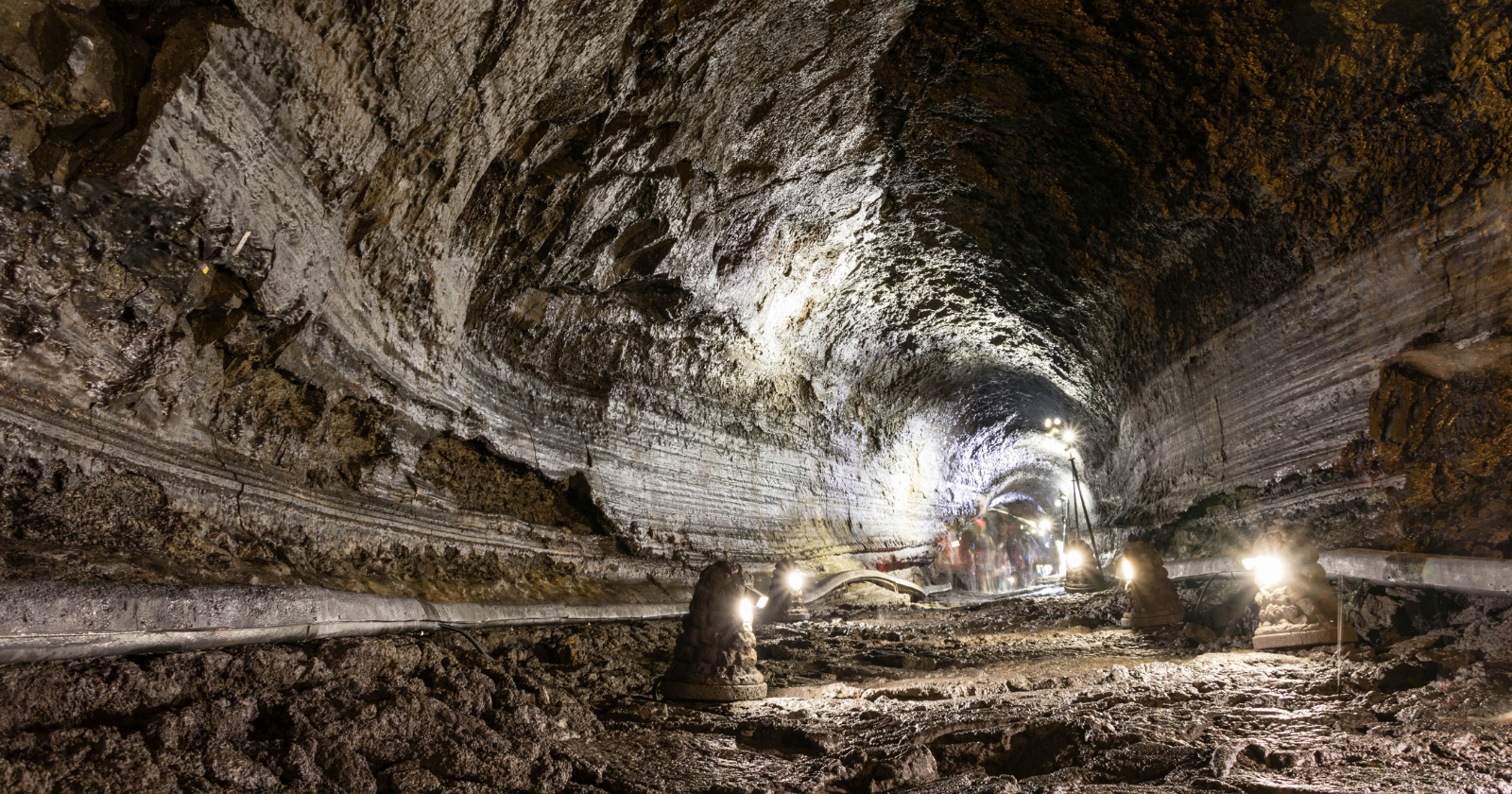
A lava tube is a tunnel that forms when the outer skin of a river of molten rock cools and hardens while the lava underneath keeps flowing, and eventually drains away completely, leaving a long hollow passage behind like a straw with the liquid sucked out. Most of them are short and unremarkable. Manjanggul, on South Korea’s Jeju Island, is neither.
I love finding out that some of the strangest, most alien feeling places on the planet are sitting a short drive from an ordinary tourist parking lot, no expedition required. Manjanggul is exactly that kind of place, and once you start reading about it, the questions pile up faster than the answers.
How does a tunnel like this even survive underground for that long?
The short version is that lava tubes are built to last in a way most underground spaces aren’t. As the outer surface of a lava flow meets air and cools, it hardens into a rigid rock shell within hours or days, while the still-molten interior keeps draining downhill through gravity alone. Once the last of that interior lava empties out, what’s left behind is essentially a solid rock pipe, not a fragile hollow waiting to cave in. That structural stubbornness is a big part of why a tunnel carved out this long ago is still walkable today, instead of having collapsed into rubble the way a lot of softer underground spaces eventually do.
So how long is Manjanggul, exactly?
A survey of the site found that “it stretches for 8,928 meters and its passages are up to 30 meters high and 23 meters wide,” wide and tall enough in places to drive a bus through if anyone were foolish enough to try. Walking it end to end at an easy pace takes a solid chunk of an afternoon, not a quick stroll. It’s part of a larger network called the Geomunoreum Lava Tube System, which is why you’ll sometimes see a much bigger number, over 13 kilometers, attached to the same cave. That figure is the whole connected system, not Manjanggul on its own, and mixing the two up is an easy way to end up with the wrong headline.
Where did it actually come from, and how old is it?
Manjanggul formed when the Geomunoreum volcano, on the northeastern side of Jeju, erupted and sent lava racing downhill toward the coast. A geological survey presented at the International Symposium on Vulcanospeleology places the eruption at somewhere between 100,000 and 300,000 years ago, based on the region’s volcanic history. That is a genuinely wide window, and it says something honest about how hard it still is to pin an exact date on volcanic rock this old. Either way, humans weren’t anywhere near modern yet when this tunnel formed. It just sat there in the dark for a few hundred thousand years before anyone walked through it.
What’s actually living inside a tunnel with zero light?
Here’s the part that made me stop scrolling. That same survey reports that “some 30,000 common bent-wing bats (Miniopterus schreibersii) have taken permanent residence inside the tube, forming the largest colony of bats so far known to be living in Korea.” Thirty thousand of anything living together in total, permanent darkness is a hard number to picture. It’s a small city’s worth of bats, hanging in a tunnel a volcano carved out before there were cities anywhere on earth.
Bats aren’t the only residents, either. The same survey identified around 38 types of cave-dwelling creatures across the wider lava tube system, the most common being the Jeju cave spider, a species that as far as anyone knows doesn’t live much of anywhere else on earth. All of it is adapted to a world with no sunlight, a stable temperature year round, and near total silence except for itself. Life that evolves in a place like that tends to give up things it doesn’t need anymore, like pigment or working eyes, and invest everything else in whatever actually helps it survive in the dark. It’s the same basic evolutionary logic that shows up in cave-dwelling species everywhere on earth, just playing out in a tunnel a volcano happened to leave behind.
Why a cave full of bats is more fragile than it looks
Manjanggul is not only associated with a common bent-wing bat colony. In July 2026, Jeju’s wildlife rescue centre treated one exhausted endangered red bat found near the cave entrance and released it back into Manjanggul after it recovered. Centre director Yoon Young-min described the species as nocturnal and light-sensitive, and said lighting, visitor noise and small changes in temperature or carbon-dioxide concentration can cause stress.
That’s the strange trade a place like this lives with. The reason Manjanggul is worth visiting at all, a genuinely otherworldly tunnel you can actually walk into, is the same reason every visitor adds a small amount of pressure to the thing they came to see. Only a portion of the full tube is actually open to the public for exactly this reason, with the rest kept closed off to keep the bat colony and the rest of the cave’s ecosystem as undisturbed as something this old can reasonably be.
Most of us will never stand in a cave that’s been sitting in total darkness since before our species figured out fire, sharing the air with thirty thousand bats that have never seen daylight in their lives. Having grown up moving between a handful of very different countries, I’ve noticed that the places people fly halfway around the world to see are rarely the whole story. Jeju gets sold on beaches and volcanic craters above ground, and the more interesting resident, in sheer numbers, has been living quietly underneath the whole time. It’s a strange kind of humbling, and it’s sitting under a fairly ordinary looking hillside on an island a lot of people visit for the coastline.