

Inside a quartz tube barely wider than a wrist, the temperature climbs past 800 degrees C and a forest begins to rise. Not trees, but carbon nanotubes, billions of them per square centimeter, standing on end like grass and lengthening upward at roughly a micrometer every second. Feed them acetylene, keep the iron catalyst at their roots alive, and they will climb for hours. The trouble has always been that the roots die first.
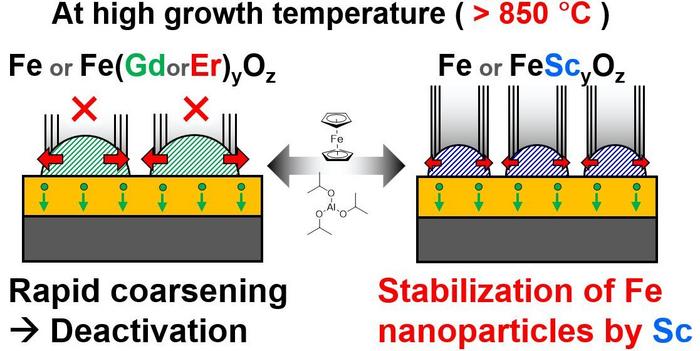
Those roots are iron nanoparticles, and at high temperature they misbehave. They migrate, clump together, coarsen, and slowly sink into the surface they sit on, and once enough of them have gone the whole forest simply stops growing.
The Roots Give Out Before the Forest Does
A team at Kindai University in Japan, led by Hisashi Sugime, has spent years chasing ways to keep those iron particles stable for longer. The reasoning is straightforward enough: a catalyst that lasts twice as long grows a forest twice as tall. Earlier work had shown that sprinkling in a rare-earth element, gadolinium, helped the iron resist the structural slump. So Sugime’s group decided to put gadolinium up against two of its periodic-table neighbours, erbium and scandium, and see which one held the line best.
At 800 degrees C, the answer was disappointingly democratic. All three rare earths worked, and worked about equally well, each coaxing forests past a centimeter tall over three hours while bare iron petered out after about 75 minutes at a mere 5 millimeters.
So the team turned up the heat. At 900 degrees C, iron particles degrade far faster, which makes it a brutal stress test, an accelerated way to watch a catalyst age in fast-forward.
Cranking the Heat Reveals the Winner
That is where the three elements parted ways. Forests grown with erbium or gadolinium gave up after 7 or 8 minutes. The scandium forests kept going for around 18 minutes, better than twice as long, and reached roughly 2mm against the others’ 0.8mm. “This study demonstrates that Sc can significantly improve the durability of Fe catalysts during CNT growth,” says Sugime. “Maintaining catalyst stability is essential for producing longer and higher-quality CNTs efficiently.”
Why scandium? When the researchers annealed their catalysts and counted particles under the microscope, the scandium samples had held onto far more of them, the iron resisting the urge to clump. X-ray absorption spectroscopy, which can read the chemical state of the iron atoms, told the rest of the story: with scandium present, the iron stayed in a more oxidized state, and oxidized iron is stiffer, more reluctant to rearrange itself into the blobs that kill growth. Scandium, it turns out, has an unusually strong appetite for both oxygen and iron, and by gripping both it seems to pin the nanoparticles in place. The team thinks composite oxides form at the interface, a kind of molecular scaffolding.
It is, they note, the first time anyone has reported pairing iron with scandium as a catalyst for this sort of high-temperature work. Which is a little surprising, given how much attention nanotube growth has had over three decades.
None of this means scandium forests are about to pour out of factories. The tubes here are multi-walled, a few nanometers across, grown in a tube you could hold in one hand; scaling that to industrial volumes is its own long story, and scandium is not exactly cheap.
Still, the appeal of long, well-aligned nanotubes is hard to overstate. Spin them into fibers and you get threads that conduct heat and electricity beautifully; pack them into electrodes and you might get batteries that hold more charge and last longer, or biosensors sensitive enough to pick up a single molecule. “Our motivation has been to find practical ways to harness the outstanding properties of CNTs,” says Sugime. Every one of those uses leans on the same dull-sounding prerequisite, which is making the tubes long and clean in the first place.
For now, the lesson is smaller and sharper than any of those applications. Keep the catalyst’s roots from dying, and the forest will look after itself. Scandium, against the odds, seems to know how.
Frequently Asked Questions
Why do carbon nanotube forests stop growing?
The iron nanoparticles that seed each tube gradually lose activity at high temperature, migrating and clumping together until too few remain to sustain growth. Extending that catalyst lifetime is the main route to taller, higher-quality forests.
Why does scandium work better than erbium or gadolinium?
At 900 degrees C, scandium kept the iron particles from coarsening and held the iron in a more oxidized, structurally stable state. That let growth continue for about 18 minutes versus 7 to 8 minutes for the other two rare earths.
Could this lead to better batteries or sensors?
Potentially. Longer, cleaner nanotubes are useful for high-power batteries, conductive fibers, and electrochemical biosensors, though moving from a lab-scale tube furnace to industrial production remains a significant hurdle.
Is the iron-scandium pairing new?
Yes. The researchers report it as the first binary iron-scandium catalyst system used for high-temperature reactions of this kind, opening a new direction for catalyst design.
