

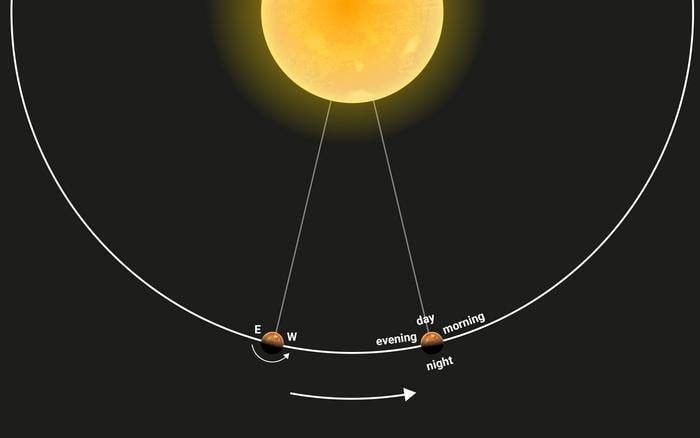
For four and a half hours, a planet 880 light years away slid across the face of its star, and as it slid, it turned. Not much. About thirty degrees, roughly the angle between noon and two o’clock on a clock face. But that small rotation was enough. As WASP-121 b crept across its star, fresh longitudes of its scorched atmosphere rotated into view, and the starlight pouring through them carried a signal nobody had ever managed to catch before.
The planet is what astronomers call an ultrahot Jupiter, a gas giant whipped so close to its star that a year there lasts barely 30 hours. It is tidally locked, meaning one face is pinned permanently toward the furnace while the other stares out at cold space. And the temperature difference between those two halves is, frankly, ridiculous.
“WASP-121b is particularly extreme, with average temperatures on the dayside hemisphere being around 2770 Kelvin, while those on the nightside are closer to about 1000 Kelvin,” says Tom Evans-Soma at the University of Newcastle in Australia, who had previously pinned down the planet’s temperature range. That works out to something like 2500 degrees Celsius on the day side. Hot enough to vaporize iron, never mind boil water.
Between the searing day and the merely sweltering night sit two narrow transition zones, the terminators, where dawn and dusk would be if anyone unlucky enough were standing there. Astronomers have long suspected the two are not the same.
The trick to telling them apart comes down to timing. Because the planet rotates as it transits, the leading edge of its disk shows you the morning side, while the trailing edge, rotating into view as the transit goes on, shows you the evening. Measure how the starlight changes minute by minute, and elapsed time quietly converts into longitude. Cyril Gapp, a PhD student at the Max Planck Institute for Astronomy in Heidelberg, and his colleagues did exactly that, using the James Webb Space Telescope across two separate transits.
“With its unprecedented observational quality, JWST gives us the most detailed glimpses into distant planets to date: By measuring how star light absorption changes as WASP-121 b rotates, we probe its atmosphere longitude by longitude.” That is Gapp’s summary of the approach.
The Evening Glows Brighter
What the team found is that the planet absorbs more starlight toward the end of the transit than the beginning. The evening terminator, in other words, is doing more blocking than the morning one. The standard explanation is wind: ferocious eastward jets that drag heat from the dayside around toward dusk, puffing up that side of the atmosphere so it swells outward and intercepts more light. A bigger cross-section means a darker silhouette. The data sat awkwardly with any model that treated the planet as a tidy, symmetric ball, and only a model that let the planet’s apparent size drift during the transit fit properly. That asymmetry, teased out of light curves measured to a few hundred parts per million, is the fingerprint of rotation itself. The carbon monoxide signal climbed as the evening rolled into view. The water signal, oddly, sank.
That contrast is the clever part. Carbon monoxide is a tough molecule, stable even at these temperatures, so its abundance stays roughly flat right across the planet. Water is not so lucky.
Where the Water Comes Apart
On the blistering evening side, it gets hot enough that water molecules are torn into their constituent atoms, a process called thermal dissociation, so the water signature fades exactly where the temperature climbs. Carbon monoxide, riding the same heat, appears to strengthen, but that is mostly the atmosphere expanding and lifting the gas higher rather than any genuine increase in the molecule. Read together, the rising CO and the falling H2O tell the same story from two directions: the trailing limb is hotter, and the water there is quite literally coming apart. It is the kind of result that had been predicted on paper and then sat there for years, waiting for an instrument sensitive enough to confirm it.
There was a wrinkle, though. When the team ran atmospheric simulations to check their numbers, the models produced the asymmetry but undershot its size. The real planet was lopsided by more than the physics predicted.
The likeliest culprit is clouds, the team suspects, though not the fluffy white sort. On a world this hot, clouds would be made of vaporized rock, silicate minerals condensing on the cooler morning side. Such clouds could mask the heat radiating from deeper layers, making the morning terminator look colder than it really is and exaggerating the gap between dawn and dusk. Cloud physics is notoriously hard to simulate (condensation and evaporation in a churning atmosphere defeats most models), so the simulations leave them out entirely. When the researchers crudely faked the cloud effect by muting the morning side’s temperature gradient, the match improved.
None of which proves the clouds are there. It is a strong hint, no more, and confirming it will take more sophisticated models than anyone currently has to hand. What the work does prove is that the method works: that a planet’s slow turn during a few hours of transit can be read like a clock, each minute reporting on a different stretch of sky.
And WASP-121 b is not alone. The team has already drawn up a shortlist of other ultrahot worlds, fast-spinning and fierce, that should yield to the same trick. Worlds where, soon enough, we might compare one alien dawn against another, and start asking why no two of them seem to break their weather the same way.
Nature Astronomy, DOI: 10.1038/s41550-026-02887-6
Frequently Asked Questions
How can astronomers tell the morning side of a planet apart from the evening side when it’s hundreds of light years away?
They use timing. As the planet crosses in front of its star it also rotates slightly, so the leading edge of its disk reveals the morning terminator and the trailing edge reveals the evening one. By tracking how the starlight filtering through the atmosphere changes minute by minute during the transit, the elapsed time effectively maps onto longitude. It is a remarkably indirect way of standing at two different points on an alien horizon.
Why does the water seem to vanish on the hotter side of the planet?
The evening terminator is hot enough that water molecules are ripped apart into their component atoms, a process called thermal dissociation. So the dip in the water signal is not water hiding, it is water genuinely coming undone. Carbon monoxide survives the same heat intact, which is why the two molecules behave so differently across the planet.
Is it true that this kind of asymmetry was predicted before it was ever seen?
Yes. The idea that a rotating planet would show a changing absorption signal during transit had been worked out theoretically, but no instrument was sensitive enough to catch it until the James Webb Space Telescope. This is the first time the effect, sometimes called a rotational transit, has actually been measured. It turns a long-standing prediction into an observational tool.
What’s stopping the models from matching the observations exactly?
Most likely clouds, though not water clouds. On a planet this hot, clouds would be made of vaporized rock such as silicates, and they would form preferentially on the cooler morning side. Simulating how such clouds condense, drift and evaporate is extraordinarily difficult, so the standard models leave them out, which may be why they underestimate the difference between dawn and dusk.
Could this technique be used on other planets?
It should work on any planet that is hot enough and rotates fast enough during its transit to reveal distinct longitudes. The team has already identified several promising ultrahot gas giants as targets. The hope is to build up a sample of these extreme worlds and compare their atmospheres, to see whether they all behave alike or each breaks the rules in its own way.
