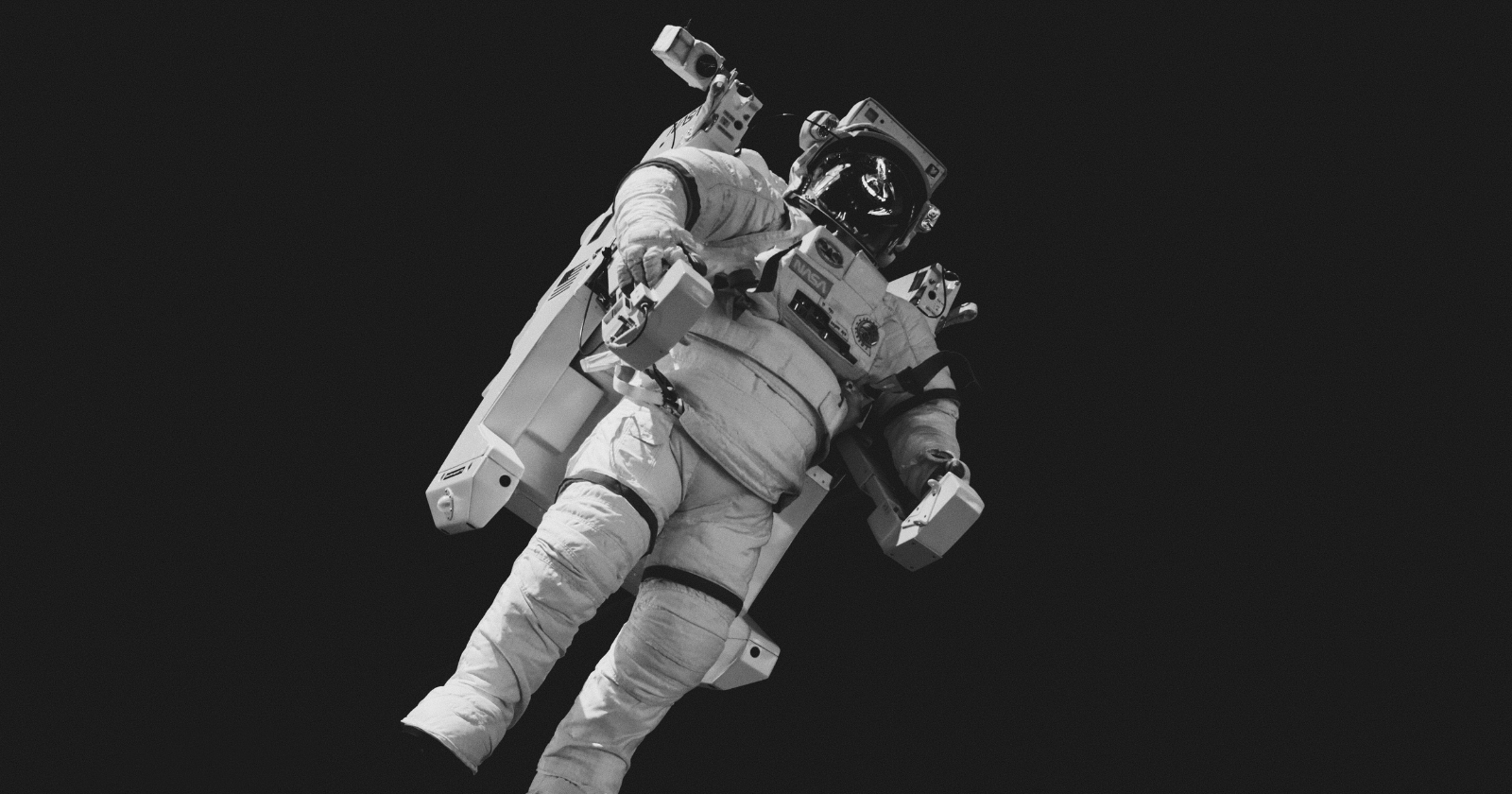
Every space movie that has ever shoved a character out an airlock without a suit gets almost the entire scene wrong, and decades of real medical paperwork prove it.
Accidental exposures inside NASA test chambers, inside decompressed spacecraft, and on stratospheric balloon flights have been documented closely enough that nobody has to guess anymore about what actually happens to an unprotected human body in near-vacuum.
The record is oddly specific, and it contradicts the movies on almost every point. I grew up on the version where someone floats away and puffs up like a water balloon, so going through the real cases one by one was its own small correction. Here’s what each myth gets wrong, and what the documented cases show instead.
1. Your body does not explode
The image everyone has stuck in their head, a body swelling and rupturing the instant the air pressure disappears, isn’t supported by a single real case.
Skin and connective tissue are strong enough to hold an internal-external pressure difference of about one atmosphere without tearing, roughly the same pressure gap a scuba diver’s body handles at modest depth, just reversed. NASA astronaut and physician Michael Barratt, who has written on the physiology of vacuum exposure for the University of Houston’s long-running “Engines of Our Ingenuity” program, put it plainly: the body “holds together just fine.” The technical name for what actually happens is ebullism, the formation of water vapor within body fluids once the surrounding pressure drops low enough, and it looks nothing like a Hollywood rupture.
2. Your blood does not boil out of you
How much of the blood-boiling image is actually true? More than you’d expect, which is exactly what makes it dangerous to leave uncorrected. Pressure is what triggers boiling in a vacuum. Heat has surprisingly little to do with it. Your arteries stay protected because your heart keeps them running well above the pressure threshold where body-temperature fluid turns to vapor. The blood sitting in your veins and capillaries, which is most of your blood by volume, is a different story. Barratt’s own explanation is blunt: water vapor forms directly inside the venous blood and effectively vapor-locks the circulation. That’s the real event: pressure-driven vapor forming inside closed vessels, disrupting circulation from within. Disaster movies picture something far more violent, blood spraying out through the skin, and no documented case has ever shown that happening.
The clip that actually stuck with me most while we were putting this video together wasn’t one of the historical accident cases at all. It was an earlier, plainer moment: a beaker of ordinary, room-temperature water sealed inside a glass jar, no flame anywhere near it, starting to boil the second a pump begins pulling the air out. Heat only explains half of why a kettle boils on your stove. The weight of the air sitting on top of the water explains the other half, and most people never think about that second half until they watch it happen with nothing but a vacuum pump doing the work.
3. You do not freeze on the spot
Space itself is famously cold, which makes this myth feel intuitive. The mechanism that would need to work quickly, though, isn’t available in a vacuum. Freezing fast requires a way to pull heat out of a body in a hurry, and a vacuum removes the two fastest routes for that, conduction and convection, since there’s no air or fluid touching the skin to carry heat away. The only route left is radiation, which astrophysicist Paul M. Sutter has described as a slow leak rather than a flash freeze. “Slowly, slowly, slowly your body radiates away your heat while you stare at oblivion,” he wrote, adding that a body in vacuum can take many hours to lose a genuinely dangerous amount of heat, not seconds. Whatever gets someone in a real exposure incident, it isn’t frostbite arriving before they can react.
4. You do not lose consciousness the instant the air is gone
You’d assume the lights go out the second the air does. They don’t quite, and the seconds in between are exactly why the real number matters. Barratt’s own estimate, drawn from the same body of NASA physiology data behind the agency’s Bioastronautics Data Book, puts useful consciousness at roughly 12 seconds after sudden decompression. The mechanism is almost the reverse of what most people assume. Your lungs normally pass oxygen into your blood. With no air pressure inside them, that exchange runs backward, and the blood leaving your lungs is already stripped of oxygen by the time it reaches your brain. Twelve seconds sits in an odd middle ground, long enough to notice something is wrong, short enough that there’s barely time to do anything about it.
5. What actually decides whether you survive
Here’s the part the myths skip entirely, because “you survive if help reaches you fast enough” doesn’t make for a great jump-scare. Two real cases sit on opposite ends of that same clock. A NASA engineer testing a prototype spacesuit inside a Houston vacuum chamber in December 1966 lost his suit’s pressure almost completely, and the chamber crew had him repressurized within about 90 seconds, conscious again with no lasting effects beyond a sore ear. Three cosmonauts aboard Soyuz 11 in 1971 had no one able to reach them at all when their cabin vented to vacuum during descent. They remain the only humans who have died in the vacuum of space.
That’s the actual gap between a survivable exposure and a fatal one, and none of it has anything to do with explosions, boiling, freezing, or instant blackouts. The window itself is narrow but not razor thin, generally somewhere in the range of a minute to a minute and a half once decompression starts, which is why LeBlanc’s chamber crew reaching the controls in time changed everything and why the Soyuz 11 crew, alone in orbit with nobody able to reach the valve, had no version of this story that ends differently. Real vacuum-exposure records keep saying the same quiet thing the myths never do. Survival comes down to how fast pressure gets restored and how close help happens to be, a much smaller, much stranger story than anything Hollywood has ever put on screen.