

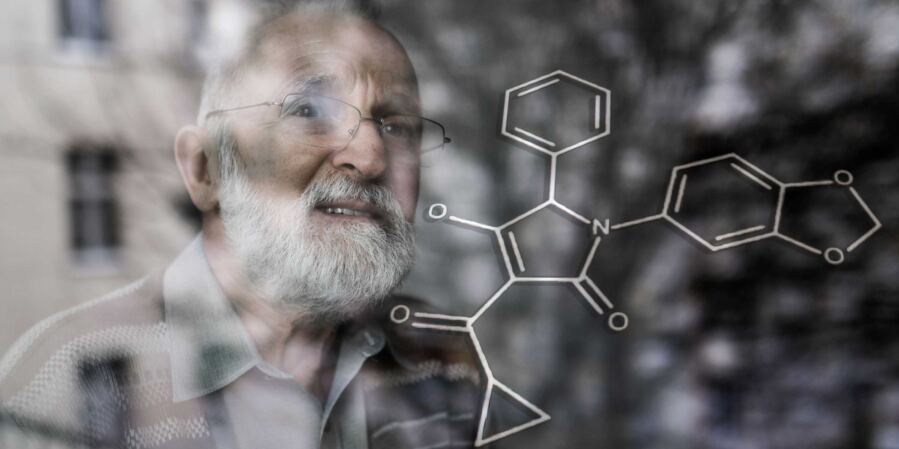
She still calls it Compound 10. Not CPD10, the formal name buried in the patent paperwork, but Compound 10, the way you might refer to a stubborn houseguest you have come to know rather well. Ursula Quitterer has spent close to twenty years getting acquainted with the problem this molecule is meant to fix. And the problem, it turns out, is an enzyme that most of your cells could not live without.
The enzyme is GRK2, and on a normal day it does unglamorous work. It helps cells read incoming signals correctly, in the heart, in the brain, pretty much everywhere.
The enzyme is GRK2, and on a normal day it helps cells read incoming signals in the heart, brain and other tissues. Quitterer and colleagues reported abnormal GRK2 aggregation in Alzheimer’s disease mouse models and examined a small set of human tissue samples from people with dementia likely due to Alzheimer’s disease. That limited human evidence does not establish a universal feature of every Alzheimer’s brain.
What happens next is the part that should worry anyone who has watched a relative fade.
“The GRK2 aggregates block the pores of the mitochondria, reducing the amount of energy they can supply and leading to a situation of stress inside the cells,” says Quitterer. Starved and stressed, the neurons start producing more amyloid beta, the protein fragment that has dominated Alzheimer’s research for decades. And here is the cruel twist. That extra amyloid stresses the cells further, which produces still more broken GRK2, which makes more amyloid. Round and round it goes.
The team traced exactly what the rogue enzyme grabs hold of: a small mitochondrial protein called TOMM6, whose ordinary job is helping to keep the power plant’s import machinery assembled. Trapped by the aggregates, TOMM6 stops doing that job, and the mitochondria suffer for it.
Breaking the Circle
Quitterer’s group asked whether GRK2 could be kept in its functional form. They built small molecules and tested them in cell cultures and mice. Compound 10 shifted GRK2 away from the aggregating form in those models; mitochondrial measures improved, amyloid deposits and neuron loss were reduced, and treated mice survived longer than untreated mice. In an assay panel covering more than 40 pharmacological targets, researchers reported no detected off-target activity. That assay result is not a safety finding in animals or people.
There were odder effects, too. Treated animals showed better heart function and, charmingly, fewer grey hairs in old age.
None of this came quickly, and Quitterer is candid about why. “It took so long simply because everything takes so long in Alzheimer’s research,” she says. Because the disease is one of aging, the experiments demand old mice, animals of perhaps one and a half to two years, and each round of work eats another eighteen months or more before it yields anything you can build on. “It’s all a great deal slower than in cancer research, for example.”
A Different Door
What makes the finding interesting is not that it promises a cure, because it does not. “Alzheimer’s is a very complex disease,” Quitterer notes, and today’s drugs at best delay the slide by a matter of months. The value lies in the direction of attack. “That’s why it’s so important that we’ve now identified a new target protein in the form of GRK2, as well as an active ingredient that operates via GRK2 and therefore via a different mechanism than existing Alzheimer’s drugs,” she says. A drug that works by a wholly different route might, one day, be paired with the ones we already have.
The caveats are real and the team does not hide them. The roots of the project reach back to brain tissue collected during tumour surgery at the Ain Shams University Hospital in Cairo, and the human side of the evidence rests on a mere handful of patients, a limitation Quitterer’s group flags plainly. Everything else, for now, lives in mice and cell dishes, and the long graveyard of Alzheimer’s drugs that shone in rodents and failed in people is a warning nobody in the field forgets.
Still, there is something compelling about a target that sits at the crossing point of amyloid, faulty mitochondria and the broader machinery of aging, rather than chasing any one of them alone. ETH Zurich has filed for a patent and is now hunting for a company willing to carry Compound 10 toward an actual drug. Whether it gets there is anyone’s guess. But after two decades of patient acquaintance, Quitterer has at least handed the field a new door to try.
Full study: Cell Reports Medicine, DOI 10.1016/j.xcrm.2026.102707
Frequently Asked Questions
Why would an enzyme the body needs end up causing harm?
GRK2 is essential in its normal, working form, but cells can chemically switch it off, and in Alzheimer’s brains that inactive version builds up and clumps together. The clumps settle on mitochondria and choke their energy supply, which sets off a damaging cascade. So the trouble is not the enzyme itself but a corrupted form of it accumulating where it should not.
How is this different from the amyloid-targeting drugs we already have?
Current disease-modifying anti-amyloid treatments target amyloid beta or its plaques. This preclinical approach instead aims to stabilise GRK2 upstream. Whether it can be combined with existing treatments safely or effectively remains unknown.
Is Compound 10 something patients could take soon?
No. The published preclinical work identified a candidate that still requires substantial validation, toxicology, manufacturing and human trials. A patent does not establish clinical safety or effectiveness.
Why did the research take almost twenty years?
Alzheimer’s is a disease of aging, so the experiments need elderly mice, and growing them plus running each study can take well over a year apiece. As the lead researcher puts it, the whole field moves far more slowly than something like cancer research. That glacial pace is part of why genuinely new drug targets are so rare.
Editor’s note: This article was updated on September 14, 2026, to align its headline and wording more closely with the evidence and sources.
