

Something dimmed a distant star, and it took ninety years to understand why.
When astronomers noticed J0705+0612 fading in September 2024, they spotted something unusual. Stars don’t simply stop shining. They flare, they pulse, they age. But they don’t just vanish for months on end. Yet here was a sun-like star, three thousand light-years away, becoming forty times dimmer than normal. By May 2025, it had spent nine months essentially disappearing.
Nadia Zakamska at Johns Hopkins University realised something extraordinary was unfolding. “Stars like the Sun don’t just stop shining for no reason,” she says, “so dramatic dimming events like this are very rare.” With colleagues across multiple observatories, she initiated a follow-up campaign. What they discovered wasn’t just rare—it was something no one had measured before.
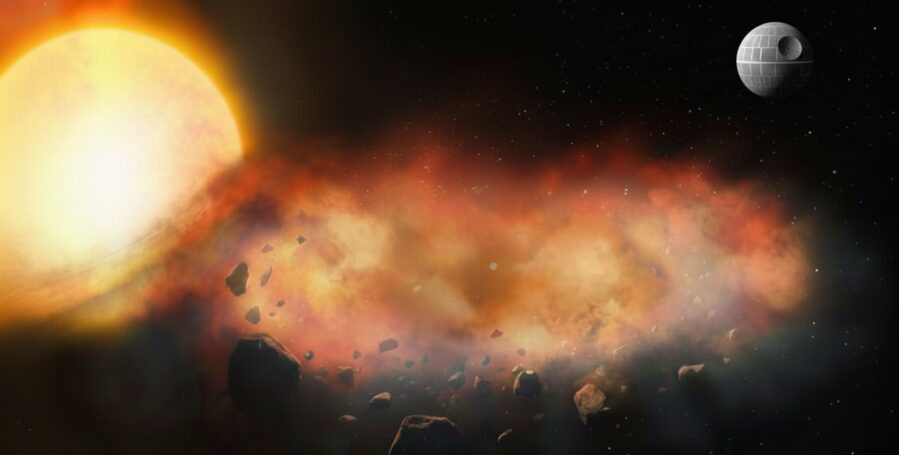
The culprit turned out to be a massive cloud of gas and dust, sweeping directly in front of the star like a cosmic curtain. But this wasn’t just any cloud. Inside it, something was moving. Winds of vaporised metals—iron and calcium—whipped through the darkness at velocities the team could measure for the first time in such a system. Using the Gemini South telescope in Chile, equipped with its cutting-edge GHOST spectrograph, they watched those metallic winds blow across the starlight in real time.
The strangeness didn’t end there. When astronomers dug into historical records, they found earlier dimming events from 1937 and 1981. Three occultations spanning roughly forty-four years. A pattern. A rhythm. Whatever was causing this wasn’t a one-time accident. It was orbiting.
Their calculations pointed to something gravitationally holding all that debris in place—a planet or brown dwarf, some unseen companion stationed about fourteen astronomical units from its star. Massive enough to keep billions of tonnes of gas and dust bound in orbit, small enough to remain hidden. Somewhere between Jupiter-sized and the threshold of a low-mass star. “When I started observing the occultation with spectroscopy, I was hoping to unveil something about the chemical composition of the cloud, as no such measurements had been done before,” Zakamska explains. “But the result exceeded all my expectations.”
The real puzzle lay in the age. Standard astrophysics says circumsecondary disks—those rings of material circling planets or brown dwarfs—should disperse within tens of millions of years. Yet this system’s primary star is over two billion years old. It’s middle-aged, settling into the mundane routines of main-sequence existence. No planetary formation happening here. No young, dusty nursery that would naturally host such rings.
Which brings us to the collision hypothesis. Somewhere in the distant past, two planets must have crashed. Not a gentle gravitational nudge, but a catastrophic impact. The kind of event that scatters rock and ice across planetary systems, vaporises material into gas, populates the void with debris. Such events can happen even in mature systems when gravitational instabilities send worlds on collision courses—sometimes billions of years after the system first formed.
Zakamska and her team found evidence supporting this scenario. The star shows hydrogen-alpha emission, typically associated with young stellar systems. The infrared excess suggests significant dust and gas—signatures of recent destruction rather than peaceful arrangement. The metals in the cloud—iron, calcium, sodium—trace the compositions expected from rocky planetary bodies. A cloud born from chaos would naturally display exactly these characteristics.
The smooth, symmetric light-curve intrigued the researchers most. When dust clouds block starlight, they typically create complicated, variable dimming patterns as clumps and gaps pass in front. Not this one. The occultation proceeded with remarkable regularity, suggesting a gas-rich disk—puffy, thick, geometrically smooth. A cloud that had settled into equilibrium after its violent origins.
Understanding how such a system could persist fascinates researchers. After collision, debris typically scatters. Either it falls inward onto the primary star, gets ejected outward by gravitational interactions, or coalesces around the massive object that remains. In J0705+0612’s case, something survived the impact—some gravitating remnant, perhaps the original planet that collided with another, perhaps a new body formed from the collision itself. That survivor’s gravity keeps the debris bound, holding billions of tonnes of material in a vast, slowly evolving disk.
Yet mysteries remain. How did the collision happen at such a late stage? What triggered planetary wandering in a supposedly settled system? Why is one debris cloud so remarkably smooth and regular? “This event shows us that even in mature planetary systems, dramatic, large-scale collisions can still occur,” Zakamska notes. “It’s a vivid reminder that the Universe is far from static—it’s an ongoing story of creation, destruction, and transformation.”
For now, astronomers await the star’s next emergence. When J0705+0612 finally rebrightens fully in 2069, another forty-four-year cycle will begin. By then, new telescopes may unlock further secrets. High-resolution post-occultation spectra could reveal which features originated near the star itself and which reside in the occulter. Submillimeter observations might map the large-scale geometry of the debris field. The star itself, already yielding its strangest discovery after millennia of quiet existence, promises to deliver more surprises yet.