

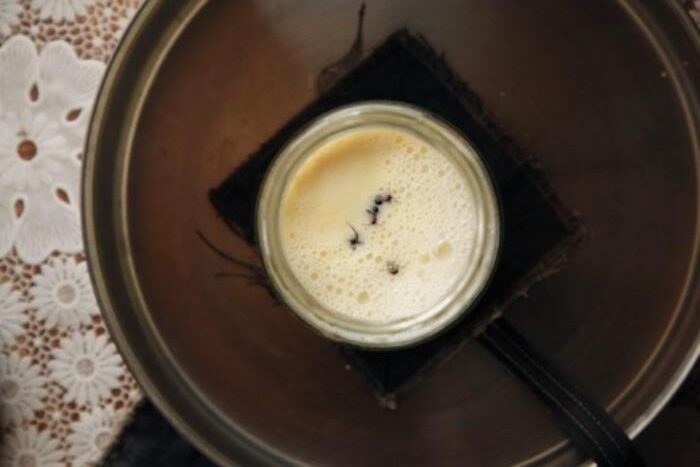
In a Bulgarian village, researchers dropped four live forest ants into warm milk, tucked the jar into an ant mound overnight, and retrieved it the next morning to find something remarkable: the milk had transformed into tangy, coagulated yogurt. The tradition, nearly forgotten across the Balkans and Turkey, turns out to have solid scientific foundations that could reshape how we think about fermented foods.
The study, published October 3 in the journal iScience, reveals that red wood ants carry an entire fermentation toolkit in their bodies and microbiomes. When added to milk, these insects introduce lactic and acetic acid bacteria, formic acid from their venom glands, and protein-breaking enzymes that work together to create yogurt. It is a fermentation system that evolved over millions of years, now offering fresh possibilities for modern food science.
A Culinary Tradition Meets Laboratory Science
Lead author Veronica Sinotte traveled to anthropologist Sevgi Mutlu Sirakova’s family village to learn the technique firsthand from locals who remembered it. The resulting yogurt had what she describes as “a slight tangy taste with mild herbaceousness and pronounced flavors of grass-fed fat.” Not your average supermarket dairy product.
Back in Denmark, the research team dissected exactly what makes ant yogurt work. They found that Formica ants host bacteria remarkably similar to those found in commercial sourdough, including Fructilactobacillus sanfranciscensis. The ants also contribute formic acid (up to 10% of their body weight) which acidifies the milk and creates an environment where acid-loving microbes thrive.
Today’s yogurts are typically made with just two bacterial strains. If you look at traditional yogurt, you have much bigger biodiversity, varying based on location, households, and season. That brings more flavors, textures, and personality.
Senior author Leonie Jahn from the Technical University of Denmark sees the research as part of a larger pattern. Industrial yogurt production has narrowed dramatically from the microbial diversity once common in traditional practices. Most commercial yogurts rely on just Lactobacillus delbrueckii subsp. bulgaricus and Streptococcus thermophilus. Ant yogurt, by contrast, introduces multiple bacterial species that create more complex flavor profiles.
From Ancient Mounds to Michelin Stars
The team tested ant yogurt in three forms: live, frozen, and dehydrated ants. Only live ants consistently produced the right microbial community for fermentation. Frozen and dehydrated versions allowed potentially harmful Bacillus bacteria to flourish instead, raising food safety concerns that might explain why traditional practitioners used live insects.
To explore contemporary applications, researchers partnered with Alchemist, a two-star Michelin restaurant in Copenhagen. Chefs created ant-shaped ice cream sandwiches, pungent mascarpone-like cheeses, and cocktails clarified with ant-induced milk separation. The dishes showcased how formic acid creates distinctly different flavors than the lactic acid dominant in conventional fermented dairy.
The work raises intriguing questions about fermentation origins. Fructilactobacillus bacteria appear to have diversified alongside ants over evolutionary time. Did these microbes jump from ant colonies into human fermentation practices thousands of years ago? The earliest evidence of yogurt comes from the same region where ant yogurt traditions persist, and architectural depictions of ants appear in prehistoric remains from Anatolia.
I hope people recognize the importance of community and maybe listen a little closer when their grandmother shares a recipe or memory that seems unusual. Learning from these practices and creating space for biocultural heritage in our foodways is important.
Still, the researchers caution against widespread adoption. Red wood ants face conservation concerns and can carry parasites dangerous to humans. The European Union has not approved them as food, despite documented traditional use. Live ants require careful handling and filtration. Frozen ants, while parasite-free, promote unwanted bacterial growth during fermentation.
The study suggests a middle path: isolating and culturing the beneficial bacteria from ants for use in fermentation without harvesting the insects themselves. These microbes might prove especially useful for plant-based yogurt alternatives, where finding the right fermentation cultures remains challenging. The bacterial strains could also apply to other ferments like sourdough, given their metabolic flexibility.
Traditional food practices often encode sophisticated biological knowledge that modern science is only beginning to decode. Ant yogurt joins a growing list of heritage techniques, from koji fermentation to kefir production, that maintained microbial diversity long before anyone understood what microbes were. Whether these practices can inform contemporary food production while respecting their cultural origins remains an open question.
For now, ant yogurt remains more curiosity than commodity. But it serves as a reminder that the forests of the Balkans still harbor fermentation secrets, and that paying attention to nearly forgotten traditions might yield practical applications alongside a richer understanding of how humans and microbes have shaped each other over millennia.