

Easton LaChappelle grew up in Mancos, Colorado — population about 1,200, tucked in the state’s remote southwest corner near the Four Corners. There was, by his own account, very little for a teenager to do. So at 14, bored and curious, he decided to build a robotic hand.
He knew nothing about electronics or programming when he started. He taught himself both, from YouTube videos and by messaging experts around the world, and built the thing out of what was lying around the house.
A hand made of toys
The first version was almost comically improvised — and it worked.
The fingers were surgical tubing. The tendons were fishing line. The frame was LEGO bricks, and five hobby servos gave each finger its own motion, driven by a microcontroller and a glove he wore to puppet it. Later versions doubled down on the scavenging: dental rubber bands from someone’s braces sprang the fingers back, a windshield-wiper motor became an elbow, a Nintendo Power Glove became the controller.
The hand could grip a soda can, shake your hand, toss a ball. In 2011, as a high-school freshman, LaChappelle took it to the Colorado State Science and Engineering Fair and won third place in the senior engineering division.
Third place turned out to be the least important thing that happened there.
The girl with the $80,000 arm
At a science fair, LaChappelle met a seven-year-old girl who had been born without her right arm. She was wearing a prosthetic — one of the most advanced models available at the time — and in the course of talking to her, he learned two facts that redirected his life.
The first was the price: the arm had cost $80,000. The second was worse. She would outgrow it, the way a child outgrows shoes, and her family would have to buy another — and prosthetics for growing kids mean paying that kind of money again and again as the body changes. For all that money, the arm did startlingly little.
That was, in his words, the “ah-ha moment.” A soda-can-gripping LEGO hand was a clever toy. An $80,000 device a child would outgrow was a problem worth solving. He set out to build a real prosthetic — one that did far more, for a tiny fraction of the cost.
From $80,000 to a few hundred
The lever that made it possible was 3D printing, which LaChappelle taught himself next — eventually building his own 3D printer to learn how to “think in 3D.”
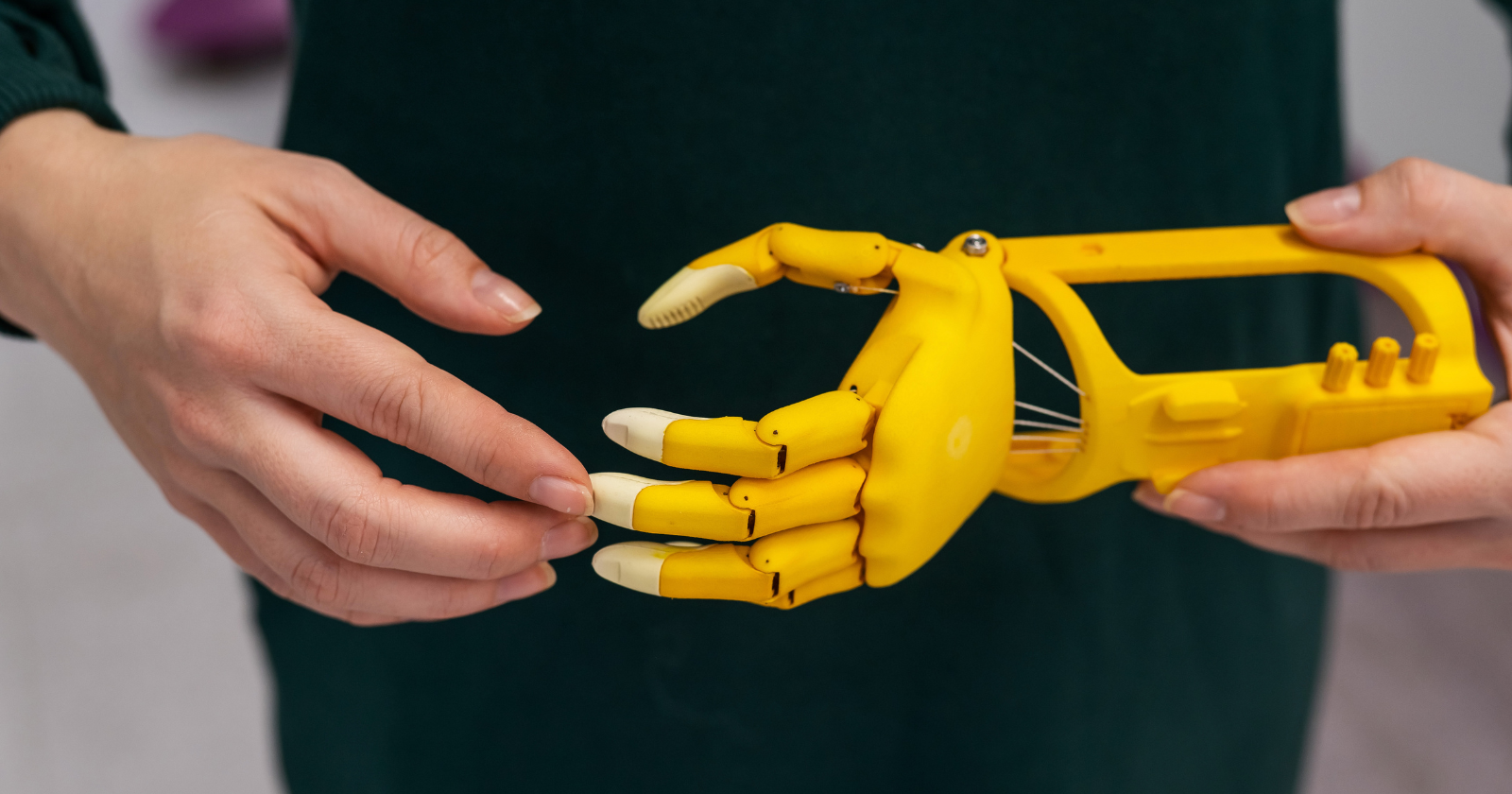
Where the $80,000 arm was expensively machined and rigid, LaChappelle’s design was printed in plastic from open-source files anyone could download and improve. His second version grew from a hand into a full arm; the third added a wireless headset that read the user’s brainwaves, letting a wearer move the limb by concentrating. The whole thing ran on an Arduino microcontroller and hobby-grade parts.
The White House described his experimental arm as costing about $250 to assemble. That was not a like-for-like comparison with the price of a fitted clinical prosthesis, but it demonstrated how inexpensively a functional prototype could be built.
The handshake and the internship
The work pulled LaChappelle into rooms most teenagers never see. He demonstrated a version at the 2013 White House Science Fair to President Obama. At the 2012 Intel International Science and Engineering Fair, he received a Second Award in Engineering and an INCOSE honorable mention.
In 2013, at 17, LaChappelle interned with NASA’s Robonaut team at Johnson Space Center in Houston, working on a tele-robotic interface designed to capture human motion. Robonaut 2 had already reached the International Space Station in 2011.
He did not stop there. LaChappelle founded a company, Unlimited Tomorrow, to drive the idea to its conclusion: custom prosthetics made through 3D scanning, additive manufacturing and a remote fitting process — so that someone far from a specialist could still receive a fitted arm.
The engine underneath the whole story is a single comparison a fourteen-year-old could see and the prosthetics industry had somehow priced past. Her parents reported that one prosthesis had cost $80,000 and would need replacement as she grew. His experimental arm could be assembled for a few hundred dollars, showing how much room there was to rethink materials and manufacturing. LaChappelle didn’t invent the robotic hand, or 3D printing, or brainwave control. He noticed that a seven-year-old was wearing an expensive prosthesis she would soon outgrow — and decided affordability was part of the engineering problem.