

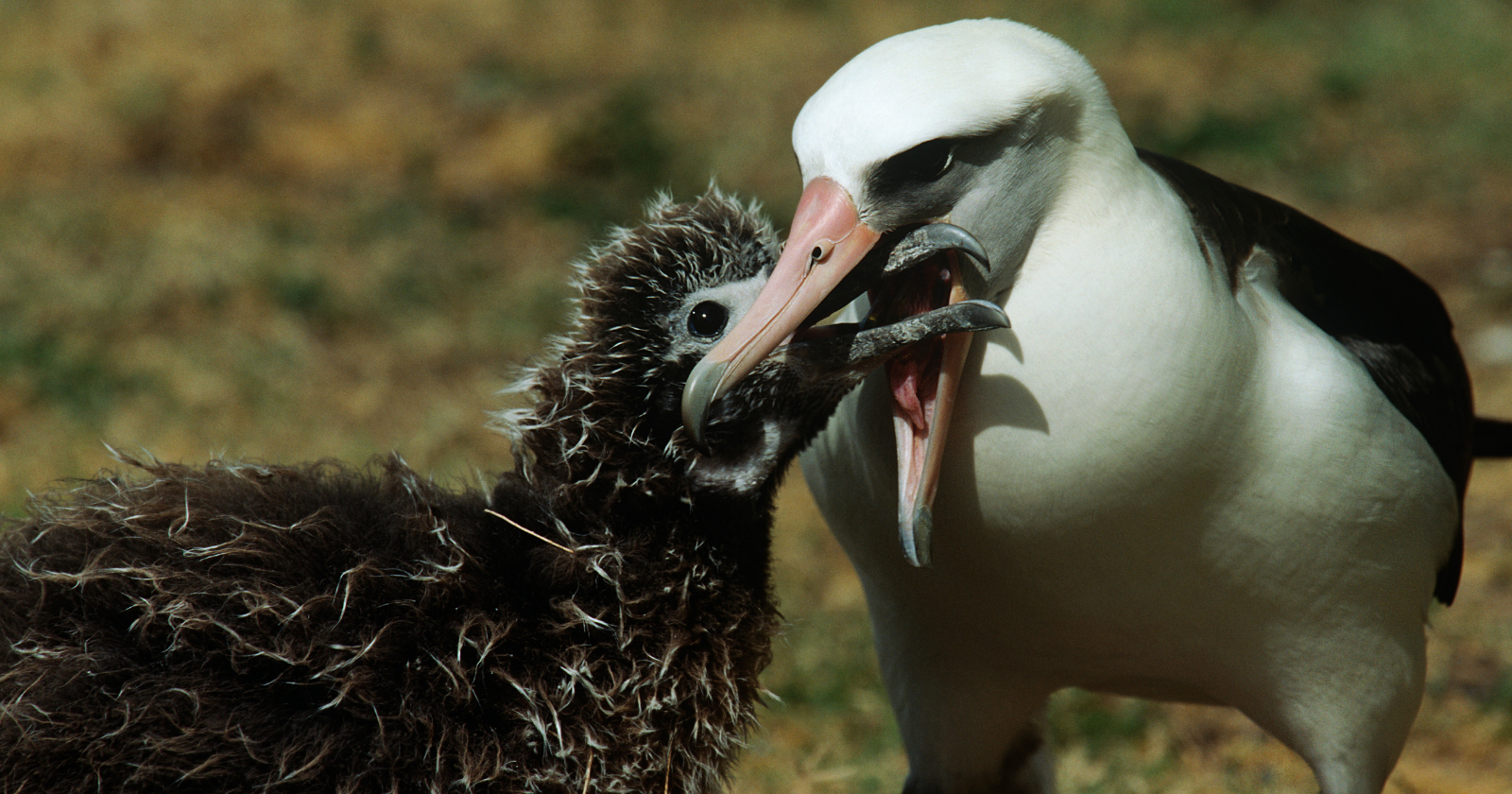
On December 10, 1956, a biologist named Chandler Robbins worked his way through the albatross colony on Midway Atoll, a speck of coral halfway between North America and Asia, closing small metal bands around the legs of nesting seabirds.
One of them was an unremarkable female Laysan albatross sitting on an egg. Robbins recorded the band number and moved on. Eisenhower was president. The transistor radio was cutting-edge consumer technology.
That bird came back to Midway this past November — for the 2026 nesting season — and found her mate waiting.
The arithmetic of an impossible age
Her name, these days, is Wisdom, band number Z333, and she is the oldest known wild bird on Earth.
Her age is a floor, not a guess. Laysan albatrosses don’t breed before about age five at the earliest, and Wisdom was already incubating an egg when Robbins banded her in 1956. So she was hatched by 1951 at the latest — making her at least 74, and “approximately 75” by the U.S. Fish and Wildlife Service’s own announcements, with every reason to suspect older.
To keep that number attached to one bird across seven decades took maintenance. The original band wore out, as metal does against coral sand and saltwater; she has been re-banded repeatedly, each worn ring replaced and the identity carried forward. And in 2002, in one of ornithology’s great full-circle moments, the biologist who recaptured and re-banded her was Chandler Robbins himself — 46 years on, checking his own old data point, by then a legend of American bird science.
If you enjoy learning about the fascinating parts of our animal kingdom, you’ll love this video on the invisible wall only elephants can see – it’s worth a watch:
What one band bought
Bird banding is the humblest instrument in field biology: a crimped ring, a number, and the hope of a re-encounter. Wisdom’s band has repaid it beyond any transmitter.
She has rewritten the assumed lifespan of her species — and of seabirds generally — in real time. Of the more than 250,000 albatrosses banded on Midway since 1956, the next-oldest known bird is 52, a 23-year gap between the record holder and the runner-up. Every year she returns, the textbook number moves.
She has also demolished assumptions about reproductive old age. Biologists estimate she has laid 50 to 60 eggs and fledged as many as 30 chicks. In November 2024, at 74, after her longtime mate Akeakamai stopped returning, she paired with a new male — banded EX25 — laid her first egg in four years, and hatched a chick in January 2025, the oldest known wild bird ever to do so. This November she was back again, arriving slightly early, and on November 26 she and EX25 found each other in a colony of a million birds.
Along the way the band has logged the incidental history: she has outlived mates, survived the 2011 tsunami that killed thousands of Midway’s chicks, and flown, by the usual estimates, several million miles of open Pacific — a distance to the Moon and back many times over, tracked the entire way by a piece of stamped metal.
The instrument nobody upgrades
There is a lesson in the technology, which is that the technology barely exists.
Modern wildlife science runs on GPS tags, satellite relays, accelerometers — instruments that cost thousands and die in a few years when batteries fade or feathers molt. Wisdom’s tracking device has no battery, no signal and no moving parts. It works because the bird reports in: an albatross’s fanatical fidelity to its natal colony and nest site means the data collects itself, one November at a time, for as long as the observer keeps showing up.
That is the real instrument — not the band alone but the pairing of a marked animal with an institution patient enough to keep reading it. The banding program on Midway has run continuously for seven decades; Robbins died in 2017, and the program simply carried on, the way the best long instruments outlive their builders. Every Wisdom headline is, underneath, a data point from a 70-year experiment that nobody ever declared finished.
Seventy Novembers
Wisdom’s fame — the USFWS announced this year’s return with “The queen returns!” — tends to obscure how strange her ordinary routine is.
Each year she crosses thousands of miles of featureless ocean to land on a six-square-kilometer atoll, walks to the same patch of sand, and waits for one particular bird among 1.5 million of her species. Most years, he arrives. An egg follows, then eight months of shifts and 3,000-mile grocery runs, then the open sea again.
She was doing this before the interstate highway system. She is doing it now, in a colony her descendants share. The longest-running tracking device in ornithology is a scuffed ring on a pink leg, and the finest thing about it is what it keeps reporting: still here, still returning, still raising the next one.