

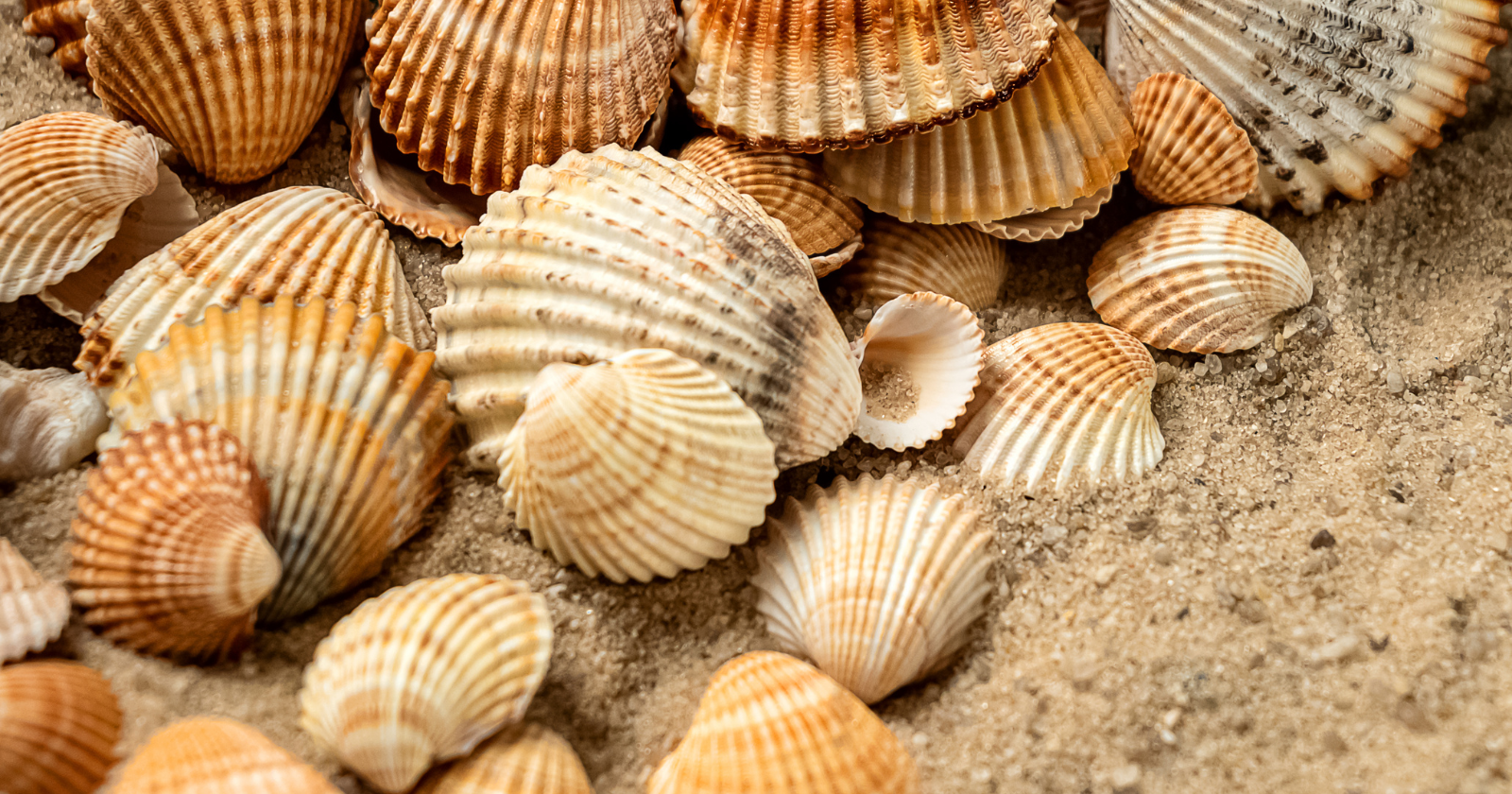
Sarufutsu, on the northernmost tip of Japan’s Hokkaido, is a scallop town. The village lands something like 15 percent of Japan’s entire scallop catch — tens of thousands of tons a year of the sweet, sashimi-grade shellfish the country eats more than any other.
But Japan eats the muscle, not the shell. And the shells had become a mountain.
Roughly 40,000 tons of empty scallop shells piled up around Sarufutsu every year as processing waste — and when overseas export of the shells slowed after 2021, the mounds had nowhere to go. Heaped on the ground, scallop shells are not harmless; they can leach and contaminate the soil, turning the village’s own signature industry into a slow environmental problem.
Then a plastics company looked at the mounds and saw not garbage but a raw material — one the scallops had already engineered for strength.
From shell to “Shellstic”
The idea came, fittingly, from the shell’s original job. A scallop shell exists to protect the animal inside from predators and the sea; its main component, calcium carbonate, is a hard, abundant mineral. Osaka-based Koushi Chemical Industry — building on bioplastic techniques from Osaka University — worked out how to turn the waste into a construction material.
The process is straightforward. The discarded shells are cleaned, boiled and sterilized, then crushed into a fine calcium-carbonate powder. That powder is blended with recycled plastic — leftover offcuts from manufacturing — to make a new mouldable material the company named Shellstic, a portmanteau of shell and plastic, roughly a fifth to a half shell by content. It flows into moulds and sets like ordinary plastic, but it is part seafood waste, and making it emits an estimated 36 percent less carbon dioxide than producing the same amount of virgin plastic.
The first product built from it was aimed straight back at the people who generate the shells.
A helmet shaped like its ingredient
The result is the Shellmet — shell plus helmet — designed with Tokyo agency TBWA\Hakuhodo, and it does two clever things with the scallop at once.
The obvious one is the material: a hard hat moulded from Shellstic, protecting the fishermen whose catch produced the shells in the first place — the shell that once guarded the scallop now guarding the scallop-fisher. The subtler one is the shape. Following biomimicry — copying nature’s engineering — the designers gave the helmet the same ribbed, fan-grooved surface a real scallop shell has, because those ridges are structural: they are how a thin shell resists crushing. A computer simulation estimated the ribbed design could reduce stress on the helmet by around 30 percent compared with a smooth dome.
Material and shape together produced the headline your title names: the finished helmet tested about 33 percent stronger than an equivalent made of ordinary plastic. The waste product didn’t merely substitute for plastic — it beat it.
Why the shell wins
There is a satisfying logic to why crushed seafood waste outperforms the material it replaces, and it isn’t a fluke.
Calcium carbonate is a genuine reinforcing filler — the same mineral family that makes chalk, limestone and, not coincidentally, real seashells rigid. Blended into a plastic matrix, the hard mineral particles stiffen the mix, much as gravel stiffens cement. Nature had already done the materials science: a scallop shell is calcium carbonate arranged, over millions of years of evolution, into one of the most efficient lightweight protective structures going. Koushi’s process borrows both halves of that — the substance and, in the ribbing, the geometry.
The honest scope is worth stating. This is a small-scale, deliberately local product, not a plastics revolution; the Shellmet started as helmets for Sarufutsu’s own fishing association and a few hundred fishermen, expanding to public sale and disaster-prevention stockpiles in a country that lives with earthquakes. The strength and carbon figures come substantially from the maker. And 40,000 tons is a lot of shells; helmets alone will never consume them — Shellstic is pitched as a general plastic substitute precisely because headgear is just the demonstration.
But as a demonstration it is close to perfect, because it closes a loop most recycling only gestures at. The village’s problem material became a village product; the fisherman’s hazard became the fisherman’s safety gear; and the mineral a scallop grows to keep itself alive got a second life keeping a person alive, arranged in the same ridged shape for the same reason. The shells were never waste. They were a high-performance material that the town had been paying to throw away — until someone crushed a mountain of them and molded it back into the oldest idea a shell ever had, which is: don’t let anything through.