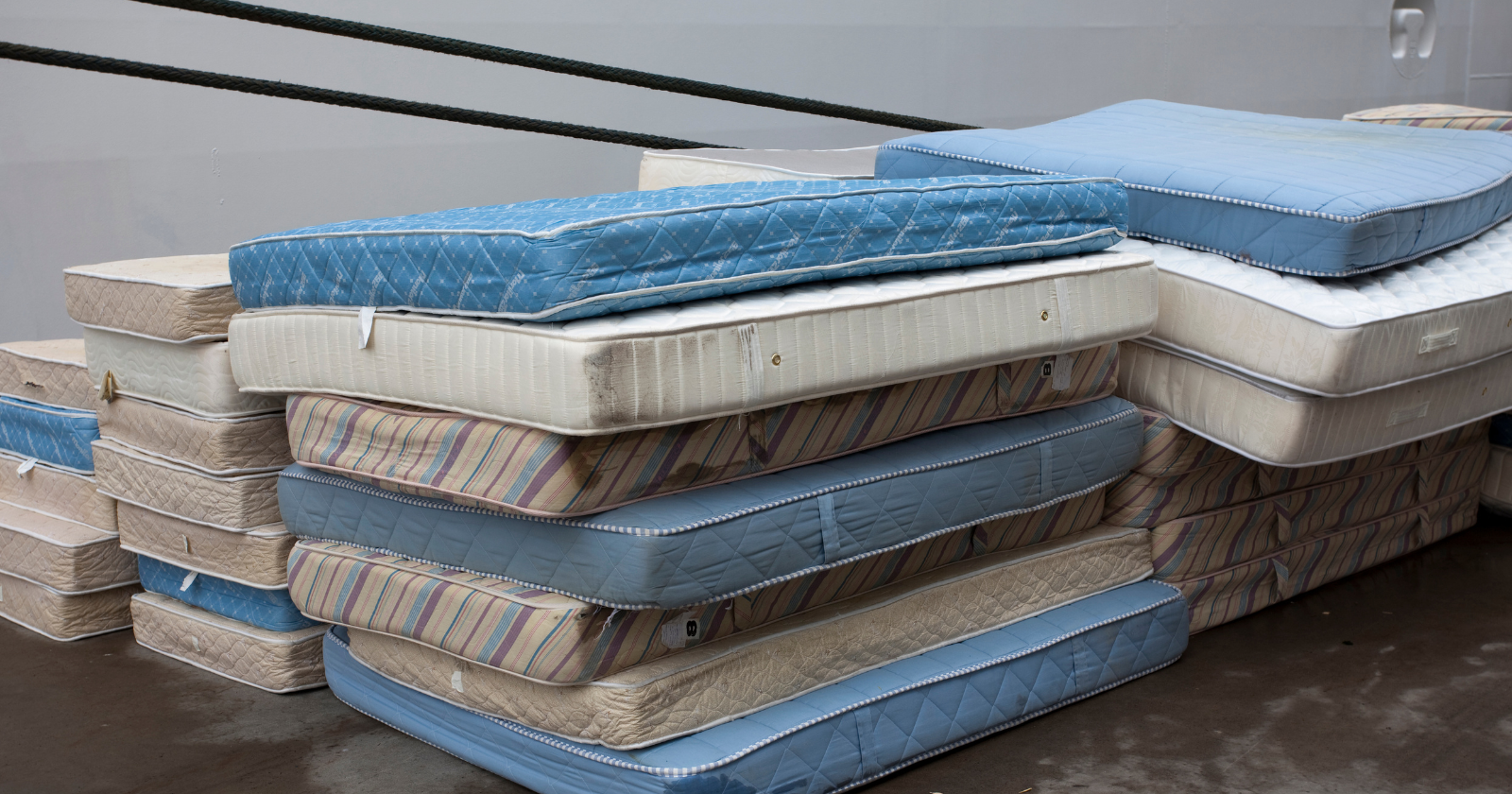
Every day in America, roughly 50,000 mattresses go out the door for the last time. Leaned against dumpsters, hauled off by delivery crews, dropped at transfer stations. That is 15 to 20 million a year, a river of beds flowing steadily toward the country’s landfills, where more than four out of five of them end up buried or burned.
Ask a landfill operator what they hate about that river and the answer is not what you would guess. It is not the foam, or the flame retardants, or the sheer bulk. It is the springs.
A machine’s worst meal
A landfill is a business built on squashing things. Operators run enormous steel-wheeled compactors back and forth across each day’s waste, because every cubic foot of air they crush out of the pile is a cubic foot they can sell again. Cardboard flattens. Drywall shatters. Furniture splinters. Almost everything gives up.
A mattress does not. It is designed, by definition, to resist compression, and even after a compactor has done its worst, a buried mattress can still hold something like 23 cubic feet of space, the volume of a small refrigerator, forever. But the space problem is only the polite half of it.
The other half happens when the machine actually bites down. An innerspring mattress contains hundreds of feet of high-carbon steel wire, and that wire does not crush the way the engineers of waste equipment would like. It tangles. Coils wrap themselves around the axles, drums and rotors of compactors and loaders, winding tighter with every rotation, and there is no elegant fix. The machine stops, and someone climbs down with cutters and frees the shaft by hand, wire by wire, while the equipment sits idle and the day’s tonnage waits. The same springs chew up shredders and conveyor equipment at waste-to-energy plants. In an industry that measures everything in throughput, the humble bed spring is a saboteur.
The problem is also the prize
Here is the twist that makes mattress disposal genuinely strange: the exact component that wrecks the machinery is the most valuable thing in the mattress. A typical innerspring bed holds roughly 25 pounds of steel, and scrap steel reliably finds buyers. Add the polyurethane foam, which becomes carpet underlay, the wood from box springs, and the cotton and fiber, and 75 to 90 percent of a mattress can be recycled into materials industry will pay for.
The catch is that none of it can be recovered by ordinary waste machinery, for the reasons above. Mattresses have to be taken apart more or less the way they were put together: one at a time, largely by hand, with workers stripping the fabric, pulling the foam, and feeding the naked coil units into presses built specifically for the job. In Minnesota, engineers had to invent a first-of-its-kind coil spring compactor just to squash mattress springs into bales dense enough for steel mills to accept. The Goodwill operation running it has since recycled more than 3,000 tons of mattress steel.
Where the system actually works
Because dismantling costs labor and landfilling looks cheap, the national recycling rate for mattresses sits somewhere below one in five, and by some counts below one in ten. Where the numbers improve dramatically is the handful of states that stopped treating mattresses as ordinary trash.
California, Connecticut, Rhode Island and, since 2025, Oregon run producer-responsibility programs funded by a small fee collected when a new mattress is sold. The fee pays for free drop-off networks and dismantling plants. The Mattress Recycling Council, which runs these programs, reports more than 14 million mattresses recycled and over half a billion pounds of steel, foam, fiber and wood kept out of landfills. Massachusetts went further still and simply banned mattresses from disposal outright in 2022. Everywhere else, the default remains a hole in the ground.
What you can actually do with a dead bed
For anyone replacing a mattress, the practical options are better than most people think. Many retailers will haul away the old bed when delivering the new one, and in program states that old bed goes to a recycler at no charge. Outside those states, a growing number of cities and counties run drop-off days, and nonprofit dismantlers accept mattresses for a modest fee that is usually less than the cost of a bulky-item pickup.
The one thing worth avoiding is the alleyway. Mattresses are consistently among the most illegally dumped items in America, partly because disposal fees discourage honest routes, and an abandoned mattress reliably attracts more dumping to the same spot.
The spring’s revenge
There is something fitting in the physics of it. A mattress spends its working life absorbing force and bouncing back, ten years of nightly compression shrugged off by morning. Then it arrives at a landfill, where the entire business model is applied force, and it keeps doing the only thing it knows. The steel that made the bed comfortable makes it indestructible, and the industry’s answer, increasingly, is the sensible one: stop fighting the spring, cut it free, melt it down, and let it come back as something new.