

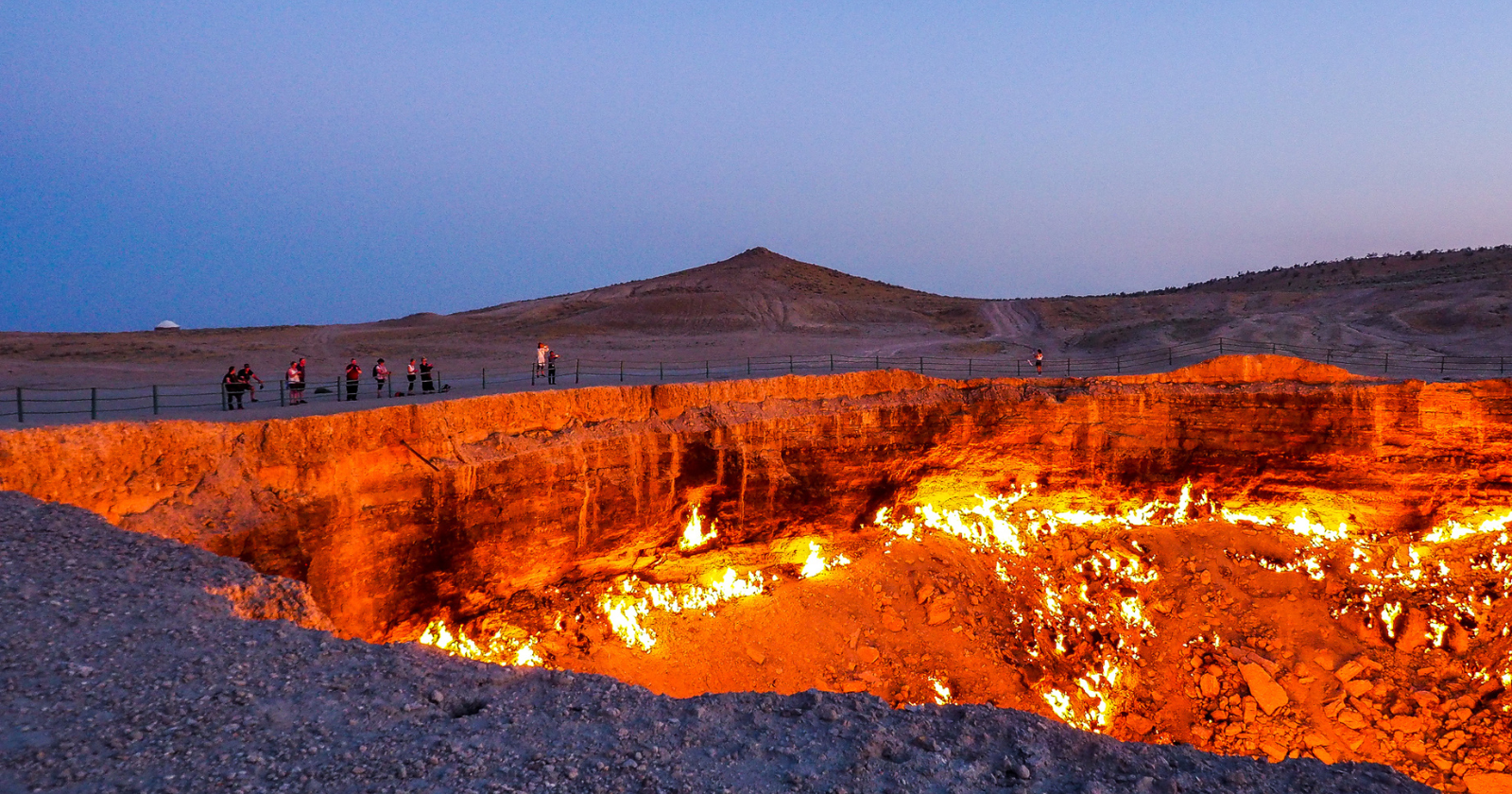
In the middle of the Karakum Desert, one of the emptiest places on Earth, there is a hole in the ground that has been on fire for the entire lifetime of most people reading this.
It is a near-perfect circle, roughly 230 feet across and about 100 feet deep, its floor and walls covered in hundreds of small flames with a few larger ones roaring at the center. At night the glow is visible for miles across the flat black desert. Locals call it the Darvaza crater, after the nearby village — but the world knows it as the Door to Hell.
And the story of how it caught fire is one everybody tells and nobody can quite prove.
The story everyone tells
The standard version goes like this. In 1971, Soviet geologists were drilling for natural gas in the Turkmen desert, then part of the USSR, when the ground beneath their rig gave way. The drilling equipment vanished into a collapsing cavern, and a wide crater opened up, hissing methane and other toxic gases into the air.
Worried that the fumes would poison nearby villages, the engineers made a decision that sounds reasonable and turned out to be permanent: set the gas alight and let it burn off. Fire consumes methane, and they expected the crater to exhaust its fuel in a few weeks.
It did not. The crater has been burning continuously ever since — for more than fifty years — fed by one of the largest natural gas systems on the planet, which keeps seeping up through the fractured rock faster than the fire can ever clear it. What was meant to be a quick controlled burn became one of the longest-lasting fires humans have ever lit.
The part nobody can verify
Here is where honesty is more interesting than legend: almost none of that origin story is confirmed.
Turkmenistan keeps no official record of the incident, and Soviet documentation from the period is patchy and was rarely made public. The 1971 date is the most widely repeated, but researchers disagree — a Turkmen geologist named Anatoly Bushmakin suggested the collapse may have happened, and the fire may have been lit, closer to the early 1980s. Some accounts say the crater collapsed in the 1960s and wasn’t set alight until years later.
The one person who has actually been to the bottom is Canadian explorer George Kourounis, who rappelled into the burning pit in 2013 to collect soil samples. Even he has pointed out there is no solid documentary evidence for the popular tale. So the “1971, Soviet engineers, a few weeks” story is best told the way locals tell it — as the account that has attached itself to the crater, not as verified history. What is not in dispute is the fire itself, which anyone can go and watch.
What it’s actually like
The physical reality lives up to the nickname. Kourounis, kitted out in a heat-reflective suit and a harness, described a roar you can hear from the rim, heat that is unbearable downwind, and a floor of flame like a small piece of a star parked in the sand. Temperatures inside have been estimated to run to around 1,000°C.
Improbably, it is not lifeless. On his descent, Kourounis’s team was looking for exactly the thing you would not expect in a pit of burning gas — living organisms — and researchers have since reported bacteria in the crater’s soil that thrive in the heat, and anecdotal sightings of spiders drawn to, or trapped near, the glow. A place named for hell turns out to host its own tiny biology.
The crater has also become, against all odds, a tourist attraction. Turkmenistan is one of the most closed-off countries on Earth, but the Door to Hell is its single most famous sight, drawing travelers who camp on the rim to watch it burn through the night.
The door may be closing
The strangest recent twist is that the eternal fire might not be eternal after all.
Turkmenistan’s government has wanted the crater gone for years — successive presidents have ordered it extinguished, citing wasted gas, environmental damage and health concerns, though nobody could figure out how. Now they appear to be succeeding, not by smothering the flames but by starving them: drilling new wells around the crater to draw off the gas before it can reach the fire. Officials reported in 2025 that the blaze had dimmed dramatically — by roughly threefold — from its former fury.
After more than half a century, in other words, the Door to Hell is quietly going out — not with a grand extinguishing, but by having its fuel line slowly unplugged from the side. It is a fittingly undramatic end for a fire that began, if the story is true, as a short-term fix that no one bothered to plan past. The engineers of 1971 expected the crater to burn for a couple of weeks. It took a nation half a century, and a ring of drilling rigs, to finally make them almost right.