The two-tonne block of ice arrived at the Iowa State Memorial Union in a refrigerated truck.
It had been extracted from the Portage Glacier near Anchorage a few days earlier by a team of US Navy scuba divers, hoisted out by helicopter, flown to Anchorage airport, put on a commercial flight to Minneapolis, and then trucked the last three hundred miles to Ames. The organiser of the conference at which it was about to be exhibited was a 42-year-old Saudi prince named Mohammed bin Faisal, son of the reigning king, and head of Saudi Arabia’s Saline Water Conversion Corporation.
The delegates arriving in Ames on October 2, 1977 for the First International Conference on Iceberg Utilization were greeted by chips of the two-tonne iceberg being used to chill their drinks. The drinks themselves were apricot nectar, in deference to the prince’s religious observance. Larger hunks of Portage Glacier ice were placed, somewhat artlessly, into punchbowls. The ice was approximately 4,000 years old.
The prince was not doing this for entertainment. He was trying to prove a point.
Why a prince was importing icebergs to Iowa
Mohammed bin Faisal had spent the previous decade running Saudi Arabia’s national desalination program. He was, at the time of the Iowa conference, arguably the person who had done the most anywhere in the world to industrialise the extraction of drinking water from seawater. Saudi Arabia’s ability to sustain a modern population in a country with almost no natural fresh water was, and still largely is, the direct result of the desalination infrastructure he built.
He also knew, from inside the operation, exactly how expensive desalination was.
Removing salt from seawater required enormous energy inputs. In Saudi Arabia, that energy came from burning oil — oil the country was otherwise selling on international markets for hard currency. Every gallon of desalinated water represented, in effect, a gallon of foregone oil revenue plus the substantial capital and operating cost of the desalination plant. As Saudi Arabia’s population grew, the water demand grew with it, and so did the specific economic drag of running desalination at scale.
Mohammed bin Faisal was looking for alternatives. And in the late 1970s, one specific alternative was being taken very seriously by a small group of engineers around the world: harvesting the enormous quantities of freshwater that were currently melting uselessly into the ocean every year as icebergs calved off Antarctica and Greenland.
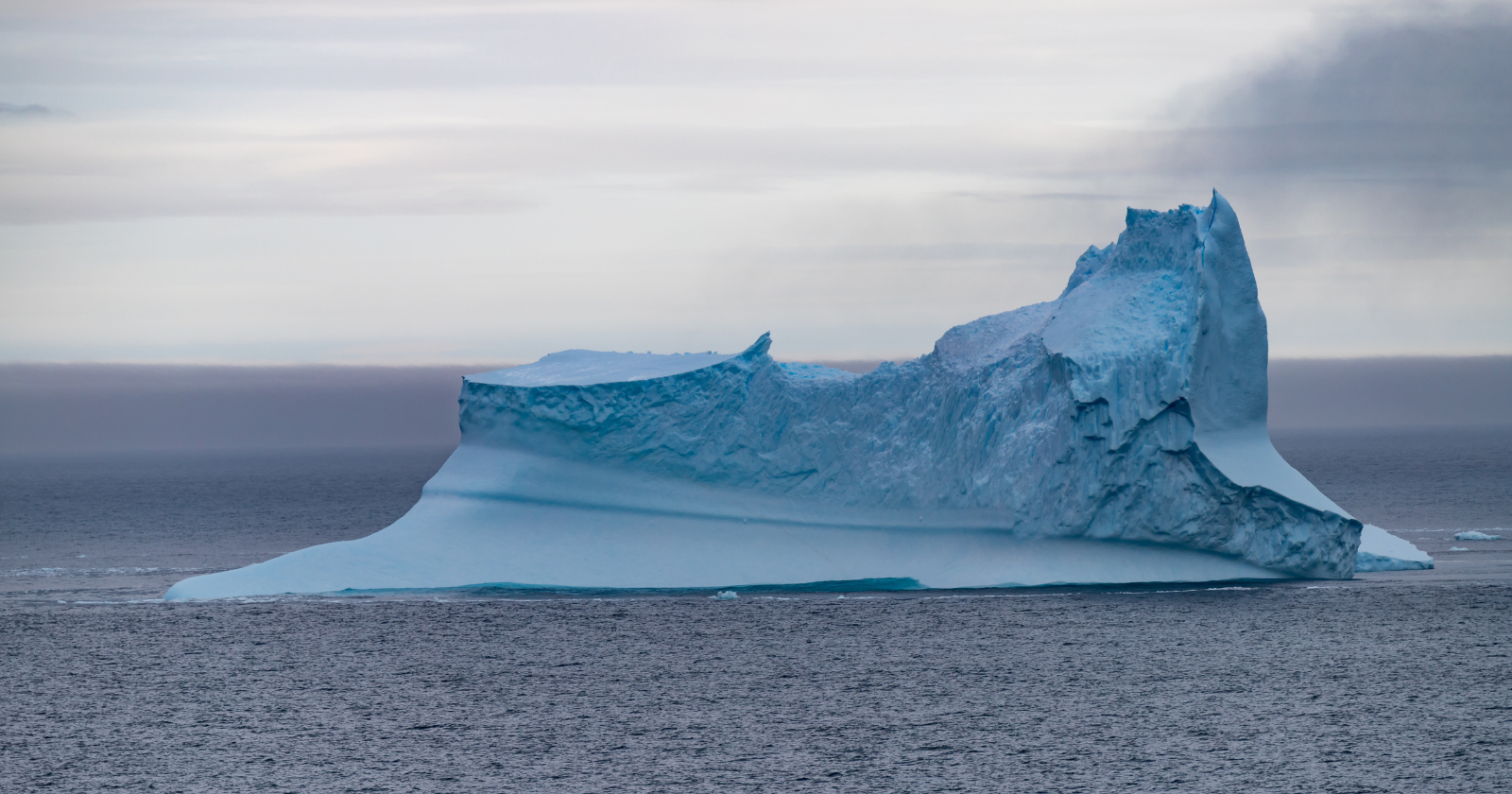
The math was interesting. A single large Antarctic iceberg contains more freshwater than most cities use in a year. If one could be reliably towed to a coastal desalination-dependent country, wrapped in insulation to slow melting during the voyage, and then melted down in a controlled way at the destination, the resulting water could in principle be cheaper than desalination.
The specific proposal Prince Mohammed was promoting called for an 85-million-tonne Antarctic iceberg to be towed approximately 5,000 miles through the Indian Ocean and Red Sea to Saudi Arabia. Estimated cost: about 90 million dollars.
What actually happened next
The plan did not proceed.
At the closing of the Iowa conference, the prince told the delegates: “We can do it if we put the effort into it. Perhaps we will tow an iceberg in three to five years.” A Time magazine report from the same month quoted him predicting an iceberg would reach Arabia within three years.
Neither happened. The specific engineering challenges of towing a hundred-million-tonne floating block of freshwater 8,000 kilometres across warm equatorial waters turned out to be substantially more difficult than the initial modeling had suggested. The insulation problem was particularly hard. Any wrap that could survive the voyage, keep enough of the iceberg intact through weeks in tropical waters, and remain economical at scale had not been developed. The propulsion problem was also serious — no available tugboat could pull a mass of that size at any meaningful speed against real ocean currents.
The French engineer Georges Mougin, who had been part of Prince Mohammed’s original team, kept working on the problem quietly for the next thirty years. He never really let go of it. In 2011, using 3D modeling software, updated ocean current data from satellites, and improved insulation materials that had not existed in the 1970s, he ran new simulations. His conclusion, presented at various technical conferences, was that iceberg transport was more feasible than the 1977 attempt had been able to demonstrate — but still expensive, still risky, and still requiring specific political and financial commitment that no country had been willing to make.
The idea drifted quietly into the same category as ocean thermal energy conversion and salt-domed compressed air storage: technically plausible, economically borderline, and unfashionable enough that no serious money went into it.
Why the idea is being looked at again
The specific reasons the idea has come back into engineering discussions are worth being clear about.
Desalination has not gotten cheaper as fast as originally hoped. Newer reverse-osmosis systems have driven costs down substantially since the 1970s, but the energy input required to remove salt from seawater remains fundamentally large, and countries whose fresh water depends on desalination continue to look for alternatives.
Iceberg melt into the ocean, meanwhile, has accelerated. Antarctic and Greenland ice mass loss has increased significantly since the 1990s. The specific freshwater that Prince Mohammed was proposing to capture and use is, in aggregate, being released into the salty ocean at higher rates than at any point in recorded history. In one specific technical sense, the case for iceberg harvesting has strengthened simply because there is more free-floating ice to work with.
Interest resurfaced during Cape Town’s severe water crisis in 2018, when several proposals were floated to tow an Antarctic iceberg to the South African coast. A separate proposal in 2019 targeted the UAE. Neither project moved beyond feasibility studies. But both showed that the idea has not died.
An Anchorage Daily News piece published this week revisited the Portage Glacier story from the Alaskan angle, noting that engineers in several countries are once again running the numbers on iceberg transport as a potential response to worsening freshwater scarcity in the Arabian Peninsula, southern Africa, and parts of Asia.
Nothing has been built. Nothing has been formally commissioned. But the specific idea Prince Mohammed was promoting in a Memorial Union at Iowa State University in 1977, with 4,000-year-old ice melting into apricot nectar in front of him, is not currently dead. It is being looked at again, quietly, by people who think the specific circumstances of the mid-2020s may finally be closer to what the plan actually needs to work.
Whether they will be right is another question. The prince died in 2017, without ever having seen an iceberg reach Arabia. The engineers who succeeded him are, at least, still doing the math.