

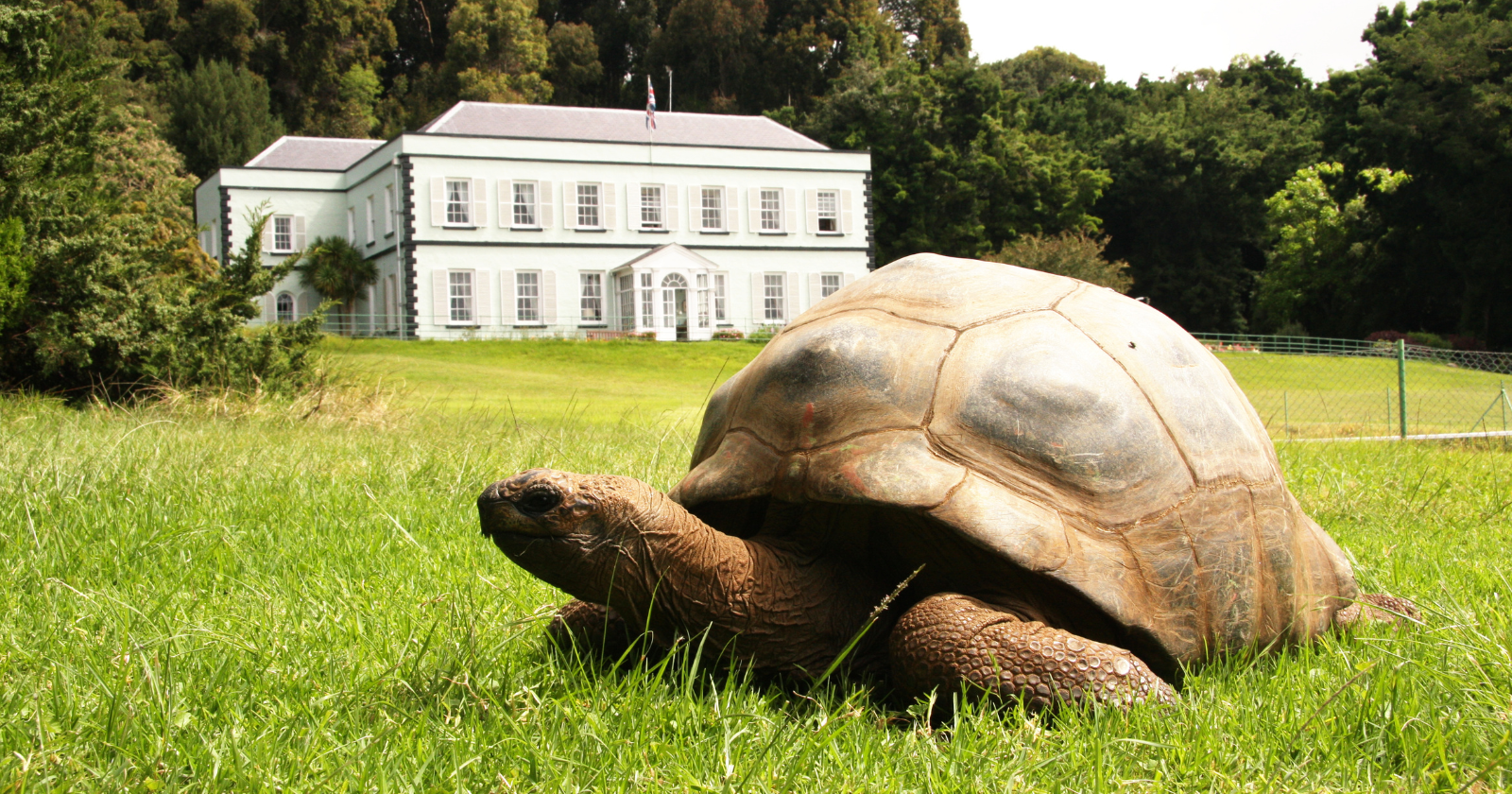
On the lawn of a Georgian mansion on one of the most remote islands on Earth, a very large, very slow animal is working through his morning grass. He was doing roughly the same thing when Charles Darwin published On the Origin of Species, when the American Civil War began, when the light bulb was invented, and through the entire lifespan of everyone who has ever read about him.
His name is Jonathan, he is a Seychelles giant tortoise, and at an estimated 194 years old he is the oldest known living land animal on the planet.
The arithmetic of a very old reptile
Nobody wrote down Jonathan’s hatching date, because nobody writes down a tortoise’s hatching date. His age rests instead on one solid documentary fact: he arrived on St Helena, the British island in the South Atlantic best known as Napoleon’s place of exile, in 1882, as a gift to the governor, and he was described at the time as fully mature. A Seychelles giant tortoise takes about 50 years to reach full size, so he must have hatched by around 1832 at the latest. A photograph taken within a few years of his arrival shows him already enormous on the Plantation House grounds.
That makes 1832 the conservative estimate, the figure accepted by Guinness World Records, which lists him at 194 in 2026 and notes that in all likelihood he is even older. In 2022 the island’s governor settled the paperwork problem by granting him an official birthday, December 4, 1832, and St Helena now throws him a party, with a tortoise-friendly cake, every year.
He has outlived the average lifespan of his own species, around 150 years, by a comfortable margin. He has grazed the same lawn through the terms of more than 30 St Helena governors and roughly 40 US presidents. He met Queen Elizabeth II when she visited as a young princess, and was once photographed giving a ride to the future King Edward VIII.
Life at 194
The honest picture of extreme tortoise old age is both frailer and funnier than the postcard version. Jonathan is blind from cataracts and has lost his sense of smell, which means he can no longer find food on his own; the veterinary team hand-feeds him weekly bowls of fruit and vegetables to keep his calories up. His hearing, though, remains excellent, and he knows the voice of his longtime vet, Joe Hollins, ambling toward it, at his top speed, when called.
Everything else, by his caretakers’ cheerful accounts, still works. His appetite is keen, he grazes his lawn daily, and he continues to make regular romantic overtures to his two companions, Emma and Frederik, undeterred by the discovery some years ago that Frederik, long known as Frederika, was in fact male. He is, in the fullest sense, enjoying his retirement.
Killed by the internet, briefly
Fame at that age has hazards. On April 1 this year, a social media account impersonating Hollins announced that Jonathan had died peacefully at 194, and the hoax was convincing enough that major international outlets briefly reported the death before the island could respond. The account, it turned out, was soliciting cryptocurrency donations; the real Hollins called it not even an April Fool’s joke but a con. The St Helena government issued a statement the next morning, with photographic proof, that Jonathan was very much alive and well and enjoying his routine, and in June, Guinness World Records went further and designated him an official Icon.
There is something fitting in an animal born before the telegraph being killed and resurrected by X in under 24 hours, while remaining entirely unaware that anything had happened.
Why tortoises get to do this
Jonathan’s age is exceptional, but his species’ longevity is not an accident, and it fascinates researchers who study aging. Giant tortoises run on a famously slow metabolism, spend their energy at a miser’s rate, and carry armor that made adult mortality from predators essentially zero in their evolutionary history. When almost nothing can kill you, evolution has reason to invest in bodies that keep working, and studies of tortoise genomes have found expanded families of genes tied to DNA repair and tumor suppression. Some analyses of giant tortoises suggest their risk of death barely rises with age at all, a property called negligible senescence: they mostly do not die of being old, but of drought, accident, or misfortune.
Remove the misfortune, install the animal on a protected lawn with a personal veterinarian, and the result is Jonathan: a creature that has converted the nineteenth, twentieth and twenty-first centuries into one long unhurried meal.
Nobody knows how much longer he has; at 194 there is no actuarial table to consult. The islanders’ view is the sensible one. He was there before any of them, he gives every sign of intending to remain, and each December 4 the oldest land animal anyone alive can point to gets another cake, and eats it at his own pace.
